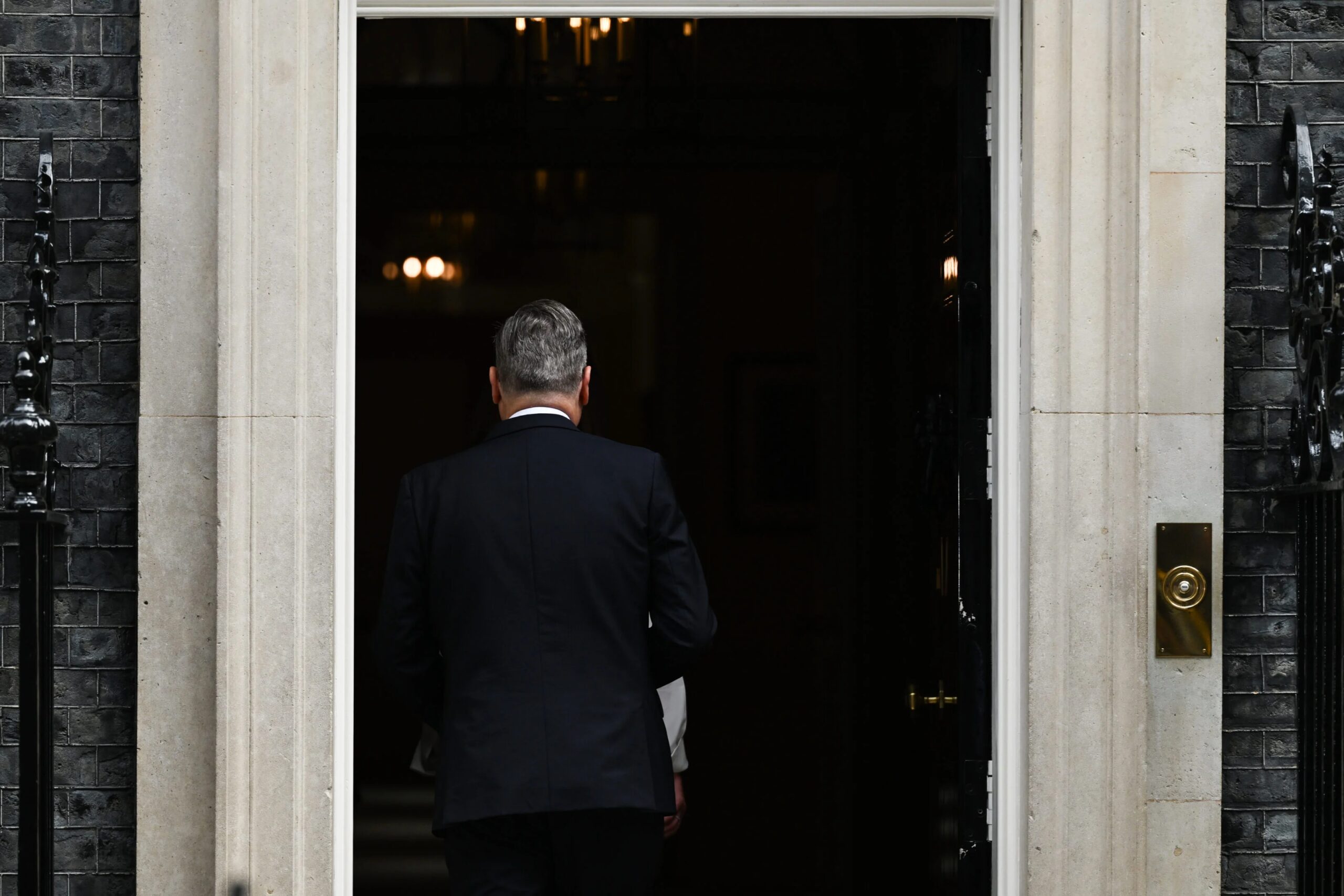
Eventually Keir Starmer also fell. The British prime minister, who arrived in Downing Street less than two years ago with an overwhelming majority and the promise of bringing seriousness back after the conservative chaos, has announced his resignation as leader of Labor and is preparing to leave the government as soon as the party has chosen his successor.
The scene, in front of number 10 Downing Street, had the flavor of inevitable endings: Starmer visibly distressed, next to his wife Victoria, forced to take note of what had now become evident in Labour. He was no longer the right man to lead the party to the next elections. Or, more brutally, he was no longer the man capable of holding together a majority that on paper seemed like granite and which instead crumbled in less than twenty-four months.
The favorite to take up the baton is Andy Burnham, former mayor of Greater Manchester, a popular figure in the North of England and the face of a more territorial, more direct, less ministerial Labor system. If he actually arrives at Downing Street, Burnham will become the seventh British Prime Minister since the Brexit referendum on 23 June 2016. Exactly a decade of political instability, worn-out leadership and governments worn out at astonishing speed.
The fall of Starmer
Starmer had come to power in July 2024 with a historic victory. After the years of Boris Johnson, Liz Truss and Rishi Sunak, the United Kingdom seemed to be asking for only one thing: normality. The former lawyer, former attorney general, man of apparatus and discipline, seemed the perfect profile to close the season of conservative excesses.
The problem is that normality alone does not govern. Especially when it becomes grey. Starmer promised competence, but failed to turn it into vision. He promised seriousness, but it was not enough to construct a political story. He promised to restore order, but the country was also asking for direction, energy, a recognizable idea of the future.
His leadership was consummated right there: in the absence of a strong identity. “Starmerism,” if it ever existed, failed to become a political doctrine, nor an emotional platform. It remained a method. And a method, in politics, can lead to government. It is more difficult to keep someone there when crises, scandals, setbacks and discontent arrive.
The serious prime minister who didn’t understand politics
Starmer has always had a complicated relationship with politics understood as a battle of ideas, instinct, popular connection. His legal training made him a procedural, orderly, almost administrative leader. But Downing Street is not a court and a country is not governed only by respecting the rules.
His biggest mistake was perhaps believing that the fall of the conservatives was above all a moral issue. After the scandals, the parties during the lockdown, the economic chaos of Liz Truss and the wear and tear of Tory power, Starmer has staked everything on the restoration of sobriety. But voters weren’t just looking for a more polite prime minister. They were looking for answers on the cost of living, immigration, public services, national identity, economic growth.
When these answers did not arrive, the promise of seriousness turned into a boomerang. Labor seemed less a government of change and more a quieter version of the existing. In an already tired country, it wasn’t enough.
The mistakes that emptied Downing Street
The honeymoon with public opinion did not last long. Starmer paid for a sequence of political mistakes that fueled the image of a cold, distant prime minister, incapable of reading the country’s feelings.
The initial message, all sacrifices and difficulties, did not give voters the feeling of a turning point, but that of another season of sacrifices. The cut in heating subsidies for pensioners has hit a symbolically very delicate segment of the electorate. The government’s backtracking gave the impression of an uncertain machine. The scandals over gifts received from Labor leaders have dented the very image of probity on which Starmer had built his rise.
Then came the Peter Mandelson case, appointed ambassador to Washington despite a politically cumbersome and divisive profile. A passage that strengthened the impression of a prime minister prisoner of the old logic of Westminster, more attentive to internal balances than to the message to send to the country.
The result was devastating: a leader elected to archive the disorder ended up overwhelmed by the disorder of his own majority.
Burnham, the “King in the North” ready for the challenge
Now Labor looks to Andy Burnham. Its strength does not come only from the curriculum, but from the positioning. Over the years, Burnham has built a profile as a man from the North, close to the territories, capable of speaking to a working-class and popular electorate that Labor has often taken for granted and which instead has lost piece by piece.
Former minister, former mayor of Greater Manchester, Burnham embodies a less technocratic and more identitarian form of Laborism. It’s less London and more Manchester. Fewer Westminster corridors and more squares, local transport, services, communities. Precisely for this reason, within Labour, he is seen by many as the man capable of mending the relationship with that part of the country that felt abandoned by both the conservatives and the metropolitan left.
But the road will not be easy. Burnham will inherit a frightened party, a worn-out government and a country where Nigel Farage and Reform UK have already tapped much of the anti-establishment anger. Changing the face of Downing Street will not be enough if the substance of the political proposal does not also change.
Ten years after Brexit, London remains unstable
The temporal coincidence is almost cruel. Starmer’s resignation comes on the eve of the tenth anniversary of the Brexit referendum. From 2016 to today, the United Kingdom has seen an impressive series of prime ministers: David Cameron, Theresa May, Boris Johnson, Liz Truss, Rishi Sunak, Keir Starmer. Now it could be Andy Burnham’s turn.
Brexit was supposed to restore sovereignty, control, decision. Instead, it opened a long season of political fragility. Not because every British crisis mechanically depends on leaving the European Union, but because that vote revealed deep fractures: between London and the provinces, between North and South, between elites and popular classes, between global openness and the request for protection.
Starmer did not fall for Brexit in the strict sense. He fell because he was unable to give a political response to the country that Brexit left behind. A nervous, impoverished, disillusioned country that is no longer satisfied with the orderly management of decline.
The failure of the “least worse”
Starmer’s parable leaves a very harsh lesson for Labor and, more generally, for all of Western politics: it is not enough to win because the opponent is exhausted. It is not enough to present yourself as the serious alternative to chaos. It is not enough to be “those who are not the others”.
Starmer also conquered Downing Street thanks to the collapse of the Conservatives. But once in government he failed to transform that victory into a mission. He administered power rather than inhabited it. He corrected, contained, slowed down. But it didn’t turn on.
Burnham, if he is to succeed him, will have to start from here: from a party that has discovered how quickly a huge majority can become politically fragile. And from a United Kingdom that, ten years after Brexit, continues to look for a leader capable not only of occupying Downing Street, but of explaining to the country where he wants to take it.