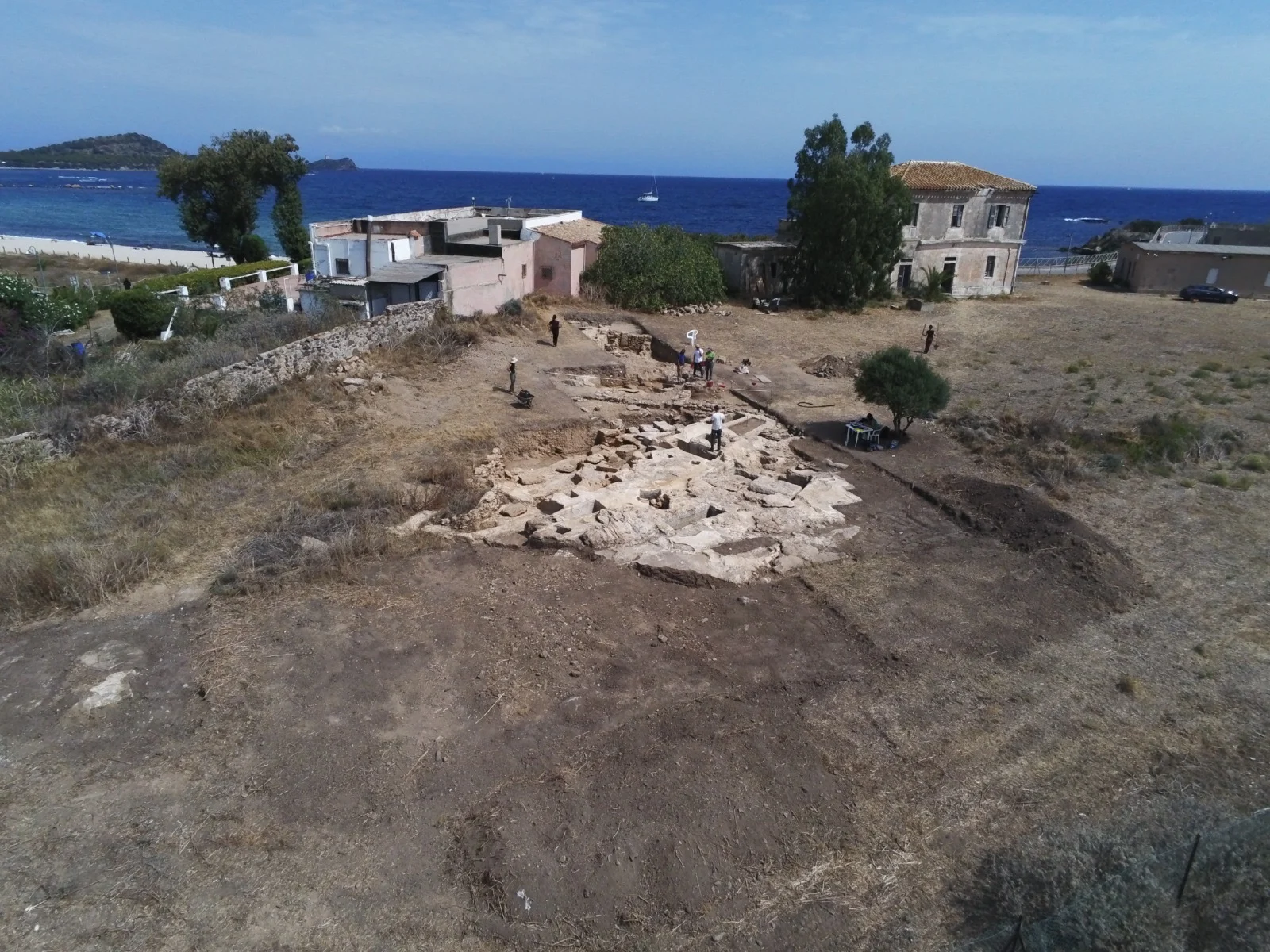
After ninety years of closure, a previously inaccessible area of the Nora archaeological park opens to the public for the first time. This historic reopening enriches the visit itineraries, offering the extraordinary opportunity to discover one of the most important and fascinating Phoenician and Punic funerary contexts in the entire western Mediterranean.
The opening to the public of the area of the Phoenician and Punic necropolis located informer military area of Nora represents an achievement of extraordinary importance for the valorisation of the historical and archaeological heritage of Sardinia. Until now closed to visits pending its full restoration, this large sector of the archaeological site now becomes part of the Park’s cultural offering, allowing visitors to access a significant portion of the ancient city and understand its history and extension more deeply.
The use of the area was made possible thanks to the joint commitment of Municipality of Pulafrom the Pula Cultura Diffusa Foundation and of Superintendency for Archaeological Heritage, who promoted the opening of a space of exceptional scientific and cultural value. Inside there are fundamental testimonies for the reconstruction of the origins and development of the city of Nora and the relationships it had with the rest of the Mediterranean.
In the northern sector of the former military base, since 2013, theUniversity of Padua conducts a complex archaeological research program which has led to the discovery of a vast necropolis used for approximately seven centuries, from the Phoenician to the Punic age. The oldest burials, dating back to the end of the 9th century BC, belong to the first decades of the Phoenician presence in Nora. These are incineration tombs created using small wells dug into the rock, in which the ashes of the deceased were placed.
The Nora necropolis constitutes a unique case in the Sardinian archaeological panorama: it is in fact the first and, to date, the only Phoenician necropolis on the island found in an excellent state of conservation and investigated using modern scientific methodologies. Anthropological analyzes of human remains have also provided important information on the origin and mobility of the communities that frequented the urban center during the 1st millennium BC
Between the 5th and 3rd centuries BC, in the Punic age, the funerary area continued to be used in different ways. Incineration practices were gradually replaced by the rite of inhumation and large underground funerary chambers were created, similar to those documented in other important centers of Punic Sardinia.
One of the most significant aspects of the research concerns the discovery of numerous Phoenician and Punic tombs that have remained untouched over the centuries. The recovered funerary objects – consisting of ceramics, metal objects and glass artefacts – represent a precious source for the knowledge of the productive activities, trade and daily life of the inhabitants of ancient Nora. The finds are today preserved and exhibited at the “Giovanni Patroni” Civic Museum in Pula.
The study of the burials and archaeological materials has also made it possible to reconstruct a complex network of relationships that connected the Phoenician communities to the Nuragic populations of the area and, at the same time, placed Nora within the main commercial and cultural circuits of the Mediterranean, with documented contacts with the Italian peninsula, Spain, North Africa, Greece and the regions of the Levant.
The evidence emerging from the excavations also attests to the continuity of use of the area in Roman times, when the oldest funerary space was progressively occupied by a residential and productive neighborhood which remained in use until late Antiquity.
The research activities of the University of Padua will resume on August 31st and will continue until October 9thconfirming the role of the western necropolis of Nora as one of the most important study laboratories for the knowledge of the Phoenician and Punic civilizations in the Mediterranean.
Jacopo Bonettoprofessor of Classical Archeology at the University of Padua, talks about the treasures found in the area of the necropolis, which until 2012 fell within the military zone: «We excavated in an area where no archaeologist had ever set foot before, an area that had been forbidden to civilians since 1936. After ten years of research, carried out in collaboration with the Superintendency, the results of our work are finally visible: from the discoveries made in the necropolis we now know much more about the inhabitants of Nora. Tombs, funerary furnishings, trinkets and jewels: numerous finds emerged from the excavation, today kept in the Patroni Museum of Pula. This portion of the archaeological area was a necropolis from the 8th century BC to the 2nd century BC, but later also hosted a sandstone quarry, a craft area and a built-up area. The excavation work in that area is by no means finished: we will soon return to work to add new pieces to Nora’s story.”
Bonetto highlights, among the many important finds, “the refined statuette of a baboon which is driving archaeologists and users of the Giovanni Patroni Museum in Pula crazy, due to its intact beauty and originality. It is a precious balsam, a baboon holding a vase, an Egyptian canopy, which in turn has a frog on its top. The scent wafted from the frog’s open mouth. All contained in this small object in faïence (glazed quartz mixture), of certain oriental origin, perhaps directly from Egypt, from the Nile delta area, or via routes from the island of Rhodes. A highly prestigious find (end of the 7th century BC), with very few comparisons in Sardinia itself. An incineration tomb which, evidently, represented someone inclined to collect prestigious goods from all over the Mediterranean”.
For the mayor of Pula, Walter Cabasinoit is a historic date for the whole island: «Returning an archaeological space of this importance to the community and visitors from all over the world has a double value: the opening of the western necropolis not only increases the spaces open to the public, but will also have economic repercussions on the territory. We must not forget the fragility of this archaeological site; the damage caused by Hurricane Harry is still visible. We hope that the relevant bodies will contribute to the protection and conservation of Nora, to allow future generations to enjoy its beauty.”
Chiara Piloarchaeologist of the Superintendency, underlines the delicate task of excavating in a fragile site like Nora: «There are no zero impact campaigns, but we continue to work on this archaeological area with the dual objective of discovering more and more information on the history of this ancient city and guaranteeing posterity the possibility of knowing it as we see it today. The campaigns and projects on Nora continue: there are still areas we have never investigated, but new discoveries are also made in areas already known and continue to expand Nora’s story.”
Andrea Boipresident of the Pula Cultura Diffusa Foundation, underlines the scientific value of the archaeologists’ work: «Making spaces of the ancient city accessible to visitors for 90 years opens the archaeological site to new opportunities. The necropolis and its finds, now exhibited at the Patroni Museum, make the visit to the Nora archaeological park even more interesting.”
Clara Pilidirector of the Pula Cultura Diffusa Foundation, focuses on the new experiences that those who visit the Pula archaeological park will be able to have: «Nora expands her visit itinerary with the opening of new areas, which until now have been the subject of study and valorisation and are now finally accessible to the public. The necropolis, of great historical and cultural value, thus becomes part of a more complete and shared story. More and more visitors, especially tourists from all over Sardinia, choose Nora to live cultural and immersive experiences, confirming the attractiveness of the site. The new opening is part of this virtuous path, designed to offer a constantly evolving experience and an additional reason to return, also thanks to the integration with thematic visits, evening tours and experiences in the area.”
Manuela SerraCouncilor for Culture, speaks of an epochal day: «We are experiencing a truly historic moment: an event that restores not only to Pula, but to the whole of Sardinia and the international community, an archaeological heritage of inestimable value. An extraordinary operation of restitution and sharing which is now a reality thanks to the precious collaboration with the University of Padua and the fundamental synergistic work carried out together with the Superintendence, to which we extend our heartfelt thanks for believing and investing in this project”.