The Italian stock exchange is populated by small and medium-sized companies which, however, count for very little in terms of overall weight. Listed companies with a capitalization of less than one billion euros represent around 80% of the stocks on the list, but are worth just 3% of the total by capitalisation. The bulk of the value of Piazza Affari is concentrated on banks, utilities and a few large groups, while industry and consumer goods are underrepresented, with a distorting effect on the picture of the real economy.
On the opposite side of the market, Italy is a country of unlisted SMEs: almost five million companies, of which between 5,000 and 10,000 are already potentially ready for access to the capital market. At the end of 2025, the overall value of unlisted companies was close to 1,800 billion euros, compared to around 1,200 billion of listed companies, highlighting a stock exchange that represents only a minority part of the national productive fabric. It is a reverse situation compared to Germany, France and Spain, where the capitalization of listed companies exceeds that of unlisted ones, and signals a chronic undercapitalization of Italian industrial SMEs.
The risk of colonization and the objective of PMI2Change
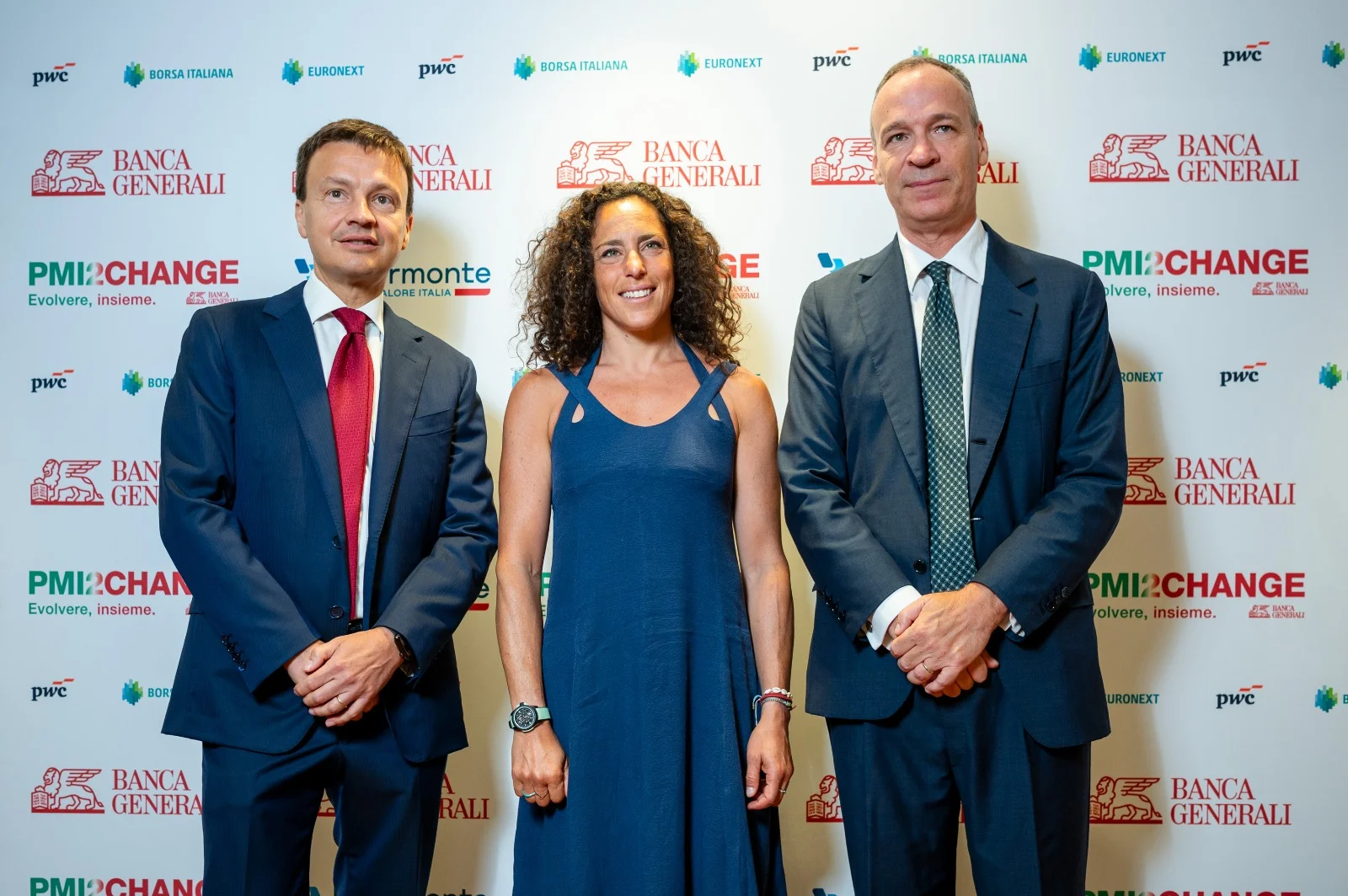
This weak representation of SMEs on the stock exchange, illustrated on 1 July in Milan on the occasion of a new initiative by Banca Generali (guest of honor was ski champion Federica Brignone), is not neutral: it translates into compressed valuations, poor liquidity and greater exposure to acquisition opportunities by multinationals and foreign private equity funds. Many Made in Italy companies thus end up in the sights of foreign operators and are delisted or transferred abroad, with a progressive impoverishment of the domestic industrial fabric and the ability to oversee strategic supply chains. A topic also widely covered by Panorama https://www.panorama.it/attualita/economia/ecco-la-lista-delle-storiche-aziende-italiane-finite-in-mani-estere-sono-piu-di-mille
PMI2Change, the ecosystem launched by Banca Generali was explicitly created to intervene on this issue, trying to strengthen the link between capital and businesses and to bring the stock market back to playing a role in financing the growth of companies, not just as a showcase for a few national champions. The project aims to create more favorable conditions for the meeting between savings and SMEs, working on two levers: greater visibility and investability of already listed companies and accompaniment of unlisted companies towards the stock exchange. The CEO of Generali Bank, Gian Maria Mossaunderlined that the project was born from the awareness that Italian companies possess talent and ambition, but often operate in a context where access to capital does not live up to their potential. PMI2Change intends to act on visibility and investment tools to create a stable mechanism to support liquidity and growth in the long term.
One hundred SMEs under the spotlight
The first piece of the strategy is the “Intermonte Valore Italia” index, built by Intermonte and dedicated to one hundred companies listed on the Italian Stock Exchange with a capitalization of less than one billion euros and not belonging to the FTSE MIB. The selection takes place on the basis of technical and financial criteria designed to guarantee minimum liquidity, transparency and real investability: sufficient free float, solid governance, coverage by analysts, financial sustainability and debt levels compatible with balanced growth.
By sector composition, the index offers a cross-section of Italian manufacturing excellence: consumer goods, mechanics, technology, energy and health, sectors that often remain on the margins of the large traditional indices dominated by banks and utilities. At the end of 2025, the companies included in the index generated a total of around 33 billion euros in turnover, with an average annual growth of 16% in the last two years and around 120 thousand employees, numbers that illustrate the dynamism of an entrepreneurial universe that is not very visible but central to the real economy.
The new active ETF: the bridge between savings and SMEs
The first actively managed ETF developed with Investlinx and Intermonte of the Banca Generali group (this is its full name: Investlinx Intermonte Valore Italia Active PIR UCITS ETF) will be added to the new index and will invest mainly in the universe defined by “Intermonte Valore Italia”. The instrument combines the tax benefits provided for PIRs, long-term Individual Savings Plans designed to direct family savings towards financial instruments issued by Italian companies (exemption from capital gains and inheritance tax after 5 years) with the flexibility, transparency and liquidity of a listed ETF. The new ETF is designed to channel the savings of private and retail clients towards SMEs, in line with the European regulatory framework of the Savings and Investments Union (SIU) which aims to mobilize long-term capital to support the real economy.
Banca Generali has committed to supporting the launch with an initial collection of 100 million euros in the first months and a target of 500 million in the medium term; if these numbers are confirmed, the estimated incremental flow is 1-2 million euros per day, equal to over 5% of the index’s free float. The active approach aims to exploit the combination of solid fundamentals and discounted valuations of many SMEs, where the market underweight is due more to poor liquidity and index concentration than to industrial weakness.
Roadshow, new prices and the role of “entrepreneur’s bank”
PMI2Change does not stop at companies already listed: with the support of Borsa Italiana and PwC Italia, Banca Generali and Intermonte will organize a roadshow in the area from next autumn to intercept and accompany companies potentially suitable for listing. The objective is to build easier access routes to the capital market, helping entrepreneurs to evaluate the stock exchange as an alternative to selling to foreign investors to finance growth without excessively diluting control.
The bank claims in this project a natural evolution of its positioning as advisor to the entrepreneur, thanks to a customer base that at the end of 2025 controlled over 25,000 companies. After the acquisition of Intermonte in 2025, Banca Generali has integrated corporate and investment banking services into traditional wealth consultancy, and PMI2Change is part of this long-term plan which aims to make the bank a central node of a broader system to support the development of the Italian productive fabric.