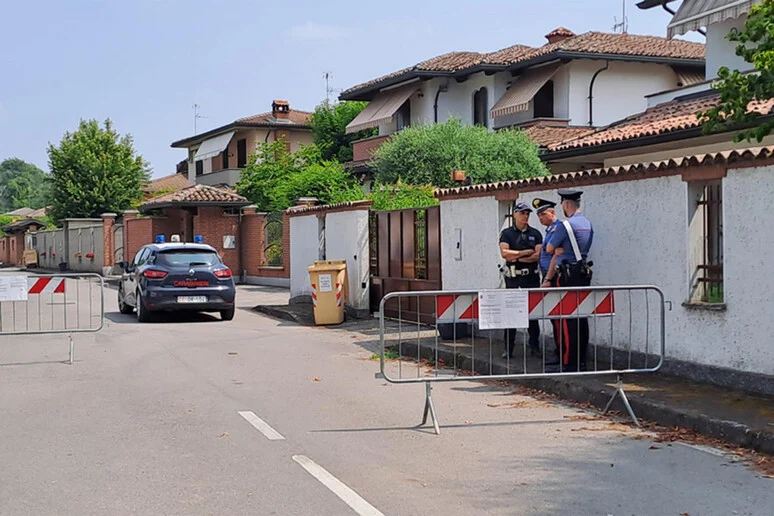
In Garlasco there is a house that has been a crime scene for almost nineteen years. It is the villa in Via Pascoli, where on 13 August 2007 Chiara Poggi, twenty-six years old, was found dead on the stairs leading to the cellar. Since then that house has no longer just been the site of a murder. It has become an archive of errors, suspicions, omissions, consultancies, counter-expertise reports, alibis, bicycles, fingerprints, DNA, computers, telephone calls, closed and reopened tracks. An ordinary house transformed into the most disturbing laboratory of Italian justice.
For years the case seemed closed. Alberto Stasi, Chiara’s boyfriend, was definitively sentenced to sixteen years in prison. A sentence, therefore a judicial truth. Not just any truth, but the one that arrived at the end of a very long, controversial trial process, crossed by acquittals, overturns and appeals. Yet today that truth is no longer enough to bring order. Indeed: the more time passes, the more the Garlasco house seems to produce new questions instead of closing them.
The paradox is all here. The only definitively convicted man, Alberto Stasi, left Bollate prison after more than ten years and is now on probation with social services. He was not acquitted, he was not declared innocent, he was not formally freed from his conviction. But he is no longer behind bars. At the same time Andrea Sempio, a friend of Chiara’s brother, is at the center of the new investigation by the Pavia Prosecutor’s Office, which accuses him of having killed the girl. He denies all accusations. His defense disputes the magistrates’ reconstruction. The Poggi family continues to believe in Stasi’s responsibility. And so Garlasco returns to being what it has always been: not a closed case, but an open wound in the form of an infinite trial.
The house where everything remained in question
Every great Italian crime has its symbolic place. Cogne has the Montroz house, Perugia the house on Via della Pergola, Avetrana the garage and the well, Erba the massacre apartment. Garlasco has the house in via Pascoli. Yet here the place is not only the scene of the crime. It is the very body of the enigma. Who came in that morning? Who knew the house? Who was let in? What path did the killer take? What traces did he leave? Which tracks were misread? Which were not read at all?
Over time, the house has become a judicial map to be reread endlessly. The cellar stairs, the floor, the blood, the entrance, the rooms, the computer, the kitchen, the objects, the path of whoever found the body, the path of whoever killed. Everything was observed, measured, discussed. And everything, years later, still seems capable of changing meaning. This is the most disturbing aspect of the case: not the absence of evidence, but its instability. The same trace, the same detail, the same imprint can become, depending on the reading, confirmation of guilt or proof of an error.
Garlasco is the story of a house where every room contains a question. The question about Stasi’s shoes. The question about the blood that wouldn’t have gotten dirty enough. The question about the time of death. The computer alibi question. The question about the DNA under Chiara’s nails. The question about the presence or absence of Andrea Sempio. The enormous question of the state’s ability to preserve, interpret and protect a crime scene when that scene becomes the center of a national battle.
The computer as a second crime scene
For years the imagination of Garlasco was dominated by blood and the cellar stairs. Today, however, the center of gravity has also moved elsewhere: on Chiara’s computer, on files, on folders, on computer media, on digital traces. It’s as if the second crime scene was no longer just physical but electronic. No longer just fingerprints and blood, but accesses, memories, deletions, personal contents, chronologies.
It is a decisive step also from a narrative point of view. The Garlasco crime, which belongs to 2007, that is to an Italy that is not yet completely digital, is reinterpreted in 2026 with the tools, obsessions and fears of the present. Back then the computer was a household object, today it is an identity archive. Then a file might have seemed like a detail, today it can become a clue, an investigative hypothesis, an emotional detonator, a battlefield between prosecution and defense.
But here you have to be careful. Because the risk is enormous: transforming a victim’s private life into consumable material. Chiara Poggi was killed once in the house. It cannot be killed a second time by morbid curiosity. The right to report must tell what is essential, not throw open every cupboard, every file, every fragment of intimacy. This is also why the Garlasco case has become a trial not only for justice, but also for the media.
Justice in front of the mirror
The new investigation into Sempio does not automatically cancel Stasi’s conviction. It doesn’t work like that. In Italy a definitive sentence does not evaporate because a prosecutor develops a new investigative hypothesis. We need documents, procedures, steps, possible requests for review, evaluations by other judges. And in fact Stasi’s defense looks at the revision as a possible but far from obvious step. The point, however, is political and symbolic even before being procedural: how can a country accept that, after almost twenty years, two such different scenarios coexist regarding its most discussed crime?
On the one hand there is the truth of the sentences: Stasi guilty. On the other hand there is the new accusatory hypothesis: according to the Pavia Prosecutor’s Office, it was Sempio who killed Chiara. In the middle there is a family who has lost a daughter and a sister, and who does not want to see their tragedy rewritten every season. In the middle there is a man who has served more than ten years in prison and continues to proclaim his innocence. In the middle there is another man who today finds himself overwhelmed by a very serious accusation and rejects the hypothesis of being the murderer. In the middle, above all, there is a terrible question: if one of the two reconstructions is true, what does the other say about the functioning of justice?
Garlasco has become the place where Italian justice is forced to look at itself in the mirror. And the mirror does not return a reassuring image. It shows the face of a system which, in major media cases, often arrives late, divided, tired, dependent on changing reports, on interpretations that mutate, on evidence that ages badly. This does not mean that every mistake is malicious. It is not said that every doubt is a scandal. But when a case remains open for almost two decades in the collective consciousness, the problem is no longer just who killed Chiara Poggi. The problem is because we haven’t yet been able to truly believe it, whatever the answer is.
The process outside the process
In Garlasco, as often happens in Italian crimes, the judicial process was never just in court. It was in talk shows, in TV lounges, in newspapers, in podcasts, in forums, in social media, in reconstructions, in models, in interviews, in audio, in extrapolated sentences, in private details transformed into debate material. Each element became an episode. Each episode has a verdict. Every provisional verdict is a fan.
The consequence is that everyone ended up living in that house. Those who watch from home, those who comment on social media, those who side with Stasi, those who side against Stasi, those who suspect Sempio, those who defend Sempio, those who accuse the media, those who feed them, those who invoke the truth and in the meantime consume the pain of others like a crime series. It is the great Italian short circuit: we ask for justice, but we also demand entertainment. We ask for respect for the victim, but we want to know everything. We ask for caution, but we feed on indiscretions.
The Privacy Guarantor’s reminder to the media, in this sense, is not a side detail. It’s a piece of history. Because Garlasco has also become the case in which reporting rights continually risk turning into permanent exposure for the people involved. Chiara, the victim. His family members. Stasi, the condemned man. For example, the suspect. Friends, relatives, lawyers, consultants. All dragged into a narrative that no longer knows clear boundaries between public interest and private curiosity.
The Poggi family and the weight of the truth
In the middle of this machine they remain, the Poggi. Because every time Garlasco returns to the opening, every time a new detail is relaunched, every time a lead is dusted off, the victim’s family is forced to return to the house of 13 August 2007. For the public it is a coincidence. For them it is Chiara. For the public it is a new hypothesis. For them it is the broken life of a daughter, of a sister, of a person who before becoming “the Garlasco crime” had a face, a job, a boyfriend, a family, a daily life.
This is also why the position of family members weighs heavily. Not because a family must replace the judges, but because in every major judicial case private pain coexists with the public search for the truth. The Poggis have always believed in Stasi’s responsibility. The new investigation, therefore, is not a liberation for them, but another wound. A possible rewriting that does not arrive in a vacuum, but after almost nineteen years of mourning, trials, media exposure and judicial battles.
The risk is to expect from family members what no family can give: perfect neutrality. Justice must seek the truth, even when that truth hurts. But the public narrative should remember that behind every act, every appeal, every consultancy and every title, there is a family that is not following a television series. He’s surviving a murder.
The house of errors
In the end everything returns there, to the house. Because Garlasco is a story of stairs, rooms, blood, computers and silences. But it is also a story of possible errors. Collection errors, reading errors, conservation errors, communication errors, media errors, human errors. The house of errors is not necessarily proof that the State has convicted an innocent person or pursued the wrong guilty person. The documents, the judges and any new sentences will have to say this. But it is proof that a crime scene, when not pacified by the truth, continues to produce ghosts.
Garlasco is no longer just a crime. It’s a national question. How long can a judicial truth last when a new investigation proposes another story? How solid can a conviction be if, almost twenty years later, the Prosecutor’s Office is working on another name? How just can justice be that arrives so late in putting its hands back on its past? And how civilized can a country be that turns every doubt into spectacle?
The house in via Pascoli is still there, in Italian memory, like a house from which no one has really left. Not Chiara, who deserves above all silence and truth. Not Stasi, who left prison but not the case. Not Sempio, who today rejects an accusation capable of devouring his life. Not the Poggis, forced to relive the worst day every time. Not us, who have been returning to the threshold of that house for almost nineteen years and wondering whether, behind the door, there is finally the truth or just another mistake.