Recipes, typical products and new Italian brands attract users from over one hundred countries. Germany, Sweden, France, Japan and Spain lead the searches, but each market shows different interests and habits.
The first step towards purchasing an Italian food product increasingly takes place online. Before entering a store or ordering from a platform, consumers search for a recipe, learn more about the characteristics of an ingredient and discover brands they were previously unaware of.
It is in this phase, apparently far from the sale, that the internationalization process of a company can begin. The challenge for Italian companies, in fact, is no longer just reaching new distributors, but being able to be found in markets where there is already an interest in Made in Italy.
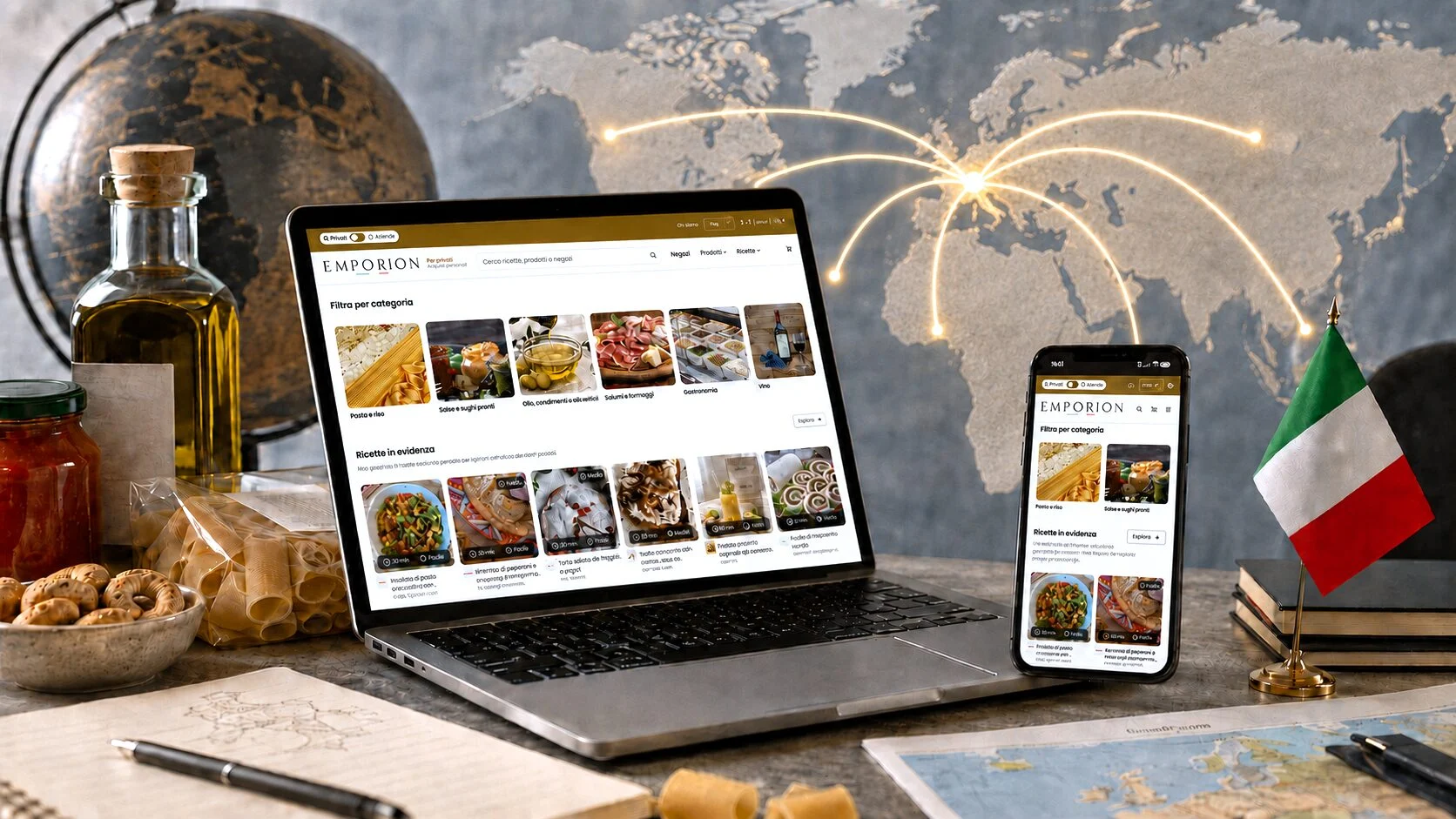
This is confirmed by the data from the Observatory “The Global Search for Italian Food 2026”, created by Tuduu by analyzing twelve months of searches generated through the international marketplace dedicated to Italian food, launched in June 2025 and today relaunched under the name of Emporion.it. Almost one click in two comes from abroad and the users involved come from over one hundred countries.
Over one million clicks and 50 million views
In the period analysed, the contents present on Emporion.it generated 1,056,980 clicks from Google searches and almost reached 50 million views.
An important fact concerns the origin of this traffic: over 95% of visits came through organic search, without the support of advertising campaigns. Users, therefore, were not reached by an advert, but found the contents while spontaneously searching for information on dishes, ingredients and products.
Recipes represent approximately 70% of overall searches. A result that shows how editorial content can become one of the main points of contact between the consumer and a food brand.
The recipe is no longer just a series of instructions to follow in the kitchen. It can become a gateway to a product, a territory or a producer. A person looking for how to prepare a dish may in fact discover a pasta shape, a regional specialty or an ingredient that they had never purchased before.
Italian food affects over one hundred countries
The international component weighs almost as much as the Italian one. Germany, Sweden, France, Japan and Spain are the countries that show the greatest interest in content dedicated to Italian gastronomy.
The presence of very different markets confirms the global strength of Made in Italy, but also highlights a limitation of uniformly constructed strategies. There is no single international consumer of Italian food: each country uses different words, follows specific trends and seeks products that do not always coincide with those best known in Italy.
Being present online, therefore, does not mean simply translating a catalog into English. To transform curiosity into a commercial opportunity it is necessary to understand the language of the market, the dietary needs of the public and the ways in which searches are carried out.
In Japan people look for cotechino, paccheri and taralli
Query analysis shows significant differences between countries. In Japan, for example, users are looking for products strongly linked to Italian tradition, such as cotechino, paccheri and taralli. The searches are carried out directly in the local language, an element that demonstrates how important it is to make the contents accessible even outside of Italian and English.
In France and Portugal, however, there is greater attention towards “free” cooking, with research dedicated in particular to preparations without eggs or butter. Sweden shows interest in international trends such as Crumbl Cookies, while in Spain more elaborate preparations are also sought, including those based on game.
These differences offer valuable insights to companies. A manufacturer may discover that their item, considered niche on the national market, instead responds to a concrete demand in another country. Likewise, a brand can use recipes and informative content to present its products in the context closest to the interests of the local audience.
The new export frontier passes through content
For years, the internationalization of food companies has been linked above all to fairs, distributors, commercial agents and agreements with large-scale distribution. These tools continue to be central, but today the consumer journey can start much earlier.
Online searches allow you to intercept demand signals even before they translate into sales. The number of people interested in a recipe or a specific ingredient can help understand which markets to invest in, which products to promote and which language to use.
In this scenario, content, data and digital localization become commercial tools. The objective is not only to increase visibility, but to accompany the consumer from product discovery to purchase.
According to Giuseppe Virzì, founder and CEO of Tuduu, Emporion.it represents one of the company’s activities, today positioned as a technological holding active in the food, nutrition and retail sectors. The solutions developed aim to simplify both the discovery and purchase of products and the diffusion of a greater culture of food well-being.
Catalogs available in over twenty languages
Emporion.it allows companies to make their catalogs available in over twenty languages, reducing the technical obstacles and time needed to build a digital presence intended for international markets.
Tuduu, founded in 2022, uses proprietary algorithms and tools based on data, content and location to help manufacturers and brands tap demand in domestic and foreign markets.
The most significant data from the Observatory therefore does not just concern the popularity of Italian cuisine. It tells of a change in the way Made in Italy is discovered.
The foreign consumer no longer necessarily waits to find an Italian product on the shelf. They look for it online, often in their own language, starting from a recipe or a specific dietary requirement. For companies, being able to appear at that moment can make the difference between an interest that remains a simple curiosity and a question capable of transforming into exports.