This evening the eyes of millions of people will be turned skyward as a total solar eclipse passes through Greenland, Iceland, parts of northern Russia and especially Spain, before ending at sunset over the Mediterranean. From Italy the show will be different but still remarkable: the totality will not be visible, while the Moon will cover a progressively larger portion of the solar disk proceeding from south-east to north-west, precisely in the last hours of the day. According to the maps developed by the National Institute of Astrophysics, coverage will go from around 18 percent in Calabria to over 93 percent between Piedmont and Liguria, with peaks close to 95 percent in western Liguria and north-western Sardinia.
The time will help make the eclipse particularly suggestive, because in Italy the phenomenon will develop as the Sun approaches the horizon: INAF indicates 7.30pm, 7.50pm and 8.20pm as some of the key moments to follow the progress of the occultation, even if in the Central-Southern regions the theoretical maximum will arrive when the Sun has already set. In Milan, for example, NASA predicts the start at 7.27pm and a maximum around 8.20pm, with around 92 percent of the solar disk covered by the Moon. However, the actual visibility will also depend on the horizon: mountains, buildings and reliefs towards the west and north-west will be able to hide the Sun before the eclipse reaches its observable maximum.
A rare astronomical spectacle, therefore, but accompanied by a fundamental precaution that ophthalmologists urge not to underestimate: in Italy the eclipse will remain partial and there will be no moment in which it will be safe to look directly at the Sun with the naked eye.
Because watching the eclipse can damage the retina
The problem arises precisely from one of the most fascinating characteristics of the eclipse. When the Moon begins to cover the Sun, the brightness of the environment decreases and the impression may arise that observing the disk directly has become less dangerous, while the part of the Sun still visible continues to emit a quantity of energy sufficient to damage the structures of the retina.
The damage is called solar retinopathyor photic retinopathy, and mainly affects the foveal region of the retina, which is fundamental for central vision and for activities such as reading, recognizing a face or distinguishing details. The American Academy of Ophthalmology explains that the lesion can appear after direct observation of the Sun and that, although in many cases vision improves spontaneously in the following months, recovery may be incomplete and permanent deficits or blind areas in the visual field may remain.
What makes the situation more insidious is the absence of a sufficiently clear immediate signal: the person can continue to observe the Sun without realizing that they are damaging the retina and only realize the consequences later.
«The solar eclipse of August 12th will be an astronomical phenomenon of great interest which may be visible as a partial eclipse from Italy, although with different intensity depending on the region you are in», underlines Sergio Ares, ophthalmologist and Country Manager of Baviera Italia, recalling that observation without adequate protective measures can cause «irreversible lesions to the retina and permanent loss of vision».
Symptoms may appear only after a few hours
Not feeling pain while looking at the Sun therefore does not mean that the eye has not suffered damage. The symptoms of solar retinopathy can appear in the hours following exposure and mainly include a reduction in the sharpness of vision and the appearance of a central or paracentral spot in the visual field.
There may also be difficulties in focusing, alterations in color perception or the so-called metamorphopsia, whereby lines and objects that normally appear straight are perceived as deformed.
If you experience visual disturbances after observing the eclipse, it is therefore advisable to quickly undergo an ophthalmological evaluation, avoiding waiting for the problem to disappear on its own. The specialist examination, possibly accompanied by diagnostic tools such as computerized optical tomography of the retina, allows us to identify any alterations in the macular region and follow their evolution.
Sunglasses do not protect against eclipse
The first rule is also the one on which NASA and specialists insist most: Regular sunglasses cannot be used to directly observe an eclipseregardless of how dark the lenses are.
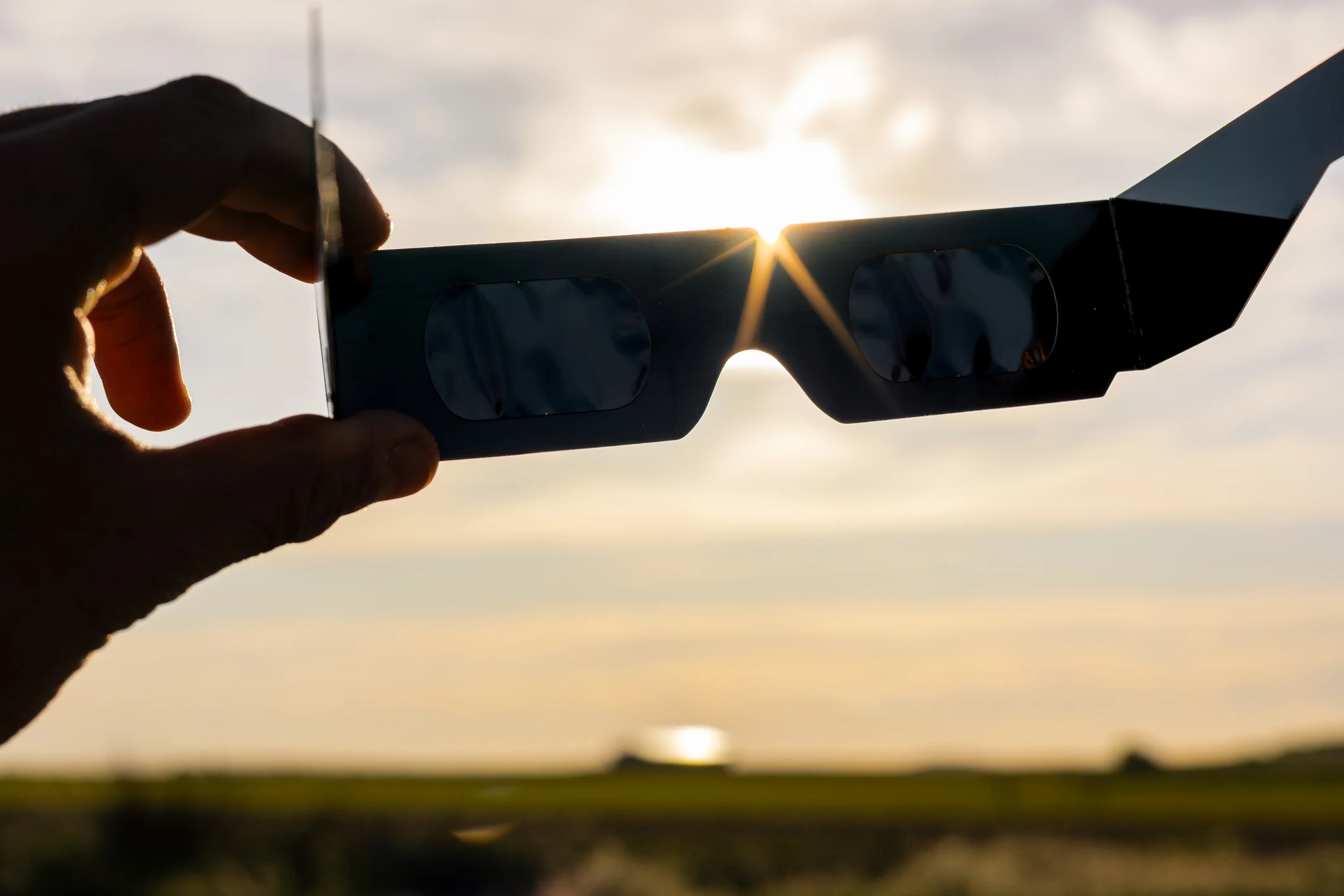
To look at the Sun, specific visors or glasses for solar observation compliant with the international standard are required ISO 12312-2designed to reduce solar radiation to levels compatible with direct observation. Before wearing them it is also necessary to check that the filter has no scratches, perforations or other damage.
This detail will be even more important on August 12 because, unlike what will happen in the areas of Spain crossed by the totality band, those in Italy will always see at least part of the bright surface of the Sun. Certified glasses must therefore be used for as long as you look directly at the phenomenon.
X-rays, dark glasses and improvised filters: what not to use
The return of eclipses brings with it a series of do-it-yourself solutions that can be very dangerous. Tarnished glass, old x-rays, photographic negatives, CDs and DVDs, films or homemade filters are not a substitute for a device designed for solar observation.
The fact that a material makes the Sun appear less bright does not mean that it adequately blocks potentially harmful radiation. Indeed, the risk is that of obtaining the opposite effect: feeling protected and staring at the Sun for longer.
For the same reason it is not sufficient to overlap several pairs of normal sunglasses. NASA reminds us that certified solar viewers are thousands of times darker than common sunglasses and are built specifically for this type of observation.
Pay particular attention to binoculars and telescopes
Even greater caution require telescopes, binoculars and cameras, because their lenses concentrate sunlight.
Don’t just put on eclipse glasses and then look through binoculars or a camera viewfinder: According to NASA, the concentrated rays from the optical system can damage the filter and cause serious eye injury. To use these tools you need specially designed and positioned sunscreens in front of the opticson the side facing the Sun.
It is therefore particularly important to avoid improvised experiments with telescopes or telephoto lenses, especially if you have no experience with astronomical observation. Camera equipment can also be damaged by concentrated sunlight.
And with the smartphone?
The phone can be used to photograph the surrounding environment or the effects of the eclipse, but pointing the camera directly at the Sun still requires attention and adequate filters, especially if optical zooms, additional telephoto lenses or other systems capable of concentrating the light are used.
Even more important is not to use the smartphone screen as an excuse to repeatedly look towards the Sun while framing: if you want to photograph the eclipse directly, the safest solution is to use specific filters and follow the instructions of the equipment manufacturer or an astronomical association.
Children require adult supervision
Particular attention must be paid to children, precisely because the phenomenon arouses very strong curiosity and a few moments of inattention are enough for them to remove their protective glasses to try to see better.
Adults should check that the devices are intact before observing, explain that they must not be removed while looking at the Sun and supervise the little ones throughout the experience. NASA also expressly recommends supervision of children when using solar visors.
The safest way is not to look directly at the Sun
Those who cannot obtain certified glasses do not necessarily have to give up the show. There are indirect observation methods that allow you to follow the eclipse without looking towards the Sun, starting with the classic pinhole projector, which uses a small hole to project the image of the solar disk onto a surface.
The principle is simple: you keep the Sun behind you and observe only the projected image, without ever looking through the hole. Even the spaces between tree leaves can act like tiny pinhole cameras and project dozens of small, sickle-shaped Suns onto the ground during the partial phase.
Astronomical observatories, planetariums and associations of amateur astronomers represent another possibility particularly suitable for families, because they allow you to use correctly filtered instruments and follow the phenomenon together with expert personnel.
On August 12, therefore, Italy will be faced with one of the most particular astronomical sunsets of recent years, especially in the western and northern regions, where the Moon will almost completely hide the Sun. The spectacular nature of the phenomenon, however, must not become the reason to lower one’s guard: a partial eclipse does not make the Sun safe to look at, even when only a thin crescent remains visible.
To enjoy the appointment, a very simple rule is therefore sufficient: certified glasses when looking directly at the sky, appropriate solar filters for any optical instrument and, in case of doubt, indirect observation. The show will last just over an hour; sight, on the other hand, must last a lifetime.