Ralf Hütter turns 80. Founder and soul of Kraftwerk, he is one of the most influential figures in contemporary music
There are groups that belong to one era and groups that end up inventing the next one. Kraftwerk belong to the second category. When Ralf Hütter and Florian Schneider began building their music in Düsseldorf in the 1970s, using synthesizers, vocoders and mechanical rhythms, the digital world that we consider normal today did not yet exist. The personal computer was far from homes, the Internet belonged to science fiction. Yet Kraftwerk had already sensed that the relationship between man and technology would become one of the great themes of modernity.
Today, August 20, 2026, Ralf Hütter turns 80. Born in Krefeld in 1946, he founded Kraftwerk in 1970 together with Schneider and remained the central figure of the group, the only founder still present in the lineup. An extraordinary continuity for a project which, more than spanning half a century of music, contributed to changing its course.
The turning point came in 1974 with Autobahn. The German autobahn became rhythm, soundscape, repetition and speed. The car was no longer just a means of transport: it entered music and determined its imagery.
From that moment on, Kraftwerk built an immediately recognizable universe. Radio Activity, Trans-Europe Express, The Man Machine, Computer World: the titles already told of their fascination with trains, networks, communications, robotics and computers. European industrial modernity became pop material.
But their revolution was not just technological. It was also cultural. At a time when much of European rock continued to look towards the United States and Great Britain, Hütter and Schneider deliberately sought a different musical identity: European, German but cosmopolitan, rigorous and very modern. Highways, stations, radios, bicycles and computers replaced the traditional imagery of rock.
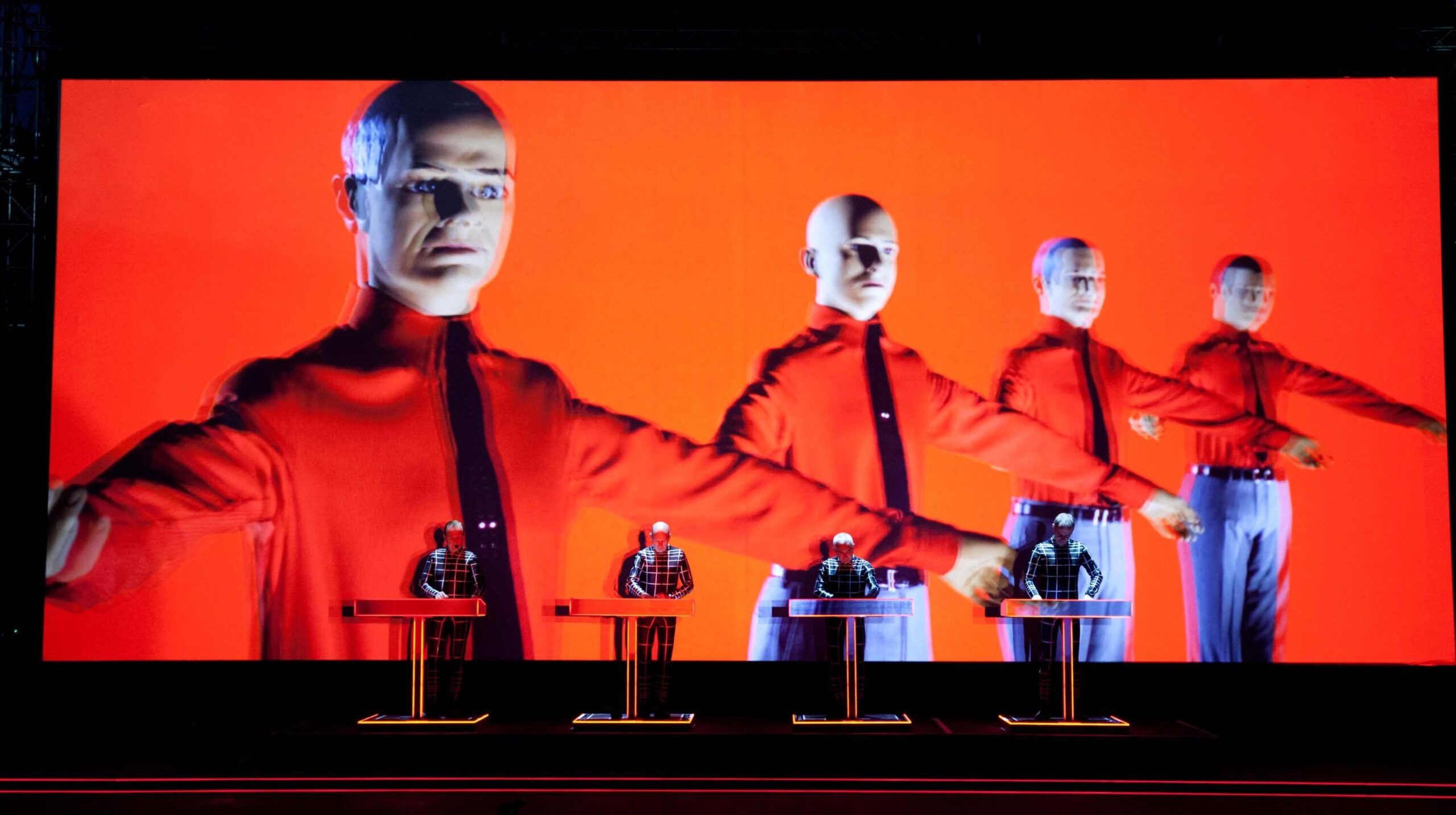
The image also contributed to the breakup. While rock stars celebrated physicality, individualism and excess, Kraftwerk did almost the opposite. On stage they appeared still, elegant, impassive. Then came the mannequins and the famous robots with their appearance.
It was the idea of Mensch-Maschinethe man-machine: not simply an aesthetic gimmick, but a reflection on the boundary between human beings and technology. An issue that today, in the age of artificial intelligence, algorithms and digital identities, appears even more relevant than it might have seemed then.
In fact, Kraftwerk’s influence enormously exceeds the history of electronic music alone. Their language entered the synth-pophip hop, electro, Detroit techno, house, industrial and dance music. Very few groups can claim such extensive lineage.
Yet their music remains surprisingly essential. The melodies are often simple, the lyrics reduced to a few words, the rhythms rigorous, the voices filtered and almost depersonalized. There is no virtuosity exhibited. Kraftwerk’s complexity lies in the ideas, not in the quantity of notes.
This is perhaps one of the reasons for their longevity. Many representations of the future born in the 1970s have aged. Theirs, however, seems to have progressively come closer to reality. In ComputerWorldin 1981, sang about computers, information and databases when personal computing was still in its infancy. With The Robots they staged automation and artificial identities. With Radioactivity they showed the ambivalence of a technology that was simultaneously fascinating and disturbing.
Today we live surrounded by digital devices, networks, algorithms and automatic systems. Those four men standing still in front of their consoles no longer seem to come from a remote future. Rather, they seem to have anticipated our present.
In the meantime the lineup has changed. Florian Schneider left the group in 2008 and died in 2020; Wolfgang Flür and Karl Bartos, protagonists of the classical formation, had abandoned the project many years earlier. Hütter remained the custodian of that universe, carrying forward a conception of the show that was increasingly closer to the audiovisual installation.
It is no coincidence that over the years Kraftwerk have also entered the large spaces of contemporary art, from the Museum of Modern Art in New York to the Tate Modern in London. After all, they were never just a band. They are a project in which music, design, image, technology and performance become a single language.
And they continue to be a living presence. In 2026, Kraftwerk is still active and Hütter continues to take the stage, faithful to one of the most enigmatic public figures in the history of music: no rock mythology, no cult of excess, no ostentatious nostalgia.
At eighty, he remains in front of his cars with the same composure as always.
Kraftwerk had imagined the future. Fifty years later, that future increasingly resembles the world we live in.