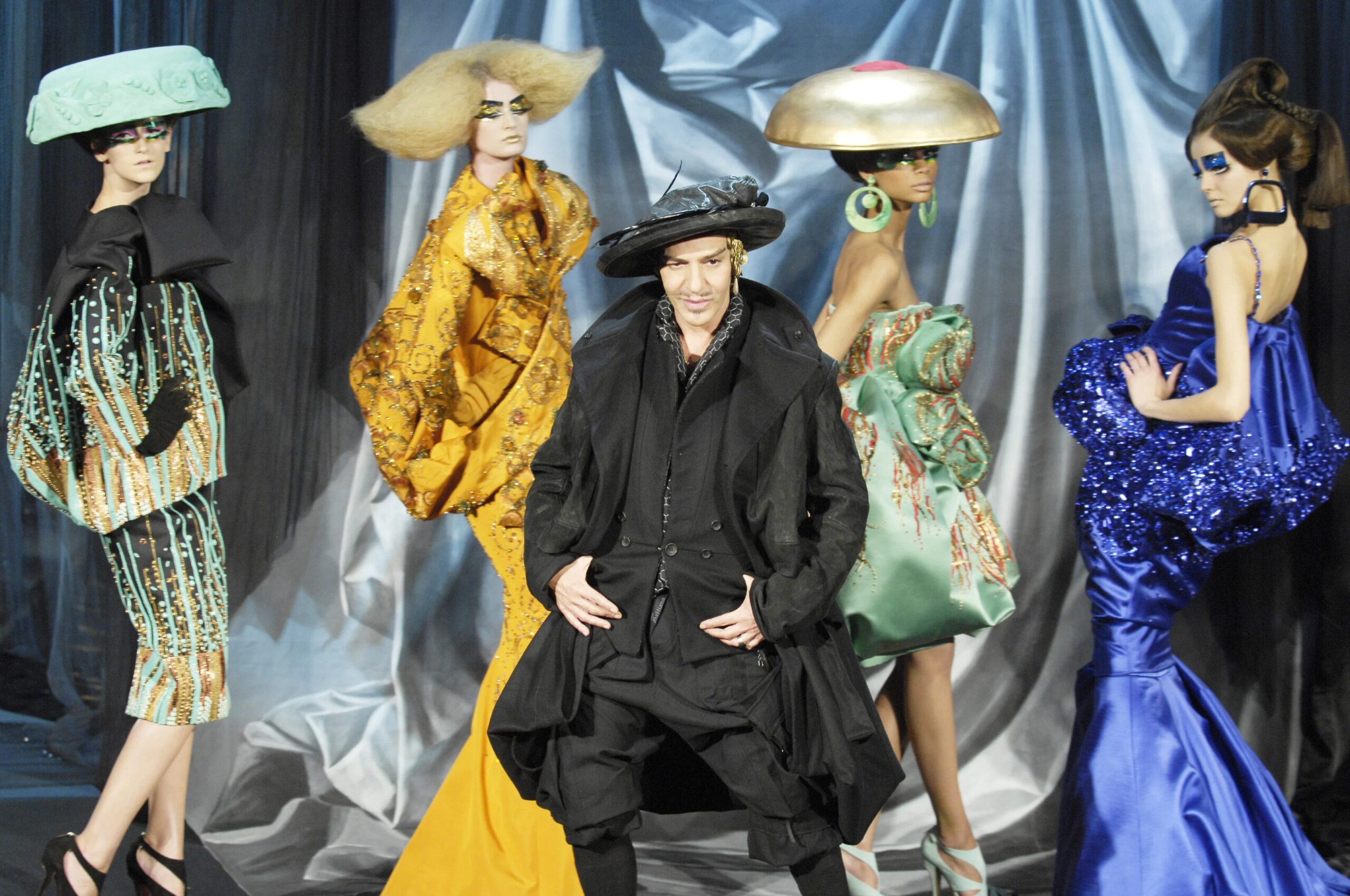
After fifteen years of apologies and a return to the top of fashion, the designer renounces the Costume Institute retrospective. A new case reopens the debate on cancel culture.
Fifteen years after the anti-Semitic and racist statements that cost him the role of creative director of Dior in 2011 and a conviction by the French justice system, John Galliano seemed to have progressively regained his space in fashion. After dealing with addictions and publicly apologizing, the designer returned to creative direction with Maison Margiela, which he led for a decade until one of the most celebrated seasons of his career.
The major retrospective of the Costume Institute of the Metropolitan Museum of Art should have represented the institutional recognition of this path. John Galliano: Horizonsscheduled for May 9, 2027, aimed to retrace over forty years of a career without removing the darkest areas. The exhibition would openly address the relationship between artistic value, moral responsibility and the possibility of redemption. Yet, a few weeks after the announcement, protests from the press, some donors and part of the public opinion led to the cancellation of the project.
“After much reflection and discussion with all the people involved, I have decided, with deep sadness, that it is better not to hold the exhibition at this time,” declared Galliano. A decision presented as personal, but matured in a climate in which the designer’s return proved to be more fragile than it appeared. His talent could be recognized again on the catwalks, but not yet enshrined in the halls of a museum.
Galliano reiterated his responsibility without seeking extenuating circumstances. “I remain fully responsible for the pain caused by my words, particularly that inflicted on the Jewish and Asian communities, and I continue to be deeply sorry for them,” he explained. «I understand that true atonement cannot be achieved through an exhibition, an institutional recognition or a single public gesture. It is an ongoing responsibility, demonstrated through listening, learning and one’s own conduct over time.”
The designer also acknowledged that an exhibition dedicated to his work might hurt some people, adding that he didn’t want to “put the Met in a difficult position” or draw attention away from the Costume Institute. However, an uncomfortable question remains: if not even fifteen years of apologies, assumed responsibility and professional conduct can allow a critical rereading of the work, is public redemption really possible? The cancellation of Horizons seems to respond negatively, transforming what could have been a complex opportunity for discussion into the new chapter of a cancel culture that struggles to distinguish between analyzing the work and absolving the man.
And another question also remains, perhaps even more uncomfortable because it concerns not only Galliano but the place and historical moment in which this exhibition should have opened: would the same have happened if Horizons had been hosted in a country less directly affected by the tensions generated by the Israeli-Palestinian conflict and by the increasingly polarized debate on anti-Semitism? It is impossible to prove this, of course, and it would be simplistic to reduce the cancellation of the retrospective to the geopolitical situation alone, but it is equally difficult to pretend that the context had no weight. In the United States, and especially in New York, every discussion that touches on Jewish identity, Israel, anti-Semitism and the boundaries of cultural freedom takes place today within an infinitely more sensitive and conflictual climate than that of a few years ago, while museums, universities and large cultural institutions have themselves become territories of political and symbolic conflict. Perhaps in another country the same exhibition would have caused controversy but it would still have made it to the inauguration; perhaps Galliano’s work would have been interrogated precisely through those contradictions that the Costume Institute declared it wanted to address. We can’t know. But this very doubt makes the story even more interesting: when the historical context changes, the threshold of what a society is willing to discuss, expose and even forgive also changes.