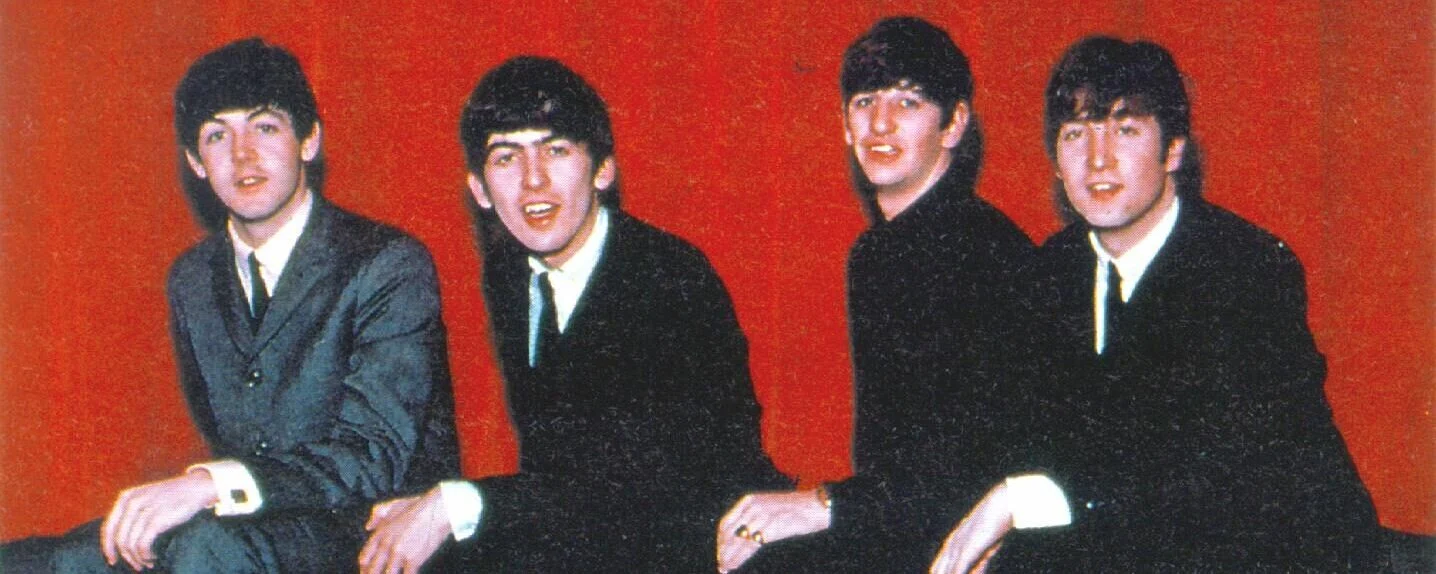
Four men who have become, together, something immensely greater than the sum of their individualities. Directed by Sam Mendes
One morning in August 2026, in front of the Abbey Road Studios in London, time suddenly seems to have stopped. Four men line up across the most famous pedestrian crossing in the history of music. The first is dressed in white. The second in black. The third walks barefoot. The last one closes the queue. The composition is unmistakable. But John Lennon is Harris Dickinson. Ringo Starr is Barry Keoghan. Paul McCartney is Paul Mescal. George Harrison as Joseph Quinn.Fifty-seven years after the shot taken by Iain Macmillan on 8 August 1969 for the cover of the Abbey Road album, Hollywood has brought the Beatles back to those same stripes. And Paul Mescal, like McCartney then, of course, is barefoot. It’s a perfect image to tell what director Sam Mendes is making. Because Mendes doesn’t make a biopic about the Beatles, but four. Four distinct feature films, constructed from the point of view of each of the band members and destined to intersect to tell a single story. The operation is titled The Beatles – A Four-Film Cinematic Event and will arrive in theaters between the end of 2027 and April 2028.
For almost twenty years Hollywood has built a decisive part of its popular imagination around superheroes such as Superman, Batman and the Fantastic Four. Mythical characters through which talent, power, rise, conflict, loss, fall and redemption are told. Now the industry seems to have found another mine of mythology. The rock stars. Characters that the public already knows. The difference is that in this case superheroes really existed. And no group lends itself to this narrative better than the Beatles. Four faces. Four personalities. Four archetypes. Four men who have become, together, something immensely greater than the sum of their individualities. The new Fantastic Four. The coincidence, moreover, is almost irresistible: Joseph Quinn, the actor who plays George Harrison, was also Johnny Storm, the Human Torch, on the first film of The Fantastic Four: First Steps. From Marvel’s Fantastic Four to the Fab Four…
The story of the Beatles is one of the most told of the twentieth century. We know the events, but Mendes wants to radically reverse the perspective. And so the underlying question will no longer be what happened to the Beatles, but what did each of the Beatles think while everything was happening?
For this undertaking Mendes has something to which no one has had free access: Paul McCartney, Ringo Starr, the families of John Lennon and George Harrison and Apple Corps have granted the project full rights to their personal stories and the music of the Beatles. An event. In a normal musical biopic the soundtrack accompanies the biography. Here the music is the biography.
And then there are them, the four actors called to carry out the riskiest operation: playing men that millions of people already think they know intimately. Paul Mescal will be Paul McCartney. The first temptation would be to look for similarity, but the interesting question is the musical preparation which already contains one of the most beautiful anecdotes of the entire project. McCartney is left-handed. Mescal is right-handed. To play him, the actor therefore had to learn to play the guitar on the other side. When the two met, McCartney thought he could help him. He picked up a guitar and started showing him how to play Blackbird. Mescal followed him, very prepared. “Hey, but you know better than me” was Paul’s comment. Yes, because it’s not enough that Mescal looks like McCartney. His hands must know where to go, because an audience can forgive a difference in the face, much less easily forgives a badly held guitar. In the conversation between the two it also emerged that Mescal will personally take care of the singing parts.
And if Mescal takes on one of the most seemingly accessible Beatles,
Harris Dickinson must deal with the most dangerous to imitate. John Lennon, the man who contained opposites: aggression and vulnerability, sarcasm and sentimentality, idealism and cruelty, the need to belong and the desire to escape. The difficulty will not be to imitate his voice, but to leave the contradiction open.
Joseph Quinn plays George Harrison, and perhaps it is Harrison himself who is destined to gain the most from Mendes’ project. In a film dedicated only to him, Lennon and McCartney don’t disappear, but they stop being the center of the universe. Harrison grows inside the Beatles. Learn to compose within the Beatles. He fights for the space of his own songs within the Beatles. And in the end he manages to write songs capable of standing up to comparison with those of the two companions who had dominated the scene for years. In the end, there’s Barry Keoghan as Ringo Starr. Ringo has always had a narrative problem: the simplicity of his public image, the man with jokes, the funny guy par excellence. The drummer who, according to an old persistent but ungenerous caricature, was simply lucky enough to find himself in the right place in the right group. Keoghan seems to have started exactly from the need to overcome stereotypes. That’s why she went to his house and had Ringo tell her story. Then, the former Beatle sat down at the drums and played for him. At one point he handed him the drumsticks, but Keoghan didn’t even touch the drums. «Playing in front of Ringo Starr was too much». The actor also said that he was so intimidated that he struggled to even look him in the eyes, but he also explained what the principle of his role will be: not to limit himself to imitation, but to try to tell the story of the other Ringo.
The authorized biopic brazenly has a disruptive force: direct access to sources, music and testimonies, but it also presents a great risk, equally evident: transforming itself into the official version that the protagonists and their heirs prefer to leave of themselves and their loved ones. If Mendes manages to maintain a balance between fidelity to the sources and artistic freedom, the four films will avoid the trap that so much musical biographical cinema falls into: transforming a life into an illustrated succession of great successes. It won’t be enough to remind us that the Beatles were immense. We already know it. It won’t be enough to remind us how talented they were. The real challenge will be to show for the first time four boys who entered the rooms and walked the streets without knowing that those rooms and those streets would forever become places of worship and pilgrimage.