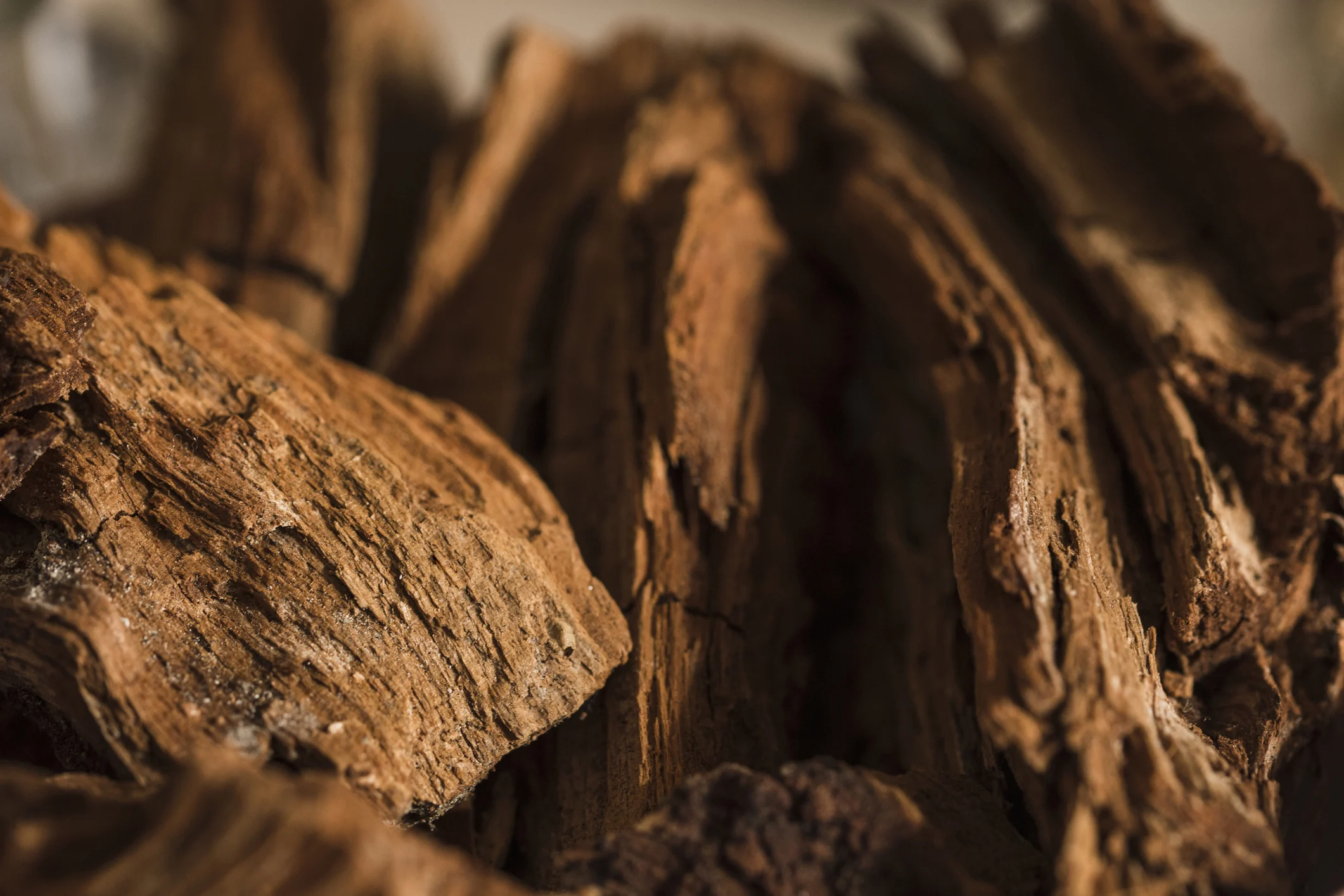
Extremely rare, aromatic, almost impossible to find: a journey into the most prized variant of agarwood, through centuries of formation, thousand-year-old uses and mind-boggling prices
In the world of perfumery and collecting, there is a more precious plant material than gold which can cost up to 10,000 dollars per gram. It is called Kynam, and it is a very rare variant of Agarwood (or Oud wood).
It is not a distinct botanical species, but one quality exceptional which develops within the trees of the genus Aquilaria.
Kynam represents the absolute pinnacle of this raw material: a dense, dark and saturated resin, which transforms the wood into an aromatic treasure of inestimable value.
The very difficult formation of wood
The birth of Kynam it is a natural event as rare as it is unpredictable, which cannot be forced or artificially reproduced on a commercial scale.
It all begins when a tree Aquilaria (widespread in the tropical forests of Southeast Asia, China and India) suffers trauma, such as a fungal infection or mechanical damage.
In response to the aggression, the tree activates a defense mechanism by producing a protective resin that slowly soaks the wood.
The factor that distinguishes Kynam from common Agarwood is the time. While standard Agarwood can be grown and harvested in as little as seven years, Kynam takes at least twenty years of undisturbed growth, but often decades or even centuries to reach ideal saturation.
The probability of a tree developing Kynam is infinitesimal. Not all Aquilaria produce resin, and only an even smaller fraction reaches the quality standard of Kynam, so much so that it is estimated that less than 10% of trees in the natural environment produce resin commercially.
The traditional test to recognize real Kynam is quite simple, while ordinary Agarwood floats on water, Kynam is so saturated with resin to sink.
Its uses
Thanks to its unparalleled aroma and its symbolic statusKynam finds use in various cultural and productive spheres, especially linked to luxury and tradition.
Oud oil extracted from Kynam is one of the most sought after raw materials in the perfume industry and its complex aromatic notes are considered inimitable.
However, given the extreme scarcity, the presence of real Kynam in a commercial fragrance is purely symbolic (sometimes even less than 0.001%), also because a single gram can cost more than the entire bottle.
In the Middle East, small fragments of Kynam are burned to welcome guests and perfume homes with a lingering fragrance. While in Japan Kynam is known as kyara and occupies the absolute pinnacle of the incense tradition, used in kōdō ceremonies.
Its use is also known in China, India and Southeast Asia, with wood playing an important role in spiritual practices and traditional ceremonies.
Also in China, as well as in South-East Asia, the incense smoke of Agarwood has historically been used as a sedative and anxiolytic therapy. And indeed, recent scientific studies have identified a possible serotonin-boosting effect in Kynam smoke, suggesting anti-anxiety and anti-depressant properties.
The cost of Kynam
Kynam is universally recognized as the most expensive wood in the worldwith a value that far exceeds that of gold. Prices vary based on purity, resin density, age and origin, but the figures involved are astronomical.
Lower quality fragments can be priced around 500 dollars a gramwhile the purest and highest quality varieties reach and exceed $10,000 per gram.
Kynam oil, extracted by distillation, is priced around $1,800 per gram. A single 10 gram portion can cost around $103,000a sum with which one could purchase almost a kilogram of gold.
The record price for this valuable material belongs to a sale of 2016when trader Alan Mahaffey disclosed that he had sold a block of 16kg of 600 year old Kynam for $20 million.
On the other hand, the supply is very limited and constantly decreasing. The species Aquilaria it is included in Appendix II of CITES, which regulates international trade to prevent its extinction.
To overcome this restriction, mother trees were grafted Aquilaria which possess the genetics to produce resin with a profile similar to Kynam.
However, the response of experts and collectors was unanimous: cultivated Kynam does not have the same depth, density and spiritual persistence as the legendary centuries-old wild Kynam.