Produced by Pinna nobilis, byssus is a unique and ancient fibre. Here are the secrets and history of the precious “sea silk”
There is a rather mysterious textile fibre, which does not come from plants or silkworms, is very light, resists water and acids but above all is not marketable: let’s talk about the byssus, the gold of the sea.
An almost legendary fibre, which has survived over the millennia thanks to very few Sardinian masters and the “Water oath“, an ethical code that prohibits its sale. But what exactly is byssus? And what causes this aura that surrounds it?
Origin of byssus
The byssus marine is not a vegetable fibre, but a secretion of animal origin produced by Pinna nobilisthe largest bivalve mollusc in the Mediterranean, also known as “nacchera”.
This mollusk secretes a tuft of very thin filaments by a special gland, used to anchor themselves firmly to the seabed. It is precisely these filaments, which can reach the 20 centimeters longto be collected and subjected to a long manufacturing process.
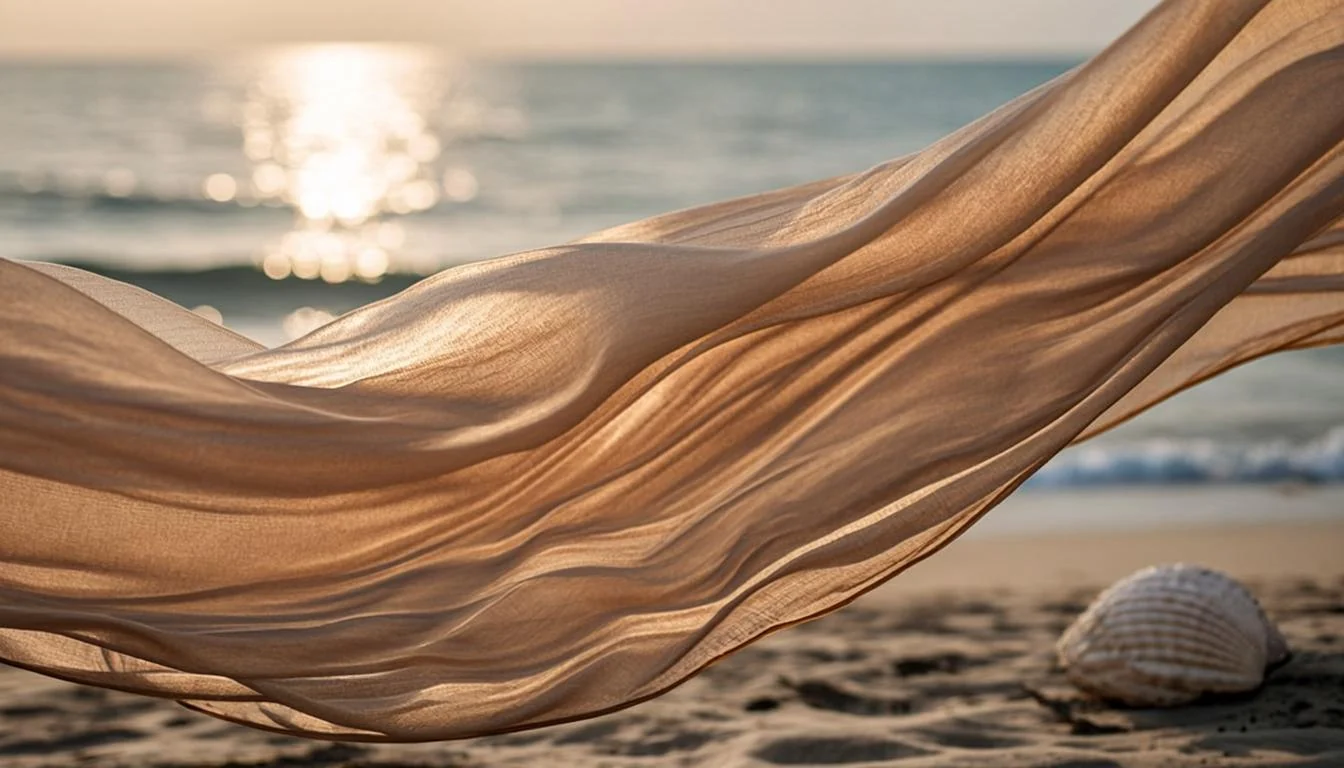
After being washed and desalted for weeks, they are treated with lemon juice, which makes them soft, elastic and gives them a characteristic golden color which does not fade over time, hence the name “gold of the sea”.
The fiber obtained is extraordinarily fine and light, so much so that, according to the chronicles, a pair of women’s gloves could be contained in half a walnut shell.
At the microscopic level, its structure is unique, composed of globular proteins organized in a helical superstructure, which gives it exceptional mechanical properties, including remarkable self-repair ability and energy dissipation.
Only a few grams of raw material is obtained from each specimen, of which just 10% is suitable for spinning, making this fiber incredibly rare.
Ancient history
The use of sea byssus as a textile fiber has ancient origins, but it is necessary to carefully distinguish between what is documented and what belongs to legend. For centuries, in fact, the term “byssus” (from the Greek byssos, in Latin byssus) indicated in ancient sources a very fine and precious linen, not sea silk.
This terminological confusion has fueled fascinating but historically inaccurate stories, which have ended up attributing uses and commissions to sea byssus that in reality belonged to byssus-linen.
The first certain written evidence of the textile use of the Pinna nobilis dates back to the 2nd century AD, when the Greek writer Alciphro describes in his writings the thalassis eria“sea wool”, as a precious material.
Shortly afterwards, also the Christian jurist and writer Tertullian he talks about it in his work De Pallio, confirming that this fiber was known and appreciated in the imperial Roman era. However, it is not a question of mass use, since its rarity and difficulty in manufacturing made it an object of extreme luxury, reserved for very few.
A particularly evocative legend, of Sardinian origin, narrates that the art of byssus processing was introduced to the island by Berenice of Ciliciaa Jewish noblewoman linked to the emperor Titus and exiled to Sant’Antioco, who taught the local women the secrets of this mastery. Even in this case, however, it is a fascinating tradition but not supported by documentary evidence.
Modern heritage
Today the processing of sea byssus is an almost lost art, preserved by very few people. The prominent figure is Chiara Vigo, a weaver from Sant’Antioco, in Sardinia, considered one of the last byssus masters in the world.
His mission is not only artisanal, but in a certain sense spiritual, also because his family has passed down this knowledge for over 24 generations. For her most important works, the Master uses a very ancient manual loom inherited from his family.
We therefore arrive at the commercial value of byssus. Which… has no value. In fact, there is the so-called “Water oath“, an ethical code that requires her to never sell byssus, but to donate it or exchange it symbolically, since it belongs to the sea and cannot be commodified.
At the same time, the very survival of Pinna nobilis is now seriously threatened. The species is classified as “in critical danger of extinction” and its collection is prohibited by European and international regulations.
Pollution, illegal fishing and a lethal pathogen have decimated the populations of this mollusc. Despite the gravity of the situation, recent monitoring has identified surviving specimens and juveniles born after mass mortality events, raising hopes that the species can still recover.
The history of sea byssus is therefore an indissoluble intertwining of an ancient art, an ethic of giving and the fragile survival of an extraordinary marine creature.