On August 12, shortly after seven in the evening, thousands of people were standing at 2,275 meters with their eyes turned towards the sky. On the top of Plan de Corones, in the heart of the Dolomites, the Moon had slowly begun to cover the Sun while the mountains were tinged with the shades of enrosadira. Around it, meadows normally crossed by skiers during the winter had become for a few hours an enormous natural observatory.
Families, photographers, couples, young people and astronomy enthusiasts had climbed to the heights thanks to the evening opening of the Kronplatz 2000 cable car in Riscone. The partial eclipse of 12 August 2026 showed an unusual face of one of the best-known mountains in South Tyrol: not only a ski area and summer destination, but a place from which to stop and watch what is happening above and around us.
And perhaps this is precisely the best way to describe Plan de Corones when summer begins to end.
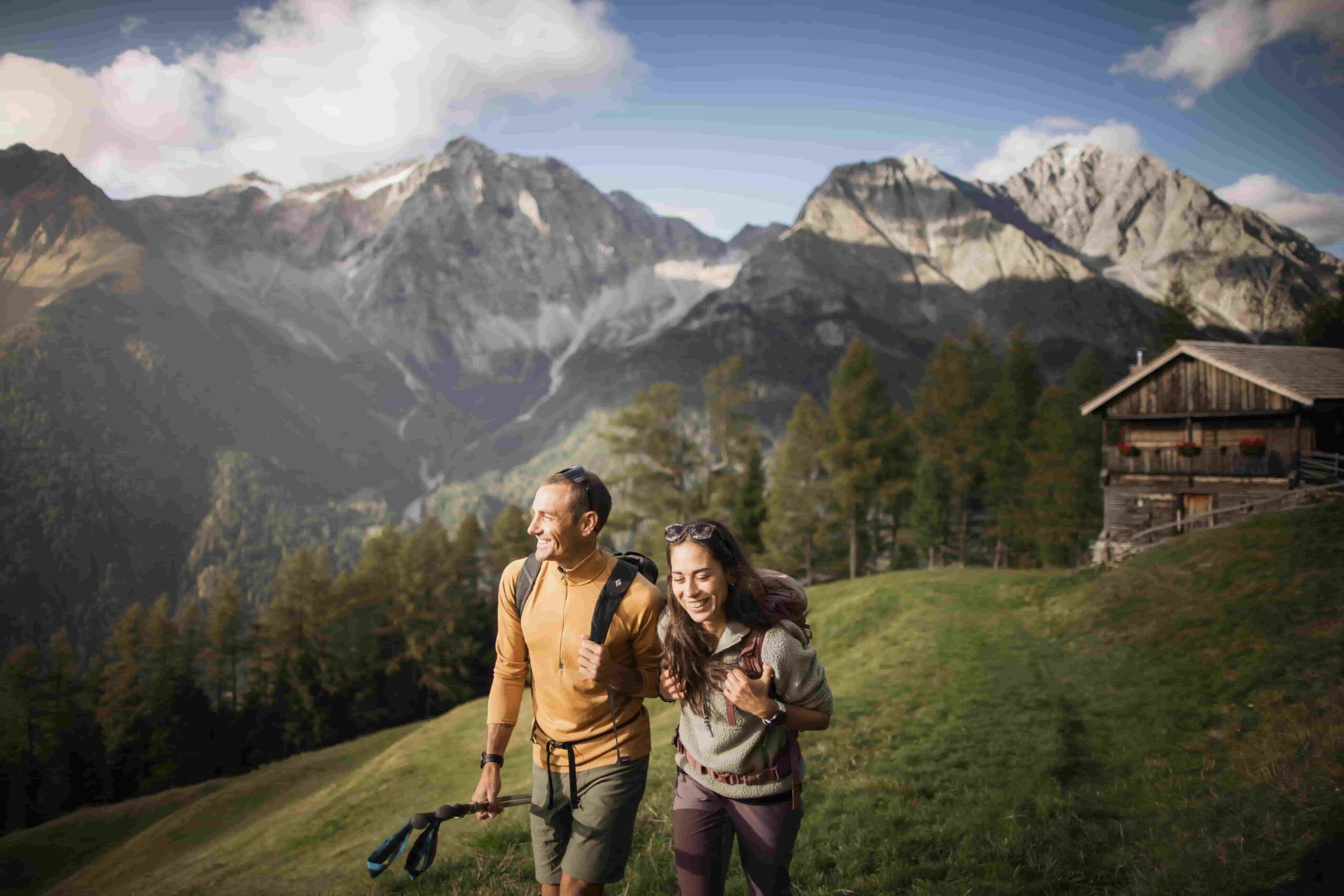
Because after the eclipse, after the shooting stars and after the height of the summer season comes a period that is only apparently less spectacular. It is that of autumn, when the mountains slow down, the woods change colour, the air becomes clearer and the paths once again become territories to be crossed without haste.
The other season of Plan de Corones
September, October and the first days of November represent a sort of privileged interlude between the summer holidays and the arrival of the snow.
The light dims, the temperatures become cooler and the foliage progressively transforms the woods of the Pusteria Valley and the Anterselva Valley. It is a season suitable for excursions but also for those simply looking for a few days away from the rhythm of the cities, alternating nature, cuisine, museums and small South Tyrolean towns.
Numerous facilities, refuges and restaurants in fact extend their opening during the autumn, allowing you to continue experiencing the mountains even after the traditional August watershed.
The territory that revolves around Plan de Corones is much larger than the mountain that gives it its name.
There is Brunico, with the porticoed historic centre, the castle, the shops and cafes. There are San Vigilio and San Martino in Badia, gateways to a part of Ladinia and to the Fanes-Senes-Braies and Puez-Odle natural parks. There is Valdaora, particularly linked to family tourism, and then Chienes, surrounded by woods and nature itineraries.
Further north, the Anterselva Valley changes its landscape once again, with the lake with green-turquoise waters and the accesses towards the Vedrette di Ries-Aurina natural park.
At 2,275 meters, between Zaha Hadid and photography
However, the point from which to observe everything remains the top of Plan de Corones.
At 2,275 metres, on clear days, the view opens up 360 degrees over the Dolomites and the surrounding Alps. And it is here that in recent years the mountain has also built its own cultural identity.
On the summit is the MMM Coronesthe museum dedicated to mountaineering designed by Zaha Hadid, together with LUMEN Museum of Mountain Photographydedicated to mountain photography. Both were exceptionally open until 10pm on the evening of the eclipse, mixing astronomy, architecture, photography and landscape.
The Via Artis also starts from the summit, a 7.2 kilometer long open-air art gallery which in 2026 will be enriched with five new works, while the Concordia 360° route goes around the summit offering perspectives on Fanes, Sella, Odle, Sass de Putia and Ortles.
It’s a different way of imagining high altitude: not necessarily as a place to conquer, but as a space to stay.
Canederli, speck and autumn flavours
Then there’s the table. If summer in the Dolomites is above all about movement, autumn seems tailor-made to give cooking an important part of the journey. In the refuges and restaurants of the area, dumplings, speck, mountain cheeses, aromatic herbs, traditional desserts and South Tyrolean wines return as protagonists.
One of the main events of the season will be the Alto Adige PGI Speck Festivalscheduled for 26 and 27 September 2026 right on the top of Plan de Corones, with local producers, tastings and local specialties.
This choice also tells something about the contemporary mountains: arriving at the summit not only to look at the view, but to encounter culture and gastronomy in the same place.
From September to November, offers to experience the mountains without crowds
Resorts in the region are also trying to extend the season further and further.
In Brunico and Valdaora, from October 1st to November 8ththe Golden Summit Weeks allow guests of participating facilities, through the Guest Pass Plan de Corones, to make one free ascent and descent per day on the lifts included in the initiative, during their respective opening periods. Guided excursions and other high altitude activities are also planned.
In San Vigilio di Marebbe, however, theAutumn Special San Vigilio goes from 5 September to 1 November 2026 and includes more than fifteen experiences and discounts, from excursions to discover Alpine fauna to visits to museums and zip lines. The total declared value of the activities exceeds 250 euros for those staying in participating structures.
The Anterselva Valley offers its own Autumn Package fromSeptember 11th to October 10thwith itineraries around the lake, visits to the farms, tastings, guided excursions and discounts for museums and facilities. In Chienes, however, from September 6th to November 8th guests of participating facilities can take advantage, among other advantages, of a daily ascent and descent on the Plan de Corones 2000 lifts.
A mountain to experience even without a car
Finally, there is a less scenographic element, but increasingly decisive in the way we choose a destination.
The Guest Pass Plan de Corones allows guests of affiliated facilities to use regional buses and trains in Alto Adige, while the Südtirol Transfer service connects the railway stations to the accommodation facilities. Several localities in the region have also undertaken paths linked to the international GSTC standards for sustainable tourism.
It means being able to arrive in Brunico by train, move between towns and valleys and enjoy a good part of your stay without constantly depending on the car.
And it is probably in autumn that this philosophy finds its most natural dimension.
On August 12, thousands of people climbed the Plan de Corones to watch the Sun slowly disappear behind the Moon. A few weeks later the show moves further down: to the larches and woods that change color, to the first cold mornings, to the paths that have suddenly become silent.
The sky has opened the season. Now it’s the mountain’s turn.