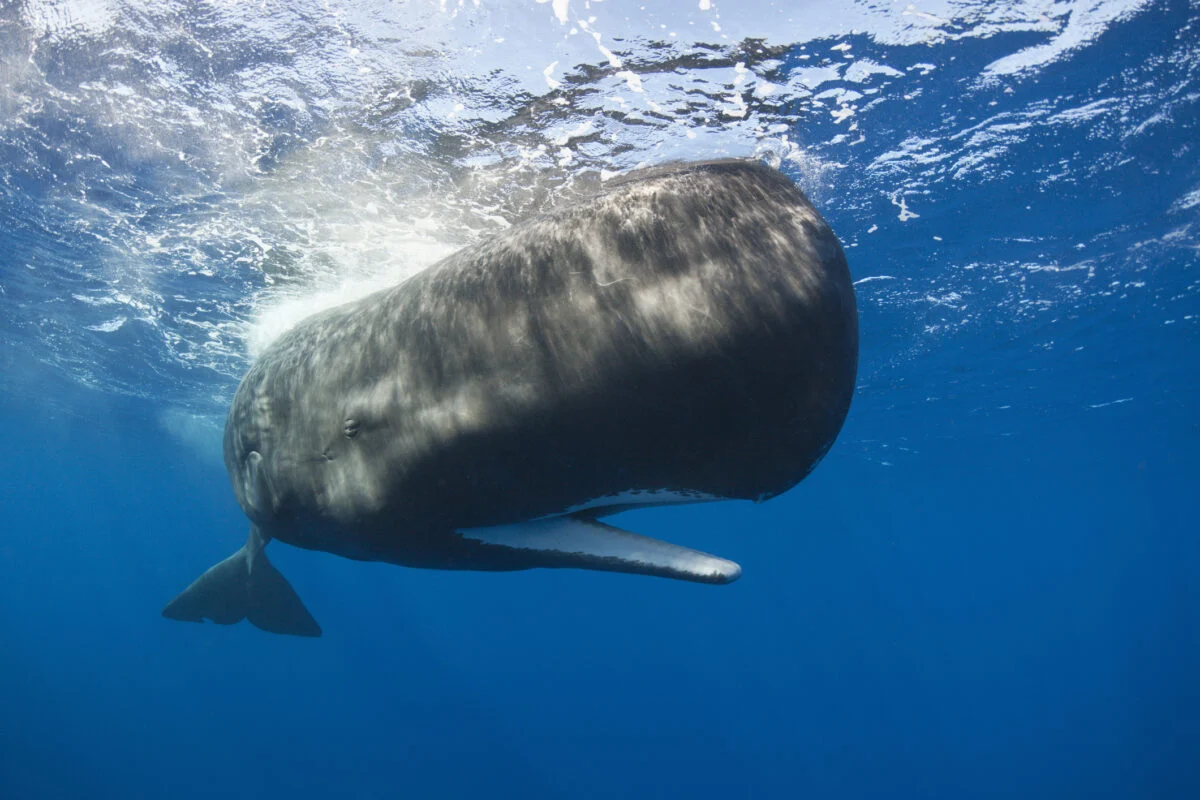
What unites luxury perfumes with whales? The answer is Ambergris, the most precious fixative in perfumery which costs up to 50,000 euros per kilo.
In the field of luxury perfumery, one of the most important principles is the ability of a perfume to remain on the skin. How some of the most celebrated fragrances achieve this will shock many people. The answer is in fact in the intestines of whales, and it has a name: Ambergris (or ambergris).
What is Ambergris
Ambergris, sometimes incorrectly called “whale vomit”, is a very rare substance, produced exclusively by the sperm whale’s digestive system. These cetaceans feed almost entirely on large cephalopod molluscs, in particular giant squid.
While the soft parts of the squid are easily digested, this is not the case for the horny beak of the mollusc, similar to that of a parrot, composed of a substance that is not digestible by the sperm whale. Not surprisingly, the cetacean normally regurgitates these hard parts every few days before they pass beyond the stomach.
Very rarely, it may happen that some beaks accidentally slip into the intestine. Being extremely sharp, they risk seriously scratching or perforating the animal’s intestinal walls.
According to the prevailing hypothesis, to protect themselves from irritation, the bile ducts of the cetacean begin to secrete a waxy, greasy and pasty substance rich in ambreina (an odorless alcohol).
This “paste” envelops squid beaks layer by layer to smooth out their sharp corners, progressively cementing together with the liquid feces into a solid concretion, similar to how an oyster creates a pearl around a grain of sand.
The method of expulsion
There is no consensus in the scientific community on how to expel ambergris. Many marine biologists argue that, in most cases, blocks of ambergris remain small in size and come expelled naturally through defecation.
No scientist, however, has ever witnessed or recorded this event using instrumentation. And here we come to the second hypothesis on the expulsion of the Ambergris, much more drastic for the Sperm Whale.
According to the biologist Robert Clarkewho has studied ambergris for over fifty years, whales cannot easily expel solid masses from the rectum. The intestinal blockage would continue to accumulate layers of squid beaks and bile resins inside the organ, growing out of all proportion.
This accumulation ends up causing alethal intestinal obstruction. The increasing pressure tears the intestine causing the cetacean’s death from septicemia. An episode actually detected in a dead sperm whale in the Canary Islands.
Second Christopher Kempbiologist author of an important essay on the subject, only the1% approximately sperm whales actually produce this substance, which clearly explains its rarity and, as we will see, its price.
The value of ambergris is so high that in the world of perfumery it is nicknamed “floating gold”: an image that gives a good idea of a rare, disputed and prohibitively expensive raw material.
But what makes this substance truly legendary is its metamorphosis at sea. Freshly expelled from the sperm whale, ambergris is black or dark brown, soft, waxy and with an unpleasant odorsimilar to manure.
Only after a long oceanic wandering, exposed for years or even decades tooxygen, sunlight and salt waterundergoes a slow process of oxidation and maturation which distorts its properties.
Ambergris changes hue light grey, yellow or whitehardens until it acquires a waxy and compact consistency, and above all develops that complex, warm and enveloping scentwith notes by tobacco, musk, ancient wood and marine scent.
The variety whitethe most “ripe” and valuable, is the one that has floated the longest and has reached the maximum olfactory purity.
Astronomical figures and uses
Once collected and processed, its main function is that of legendary fixative for perfumes: it is considered the most powerful agent capable of binding a fragrance to the skin, prolonging its persistence and amplifying its sillage.
For this reason its presence is often reserved for niche creations of designer perfumery, like Francesca Bianchi, Creed or Perris Monte Carlowhere the cost of the raw material can be justified by the final quality of the perfume.
The price fluctuates significantly based on quality and color. The variety white it is considered the most valuable, followed by the gray and yellowish ones. On the market a single gram can be quoted by 20 to 50 euroswhich means that one kilogram of good quality ambergris can reach even i 50,000 eurosultimately justifying the name “floating gold”.