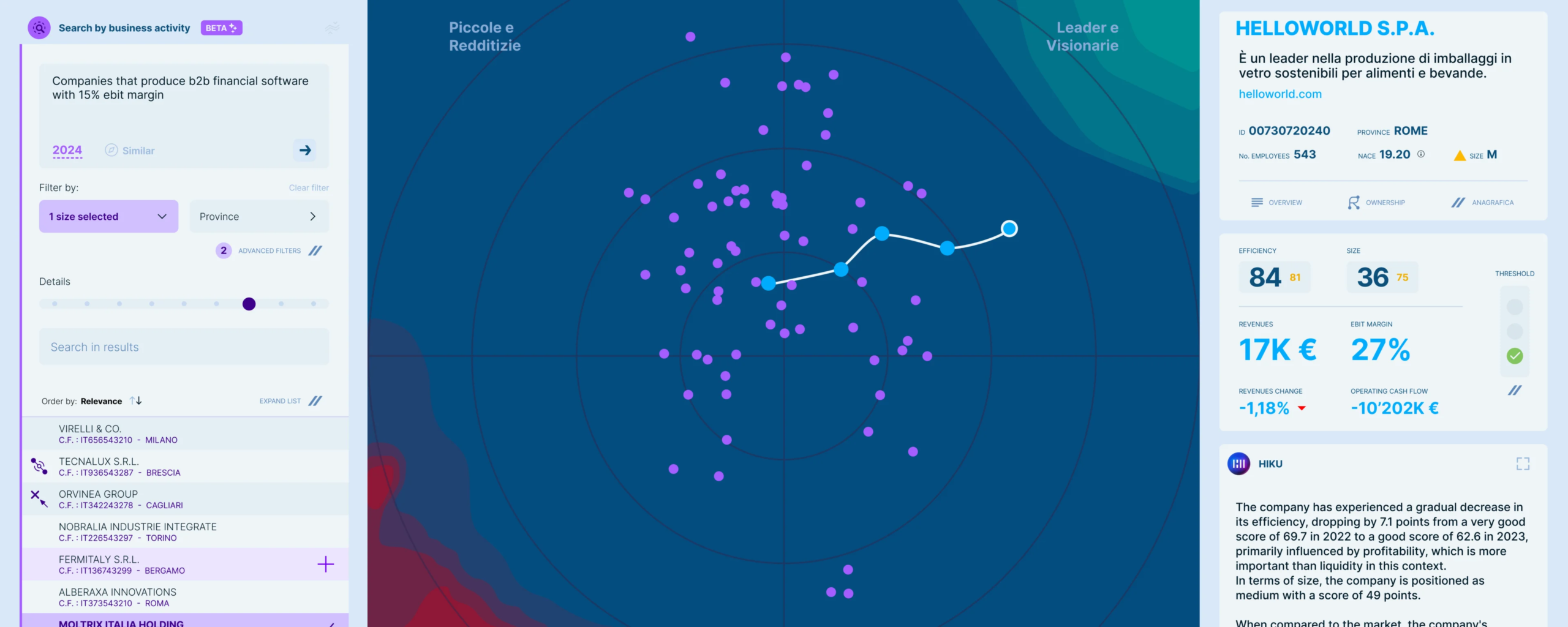
For decades, corporate databases remained passive archives of balance sheets and static figures, conditioned by the idea that it was only up to humans to extract and interpret the information. Today, the advent of Agentic AI overturns this paradigm, transforming raw data into a contextualized tool capable of anticipating company performance up to two years before official publications.
It is the guiding philosophy of Syrto and its new Syrto AI technology (launched at Microsoft HQ together with partners such as Banca Sella, BIP and Moresi), designed to bring financial intelligence directly into the digital tools used every day in companies. The turning point is not to force all managers to become financial analysts, but to democratize access to data so that understanding the productive fabric is no longer a monopoly for a select few, but rather a real value distributed to all company functions. A path of innovation told in the words of Edoardo FarielloCEO of Syrto.
How did the idea for Syrto come about? Why go beyond the traditional database model to create a solution based on agentic artificial intelligence?
Traditional databases start from an assumption: that it is the user, alone, who interprets the data made available to him. The need was not only to access the data, but also to understand it. Existing solutions had great information depth, but did not contextualize it with respect to the goal of those who used them, whether it was to find a company or evaluate a customer. Syrto was born from this gap: between the amount of information available and the still rudimentary way in which it is made available to companies, banks and consultancy firms.
Agentic AI is how we have bridged that gap. We use it on two levels: finding and creating data and interpreting it with respect to the specific need of the end user. It is this dual function, not only collection but also interpretation, that distinguishes us from traditional players.
Syrto can understand how a company will perform up to two years ahead of official financial statements. How does software “read the future” of a company?
We have built a three-tier data ecosystem. The first is quantitative: we start from the balance sheet, the official deposited data, which we reclassify and rework to build on it a greater financial depth than the original one. But the balance remains a photograph, not a 360 degree vision: it says what happened, not necessarily what is about to happen.
This is why we combine it with a second level, qualitative data: what the company sells, to whom, how, what organizational structure it has. The third level synthesizes the two previous dimensions into performance indicators.
The objective is to understand every company, from small and medium enterprises to large corporations, and reconstruct how all these companies position themselves in relation to the market and relate to each other. At that point, the forecast is no longer a simple deduction from the financial statement historical series, but comes from understanding how the company works, what it does, where it does it and how it positions itself in its sector.
Today with Syrto AI you can “chat” with the data of over a million companies using simple language. What kinds of questions can a user ask and what answers can they expect?
Those who use Syrto generally have one of two needs: analyze something they already know, or find something they don’t yet know. In both cases, a question in natural language is enough: the artificial intelligence will translate it into what you need to ask the data.
Let’s give some concrete examples: you can ask to analyze a particular supplier, evaluate its risk and potential, innovation in certain sectors. Or to find the twenty best cosmetic companies in the province of Milan with specific financial characteristics. Or again, ask for one due diligence on a specific company, map the corporate connection chains and check if anyone is controlled, indirectly, by one of my competitors.
The prompt is generated by the company itself, every time it uses the tool, and its specificity determines that of the response. You can also connect your CRM or other business software to access information from there too.
Is there anyone who, hearing about artificial intelligence, perceives a wall, a barrier, and doesn’t trust it?
It depends on the companies. I wouldn’t talk about barriers but rather about mistrust, which can be resolved with in-depth compliance work: rarely does anyone tell us no a priori, but before saying yes there are long processes to understand how the tool works, what data it uses.
Compared to a year and a half ago, when we launched the product, the attitude has changed a lot: companies were more tied to existing software, while today they are more willing to evaluate investments and economic returns.
Are the companies coming to you asking for help or are you the ones offering yourselves?
Both. The more visible we become, the more companies discover us on their own. But we remain a startup that needs to make itself known, so we also work proactively.
Syrto, in fact, has two distinct products. The first is the platform for analysts, users who are already competent in the sector, to whom we offer consultancy and training to make them autonomous in their use. The second, launched at the end of June 2026, is Syrto AI: designed to integrate into the artificial intelligence already in use in the company, be it Copilot, ChatGPT or Claude, at different levels of depth. In this case, the necessary training is minimal, because the tool fits into an already familiar environment. To bring it into companies, we also rely on an ecosystem of partner consultancy companies, who teach its use and integration.
What are Syrto’s future goals? Is there already an intention to expand internationally?
Yes: starting next year we aim to expand in Europe, with the aim of reaching a global scale later. In Europe, data is structured in a more precise and organized way; getting out of it will require a greater technological effort.
The forecasting objective, after all, is what everyone wants: a crystal ball. It’s ambitious, but we’re confident we can get there.
The world of business insight has long been an analyst-only domain, perceived as difficult to navigate. With Syrto AI we want to make it accessible also to small and medium-sized businesses, so that this information can help the Italian entrepreneurial fabric to integrate artificial intelligence into their business. We don’t want to build something elitist, but bring it to as many companies and institutions as possible.