COP30 in Manaus between climate and Brazilian contradictions. Despite political risks, Brazil offers record returns and attractive equity valuations in 2026.
In Manaus, Brazil, the 30th COP (Conference of the Parties), annual gathering of the nations that adhere to the UN convention for the fight against climate change which aims to discuss and negotiate strategies and action plans to slow down the phenomenon, implement the energy transition that we hear so much about, ensure that 8,258,296,000 inhabitants of our planet do not end up eating it and destroying it completely.
It is highly significant that this year the COP is taking place in Manaus, just outside of the Amazon, the largest green lung of the planet completely connected (otherwise it would be the Russian Taiga which is divided into three areas), which extends over 5.5m2 and absorbs, according to the latest calculations, 2.2bn tonnes of CO2 per year (in second place is the Congo basin in Africa, much less known, which absorbs around 600m/year). The Brazil is in fact a contradiction in itself given that it also hosts the largest cattle breeding activity in the world (220m of cattle that emit methane, 8% of the national GDP, 160 billion dollars in annual turnover, largest meat exporter on the planet), which requires enormous quantities of feed and consequently immense expanses of land which, being now scarce even in such a large country, are stolen from the Amazon forest by burning it. It is estimated that taking into account the CO2 emitted by the fires, in the last 10 years the area has become a net emitter of CO2leaving the leadership to Congo.
So seeing Lula, the eighty-year-old Brazilian president openly in favor of protecting the Amazon, trying to convince COP participants to act, to help emerging countries find funds to fight such practices, is highly significant. Although we know that the US government has not sent any official representative for the first time and that there are also many lobbyists who are pushing against it in defiance of the hot and humid Brazilian climate.

But let’s get to us: ours investment ideas for the year 2026 we will tell you about them as always in January, but we anticipate one that concerns Brazil.
Both the stock and bond markets of the South American country appear to be quite promising.
Starting from the latter we underline how within developed and emerging countries the Brazil offers the most attractive real bond-side yields. As the Pictet graph shows us, the value is above 10%, much higher than any other emerging country (and naturally developed one where real returns remain very low) and double compared to the historical average offered by the country in the past. So very attractive.

Why are we in this situation? Because there is a high political risk that the market prices with the Lula administration notoriously very attentive to social issues with expansive fiscal policies and less about making ends meet (government deficit expected to be around 8% this year, debt to GDP ratio which will further rise towards the 92% area). Because next year there will be important presidential and general elections (4 and 5 October) which always lead to instability, electoral promises and gifts. Despite all this we believe that the returns offered are extremely generousalso by virtue of the fact that inflation is largely under control (it is in the 5% area) thanks to the decisive action of the central bank, which acts as a counterpart to the president and is, in our opinion, the primary determinant of the current level of rates.
Gearbox side Brazilian Real after this year’s good performance, however, it still appears undervalued and we believe that any weakening should be exploited to invest.
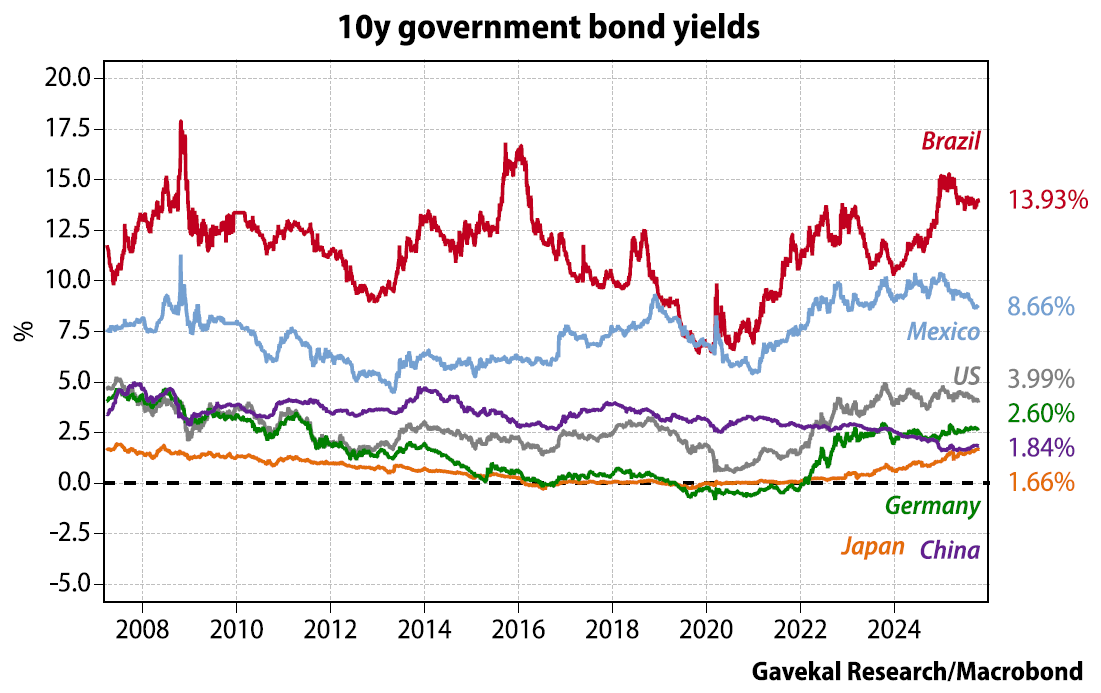
Two important indications: as always we prefer to avoid issuer risk (the Brazilian government has a credit rating below investment grade) and therefore we recommend using supranational emissions AAA (you give up around 1.5% annual return, but you are more relaxed) and secondly, given that the rate curve is very flat, we believe it makes sense to expose ourselves to medium/long deadlines (5-10 year area), where the benefits of lowering rates to smaller values will be greater. The Gavekal graph shows us the trend over time in the yield of the 10-year bond compared to other countries.
Moving on to shareholding part we can underline how the evaluations are very interesting here too. We take into account that emerging stock markets have underperformed the stock markets of developed countries in a very pronounced way in recent years (from 2012 onwards) and that within them Brazil has been among the worst as the Alpine Macro graph shows us well in which we can see the relative trend compared to emerging markets and the overall valuation falling to levels that are in theory very attractive.

A decline in the US dollar, which we believe is possible, would greatly benefit companies in emerging markets, a lowering of interest rates in the country which are currently very high (15% is the level of official rates on the central bank side) would reduce the cost of financing for companies. Again, a general change in tone of the markets with a shift in their infotech/AI/USA focus towards other sectors that are very present in the Brazilian list (financials, basic resources, energy, utilities make up 75% of the index) and towards emerging markets which have better valuations (the price-to-earnings ratio of the Brazilian Bovespa index is at 11) would be driving factors.
So Viva Brazil!