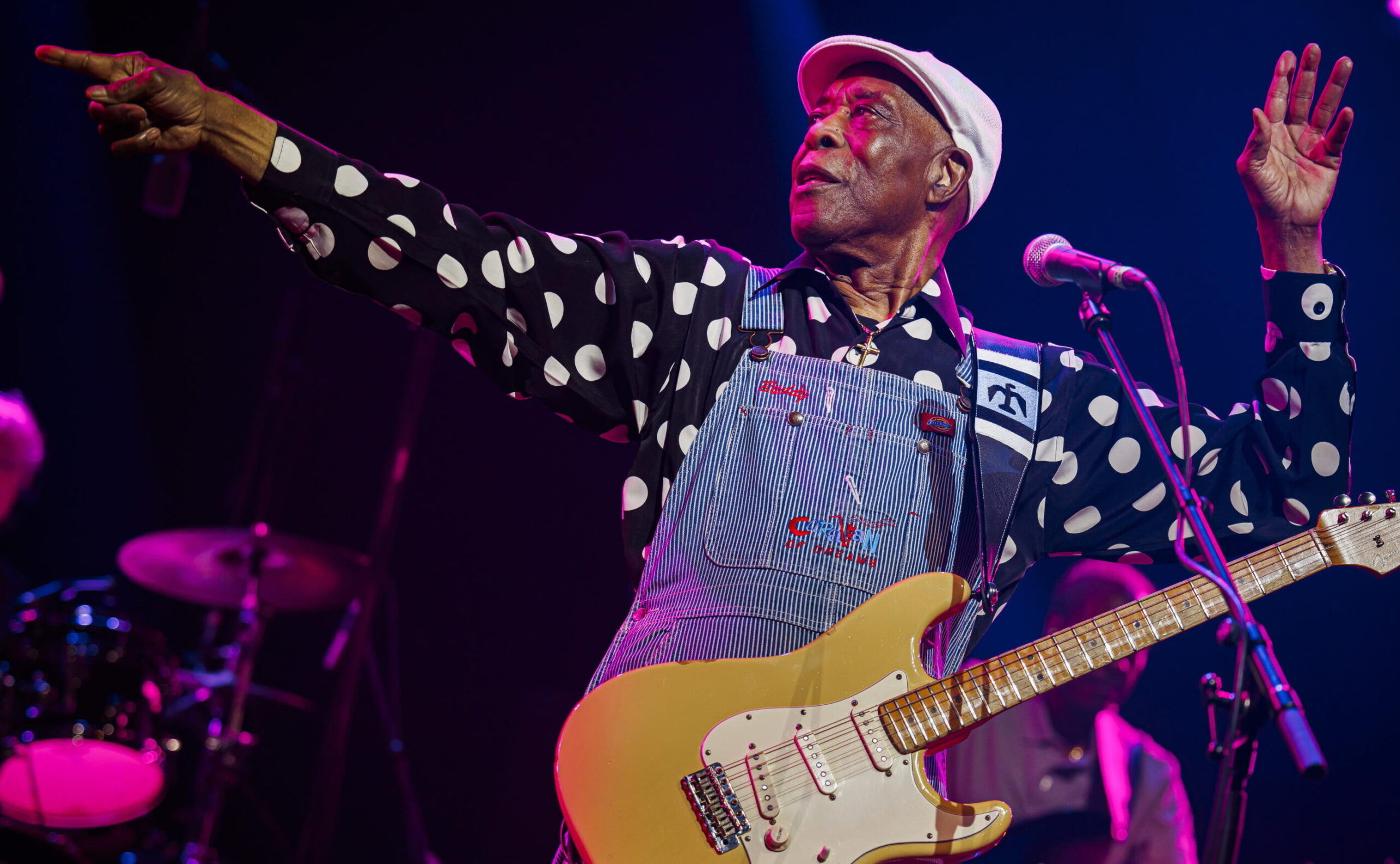
He is the musician who took up the legacy of the fathers of Chicago Blues and showed the way to Hendrix, Clapton and Stevie Ray Vaughan
Buddy Guy is not simply one of the greatest living guitarists, nor just one of the last bluesmen of the generation that changed the course of American music. It is something rarer: a living archive.
With him, a way of conceiving music that precedes marketing, the entertainment industry and even rock does not survive. When Buddy Guy was born on July 30, 1936, in Lettsworth, Louisiana, the blues was still the everyday language of African-American communities in the South.. It had not yet assumed the cultural prestige that we attribute to it today. It was the voice of men and women who spoke about work, segregation, poverty, faith and hope. It was a necessity before a show.
In the fifties, when he left Louisiana for Chicago, even the blues was changing its skin. The guitars became electric, the rhythm sections more robust, the volume louder. Muddy Waters, Howlin’ Wolf, Little Walter and Willie Dixon were building the sound that would influence the entire world.
Listening to his recordings from the 1960s today gives an almost alienating impression. Inside those notes there is already much of what would become the language of rock guitar: the violent attacks, the broken phrasings, the dramatic use of silence, the amplification taken to the limit, an expressive freedom that broke the mold of traditional blues. Jimi Hendrix would have transformed that freedom into a planetary revolution. Eric Clapton would bring it to British blues. Stevie Ray Vaughan would return her to her Texas roots. Everyone, in different ways, acknowledged their debt to Buddy Guy.
And this is where the great paradox of his career manifests itself. Millions of people know the musicians he influenced. Far fewer know the man from whom those same musicians learned. The history of music is full of pioneers who remained in the shadows while their heirs achieved success. Buddy Guy belongs to this silent aristocracy: that of artists who change their language even before becoming famous.
In fact, international consecration will only come when the world begins to look at the blues as the source of almost all contemporary popular music. The Grammys, induction into the Rock and Roll Hall of Fame, the National Medal of Arts, the Kennedy Center Honors and other recognitions received in recent decades do not represent so much a discovery as a historical repair.
At his Chicago venue, Buddy Guy’s Legends, which opened in 1989, the blues has never been displayed like a museum object. It has remained a living music, made up of meetings, improvisations, apprenticeship.
This is perhaps the most profound difference between Buddy Guy and many other great performers of his generation. He didn’t treasure the blues like a relic. It kept it moving. Buddy Guy belongs to another musical civilization. A civilization in which the value of an artist was measured by the ability to keep the breath of a room suspended with a single note.
For this reason he is not only the last great bluesman. He is one of the last men who can still tell us, without intermediaries, where the music we listen to every day comes from.