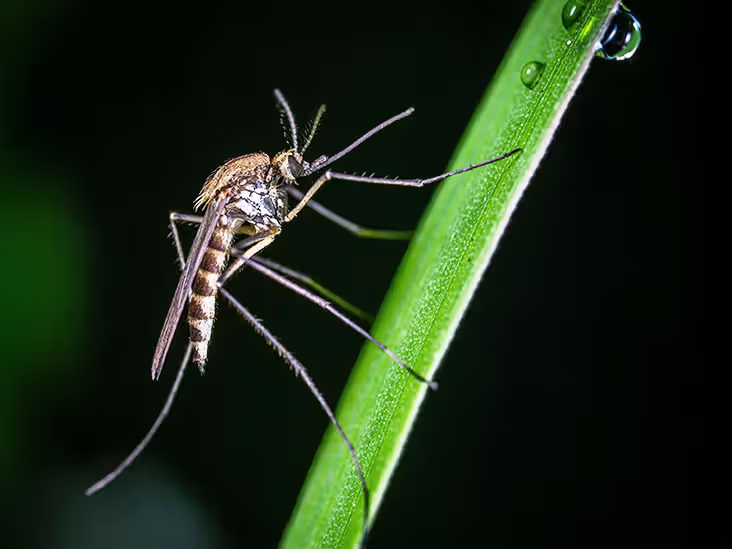
- Researchers found that Aedes aegypti, or yellow fever mosquitoes, can learn to associate the smell of DEET with a food reward through repeated exposure during feeding.
- In laboratory experiments, more than 60% of trained mosquitoes attempted to feed when exposed only to the smell of DEET, suggesting the insects had formed a positive association with the repellent.
- Trained mosquitoes were attracted to DEET-treated human skin, while untrained mosquitoes avoided it, indicating that mosquito behavior toward repellents may be shaped by experience.
- The findings suggest DEET remains highly effective, but maintaining consistent repellent levels through regular reapplication may be important to prevent mosquitoes from adapting to fading concentrations.
Mosquitoes are common across the United States, with more than 200 types of mosquitoes living in the continental United States and US territories.
Most mosquitoes in the US are nuisance mosquitoes that do not spread disease, but some bites can transmit
Although present in America, the burden of these diseases is
Prevention is often the most effective defense against mosquitoes, with public health officials recommending insect repellents containing DEET.
Typically available as liquids, lotions, or sprays, the chemical likely deters mosquitoes by interfering with their sensory receptors, making humans difficult to detect and unappealing. Health experts emphasize the DEET-based repellents are safe and effective when used as directed.
Now, a new study suggests mosquitoes may be more adaptable than previously thought, and the yellow fever mosquito can learn to associate the smell of DEET with a food reward, potentially changing how the insects respond to the chemical over time.
The findings, published in the Journal of Experimental Biology, raise new questions about mosquito behavior and how to effectively use repellents in real-world settings.
Mosquitoes may learn from experience
DEET has long been considered the global gold standard in insect repellents. Previously, it was thought that DEET worked because mosquitoes disliked its taste and smell, and because it made humans harder to detect.
However, these findings suggest that the mosquito brain may play a larger role than previously understood.
In the study, researchers used a form of Pavlovian conditioning, the same learning process made famous by Russian physiologist Ivan Pavlov, to train mosquitoes to connect the smell of DEET with feeding opportunities.
The study focused on Aedes aegypti, a mosquito species known for spreading serious viral illnesses including Yellow fever, Dengue fever, Zika, and Chikungunya.
Mosquitoes were placed behind mesh fabric while a warm blood source was positioned nearby. Once the insects began feeding, researchers introduced the smell of DEET.
After repeating the process four times, more than 60% of the mosquitoes later attempted to feed when exposed only to the odor of DEET.
The researchers then tested whether the learned behavior affected mosquito preferences. Mosquitoes were offered a choice between two human hands, one untreated and one coated with DEET at standard concentrations.
Untrained mosquitoes avoided the DEET-treated hand, while the trained mosquitoes were attracted to it.
The team also found mosquitoes could form the same learned association when sugar rather than blood was used as the reward.
Could reapplication be more important?
Importantly, the findings do not suggest that people should stop using DEET. The study authors emphasize that DEET remains one of the most effective repellents available, particularly in tropical and subtropical regions where mosquito-borne diseases are common.
Instead, the results indicate that how and when repellents are applied could influence their effectiveness.
If DEET concentrations weaken over time and mosquitoes can still feed, insects may begin associating the scent with a successful meal. This could be especially relevant for products such as treated clothing, where DEET levels may gradually decline after prolonged use.
Maintaining a consistent level of repellent protection may help reduce the likelihood that mosquitoes form these learned associations.
Rather than applying a large amount of DEET once, more frequent reapplication could potentially provide better protection by keeping the repellent active.
“Our results highlight the importance of taking the time to read the manufacturer’s recommendations on dosage and application frequency to ensure the product is effective,” lead author Clément Vinauger, PhD, an assistant professor in the Department of Biochemistry in the College of Agriculture and Life Sciences at Virginia Tech, told Medical News Today.
“Our work represents a very particular experimental scenario designed to test whether the DEET molecule itself is aversive — because of its toxicity to the mosquito or how it is detected by the mosquito — or whether mosquitoes interpret the molecule, and this interpretation can be changed by prior experiences.”
“DEET is still considered the gold standard of repellents, and it is highly repellent to mosquitoes. A possible real-world situation our work mimics is a mosquito biting someone who applied DEET long ago.”
“If the amount of DEET remaining on that person’s skin is too low, it is possible for a mosquito to bite and learn the association between the presence of DEET and the possibility of obtaining a blood meal. But we think this situation is likely rare, and people should keep using DEET and reapply it according to the manufacturer’s recommendations to prevent this from happening.”
– Clément Vinauger, PhD
“Preventing the bite is our first line of defense against mosquito-borne diseases,” said Vinauger.
“At the individual or household scale, simple things such as removing plant pots with standing water and any receptacles that can retain water, into which mosquitoes can lay eggs, or installing mesh screens in front of our windows can do a lot,” he added.
“Next, using insect repellents, including DEET-based products, can also keep mosquitoes away. There are other molecules that are often used in repellents that are very effective as well — picaridin, for example,” he advised.
“If you live in or travel to an area where mosquitoes transmit diseases, you need to protect yourself as much as possible. Mosquitoes still kill hundreds of thousands of people every year by transmitting deadly pathogens,” said the researcher.
Understanding how mosquitoes adapt
The study builds on years of research into mosquito learning and sensory behavior. Vinauger’s laboratory at Virginia Tech investigates how mosquitoes use smell, vision, and memory to locate hosts and adapt to changing environments.
Previous work from the group has suggested mosquitoes can remember and
“We were not that surprised by the speed at which they could learn to associate DEET and a reward because our prior work had shown that the same species can learn to associate other body odors — lactic acid, octenol, for example — with a blood reward in only three trials, and that was enough for them to form long-term memories of that association,” Vinauger said to MNT.
“What is remarkable in the present study is the extent to which mosquitoes learned to ‘like’ DEET and even preferred the arm of a volunteer sprayed with DEET over the untreated arm of the same volunteer, meaning that the presence of DEET increased the attractiveness of this human host,” he added.
“Again, our experimental design is closest to a scenario in which someone has traced amounts of DEET on their skin, a mosquito bites, and learns that DEET isn’t so bad after all. But we didn’t simulate this exactly: In our assays, mosquitoes were exposed to high concentrations of DEET only after they began feeding.”
– – Clément Vinauger, PhD
As mosquito populations
“This work highlights the importance of a better understanding of the sensory biology, behavior, and cognitive abilities of mosquitoes for designing novel repellents, rather than the more costly and time-consuming approach consisting of testing hundreds of substances for their potential effectiveness,” Vinauger told us.
“Diversifying our arsenal against mosquitoes would help lower the risk of seeing mosquitoes becoming resistant, indifferent, or outsmarting our control strategies,” he concluded.