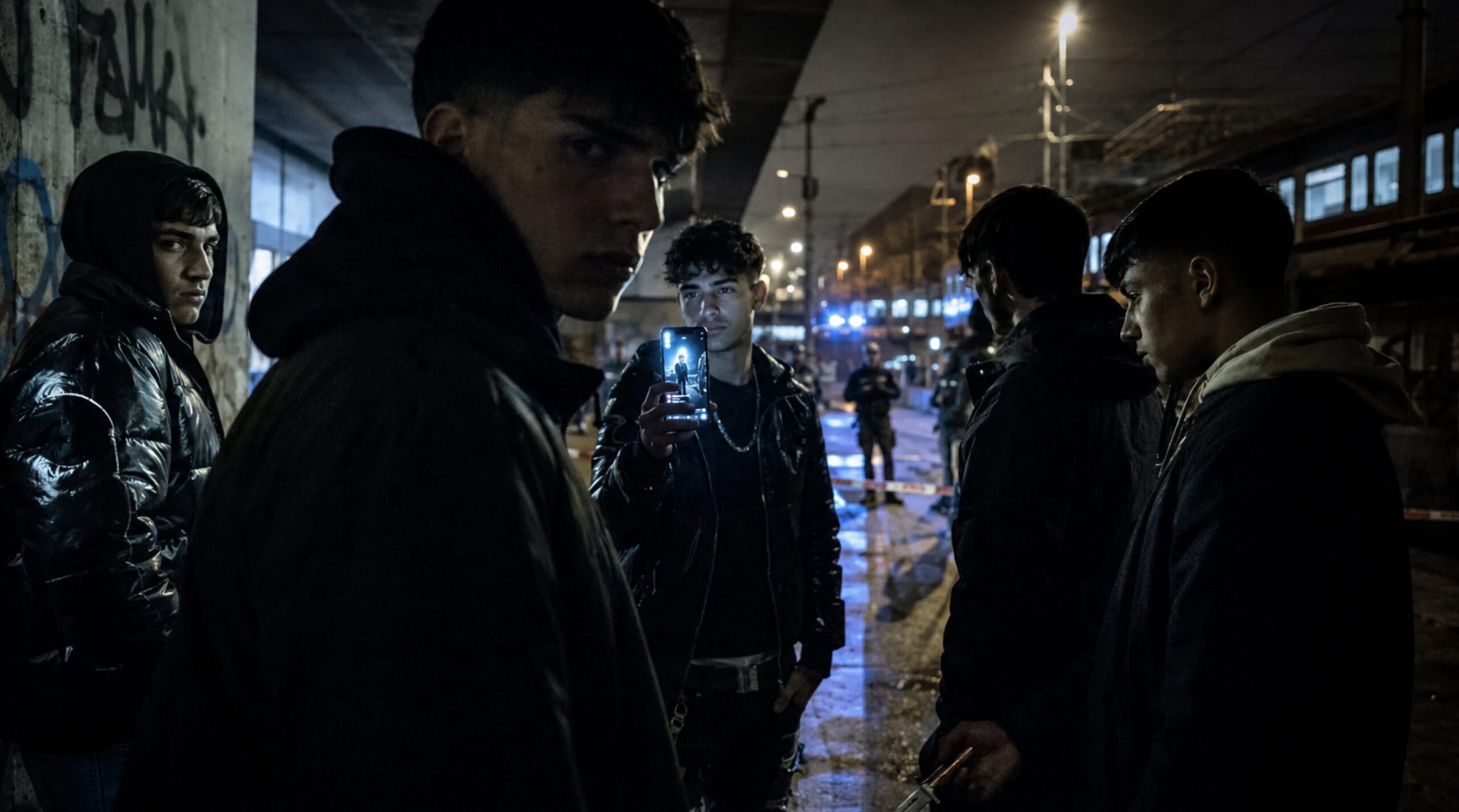
“Look, give me a shout when you’re about to do this, because I’d like to watch the stream if possible.” When the Carabinieri of the Trapani Investigation Unit open the phone seized from a twelve-year-old from San Vito Lo Capo, they not only find traces of a project that could have transformed a normal school morning into a tragedy. Above all, they find an audience. In that conversation there isn’t a kid fantasizing alone in front of a screen. There is someone who doesn’t try to dissuade him and who doesn’t tell him to stop. A few minutes later another question appears: “Can I participate?”. Until the countdown comes. «When do you plan to do it?». The answer: “Five minutes from now.” With a motorcycle helmet full of references to perpetrators of massacres in American schools and two knives. And the suspicion that someone had to watch the action live.
Everything takes place in a Telegram group made up, until a few minutes after the plan’s failure, of six people. Then something happens that intrigues the investigators. The 12-year-old’s account is removed. Someone deletes it. Someone, evidently, is concerned about the tracks. In the reports the police note that the content of the chat is no longer visible. And at that point the investigation changes perimeter. It no longer concerns only the Sicilian boy. It’s about those around him. Among the users, in fact, appears “Euno”, a nickname that has already emerged in another investigation opened over a thousand kilometers away: in Trescore Balneario, in the province of Bergamo, where on March 25th a thirteen-year-old stabbed his French teacher, coincidentally, after having launched a direct Telegram message. A detail that continually returns in the stories of new juvenile crime.
The kids are no longer isolated. They have an audience. They have someone watching and sometimes someone encouraging. Even in Taranto, after all, the story continues well beyond the crime. On May 9, Bakari Sako, a thirty-five-year-old Malian, is crossing the old city pushing his bicycle. On his way he meets a group of young people. After the chase, the attack starts and, finally, the three stab wounds delivered by a 15-year-old boy. Six people end up in the file. Four are minors. Then a video appears on TikTok. It precedes the ambush only by a few moments. Two of the boys who ended up in the shooting are involved in the investigation. But what is striking is not so much the images as the phrase that accompanies the film: “What doesn’t kill you, strengthens you.”
For years, youth violence has tried to hide. Or at least not to leave any traces. Today, however, it seems to want to do the exact opposite. It is very visible. Seek recognition. And public. It is a transformation that also affects the investigators. Because as the need to show oneself increases, it becomes increasingly difficult to understand the reason for certain gestures. The crime scene appears increasingly visible, the motive, on the contrary, particularly opaque.
In Pavia, for example, the murder of Gabriele Vaccaro is striking not only for the young age of the accused, a sixteen-year-old, but for the absence of a real motive. According to the reconstruction of the Flying Squad, everything started from an argument over a slice of pizza. For the Prosecutor’s Office, it translated into “trivial reasons”. The boy would have taken out a screwdriver or an awl and hit the twenty-five-year-old originally from the Agrigento area who had moved to Lombardy to work. The “trivial reasons” also return to Casoria, where a sixteen-year-old was stabbed while trying to break up a fight between young people. They return to Afragola, in the investigation into the murder of fourteen-year-old Martina Carbonaro, for which her ex-boyfriend Alessio Tucci was recently sent to trial.
They are continually repeated in the news featuring armed teenagers. It almost seems that violence has progressively lowered its entry threshold. All it takes is an argument, an insult, a provocation or a refusal. The disproportion between the triggering reason and the violent response appears striking.
Like in Massa, where in Piazza Felice Palma, a few steps from the Town Hall, Giacomo Bongiorni, 47, died after an attack that arose, according to the investigative reconstruction, from an argument between groups of young people. The cameras would have recorded an initial physical contact, then the punch that would have made him fall to the ground and a subsequent phase of the attack, with further blows inflicted while the victim was already on the ground. Even in this case the difference between the presumed triggering reason and the final consequences appears striking. Two suspects are adults. But there were also three minors. And, among them, also a seventeen-year-old described in the documents as a promising player in Tuscan boxing.
In Casal del Marmo, among the buildings in via Villastellone 32, the latest argument reportedly broke out over rubbish. But behind it there was a conflict which, according to those who live in the area, had been going on for some time. On the one hand Luca Di Vito, a 54-year-old Roman with a history of drugs and other crimes, on the other a just eighteen-year-old Colombian with a clean criminal record armed with a knife. A slash to the throat. Mortal. In Palermo, a sixteen-year-old kills a 69-year-old retired nurse and then turns himself in, claiming that he had been sexually assaulted.
This story also enters the statistics. But read alongside Trapani, Taranto and Pavia it tells us something else above all: the age of the protagonists continues to decrease. On the evening of May 27, Gianluca Ibarra Silvera arrives at the Certosa station in Milan together with his brother and cousin. He is 22 years old. According to the investigative reconstruction, he is surrounded by a group of around ten young people (most likely among them minors). Bottles fly. Knives appear. The shots start. One of the blows severs the femoral artery. Gianluca will die shortly afterwards. The attackers escape by boarding a train. The brother tells investigators he doesn’t know any of them. Even Gianluca, he says, had never seen them. Yet the victim’s father is convinced that he recognized one of the attackers: “I recognized one of them from the tattoos, he is the head of MS13.” One of the historic Latino gangs. And finally he adds: “This is their territory.”
When he pronounces that sentence it almost seems like he takes Milan back 20 years, to the times of the Latin American pandillas that competed for railway stations, public gardens and suburban neighborhoods. The investigators do not yet know whether there was really a structured gang behind that attack. But that word, territory, continues to appear often when we try to reconstruct the geography of youth violence. Train stations become meeting points. The underpasses are transformed into borders to be crossed or defended. Some urban spaces end up taking on a symbolic value that goes far beyond their real function.
The Attorney General of Naples, Aldo Policastro, has seen these kids arriving in the files for years. When he speaks at the inauguration of the Judicial Year he does not use prudent formulas. Before him there are eight cases for murder, 40 for Camorra association, 468 for weapons crimes and even four for terrorism. Because alongside the minors involved in the most classic crimes, teenagers intercepted for ideological radicalization are beginning to appear. It is a phenomenon that is still numerically limited, but which investigators are observing with growing attention. Then he pronounces a sentence that seems to be a warning: “The injuries and murders among very young people have never been so frequent nor have the perpetrators and victims so young.” Naples continues to be the laboratory of organized juvenile crime. The lookouts, the couriers, the boys recruited by the clans. Young people who often become involved in criminal violence while still teenagers. Also for the armed incursions into rival neighbourhoods, which represent the most evident manifestations of Camorra-inspired youth violence. “And when a fifteen-year-old becomes involved in criminal activity, the whole society fails,” observed Policastro.
In Catanzaro the attorney general, Giuseppe Lucantonio, observes a different phenomenon and in some respects even more difficult to break. He speaks of an “increase in the involvement of minors in the criminal activities” of the ‘Ndrangheta. And it signals the growth of civil proceedings opened to protect the children of mafia clans. They are not kids who enter crime, but who are born into it. It is the hereditary side of the phenomenon. What is transmitted within families and which makes it more difficult to distinguish individual destiny from the context in which one grows up.
Then there are the others. Those who don’t have an organization behind them. And which arrive at the prosecutor’s files following completely different paths. According to the (Dis)Armati report by Save the Children, in 2014 there were 690 minors reported or arrested for illegal possession of weapons. Ten years later there are almost 2 thousand. Murders and attempted murders went from 102 to 193. Robberies from 1,921 to 3,968. The fights from 433 to 1,021.
The phenomenon does not grow in the same way everywhere. Some cities seem to function as anticipatory laboratories of new youth violence. The data show that the illegal carrying of weapons among minors has increased in almost all Italian metropolitan areas, but with particularly significant accelerations in Milan and Rome.
The numbers show a growth in violence. Which develops differently in metropolises. Forensic psychiatrists try to explain this transformation. According to the Italian Society of Forensic Psychiatry and Psychopathology, murders committed by minors would have increased from 14 to 35 in a year (+150%). Today they would represent around 12% of the total murders. Specialists talk about discomfort, relational fragility, absence of adult figures, group dynamics, synthetic drugs and poly-drug use. They describe a violence that increasingly escapes traditional categories. A violence that does not necessarily arise within a criminal organization and which, for this very reason, becomes more difficult to predict. Juvenile penal institutions are also experiencing the change. Attendance increased by over 30%. Entries linked to precautionary measures are growing. The children who enter the penal circuit and leave school are growing up. “My main targets are three naive Muslims in my class, another Muslim immigrant in another class and a black girl, but I don’t know which class she goes to”, the boy from San Vito Lo Capo anticipated in chat after also mentioning two supremacists responsible for massacres carried out “to defend the white race” and recalling the ideological delusions that had accompanied those actions. Then, however, he didn’t hit his classmates, but the professor who stopped him in time.
But after a long reasoning that the twelve-year-old had already shared on the criminal consequences of his plan: “Theoretically I would like to be held criminally responsible, but in Italy minors under 14 cannot be detained in a criminal court.” From the other end comes a blunt answer: “Fair enough.” Then the boy continues, almost as if observing himself from the outside: “According to Italian law, the brain of a child under 14 has literally not developed enough to understand his own actions.” His cynical awareness must have also impressed the investigators. There are those who are already thinking about the age threshold for the criminal liability of a minor.
In Sweden, a country overwhelmed by the recruitment of minors by criminal gangs, the government has proposed lowering the age of criminal responsibility from 15 to 13 for the most serious crimes, including murders and attacks, with a parliamentary vote expected in June. A contested but revealing choice: when kids become criminal laborers or plan violence – already knowing where the Criminal Code ends – we should ask ourselves whether the old thresholds are still relevant. “Will you kill yourself later?” they ask the twelve-year-old from San Vito Lo Capo again in chat. “No”, he replies, adding that it would be a gesture “against the Christian religion”. Then, however, he adds one last sentence: “I’ll probably just be sent to a mental institution for some time.” Proof that fear of consequences now no longer represents a real deterrent.