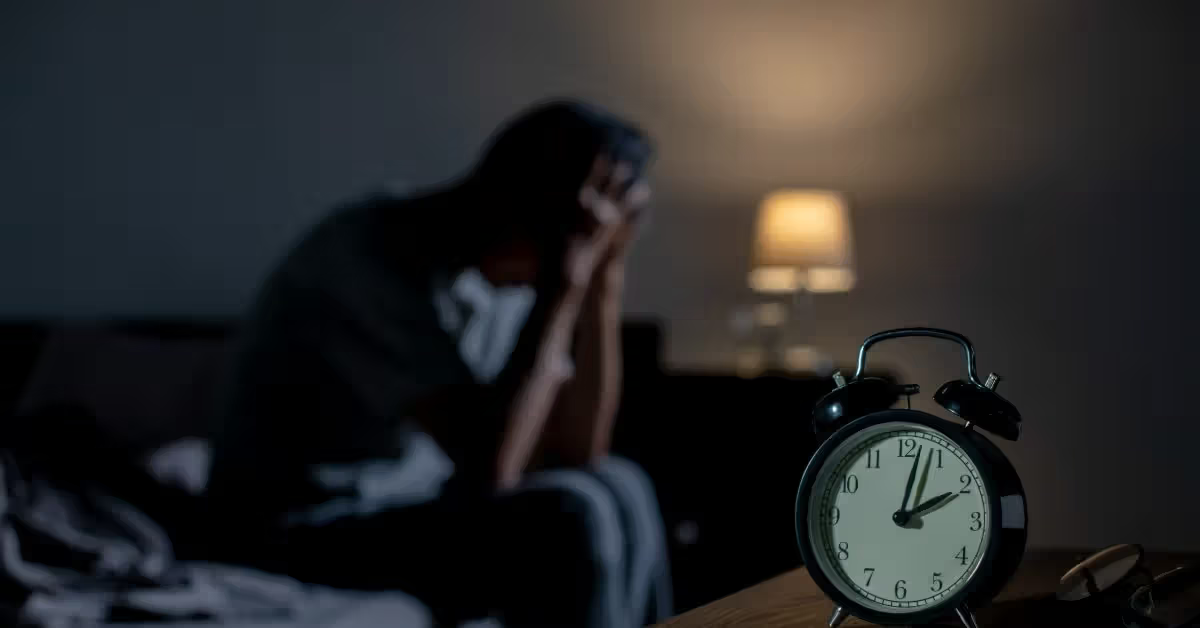
I’ve struggled half my life to make it to the next morning, and now I’ve reached the point where it’s become unbearable. I’m exhausted.” Siska De Ruysschera twenty-six year old Belgian who had suffered from depression for years, died on November 2nd. Belgium granted it euthanasiaafter years of attempts at insufficient and ineffective treatments. It was the young woman herself who explained it: «I think that many things need to change in the healthcare system. I am the product of a failing system.” Lapidary words. Siska had been raped at the age of 14 and had suffered from it ever since chronic depression and traumatic stress disorder. She had attempted suicide several times and had been sent to recovery programs: «Procedures. Waiting lists. Refunds… I was locked in isolation cells, they sedated me, they tied me onto stretchers, I saw the nurses roll their eyes, as if to say “here she is again”. I can count on the fingers of one hand the competent healthcare workers I have met.” Then, the official request to die. Accepted and registered, such as a change of residence or a transfer of ownership: Siska she was killed in a hospital in Antwerp. A chilling picture, reminiscent of another similar case that occurred last year in the Netherlands.
The case of Zoraya ter Beek
Zoraya ter Beek was 29 years old when health authorities in the Netherlands gave the green light for her death in May 2024. The girl suffered from depression, autism and borderline personality disorder. The story, with its dystopian contours, had taken on an even more disturbing drift after the woman’s words, released a few months before her death, in which she explained that the passing away would take place in the living room of the house, together with her boyfriend and their cats: «No music, I will be on the sofa in the living room. The doctor will ask me if I’m ready twice and start the procedure.” The story of Zoraya had sparked global controversy. Yet, his is not an isolated case.
Euthanasia numbers in the Netherlands
Just look at the official data from Holland. According to the 2024 report of the Regional Commissions for the Evaluation and Control of Euthanasia (RTES), requests for death at the hands of the State are in constant growth. Last year, total occurrences in the Netherlands were 9,958, 10 percent more than in 2023, rising from 5.4 to 5.8 percent of the number of overall deaths. “At present, there is no reason to assume that the gradual increase seen in recent years will stop any time soon,” the document reads. Of the 9,753 patients who died, the majority had cancer (5,346). This is followed by neurological disorders (681), cardiovascular diseases (429), pulmonary disorders (346), and finally a combination of somatic conditions (1,791). As many as 427 cases of euthanasia involved people suffering from dementia. Also from the report: «Six cases examined in 2024 involved patients in an advanced stage of dementia who were no longer capable of deciding on the request for euthanasia and could not communicate. In these cases, their advance directives replaced an oral request for euthanasia.”
The crux of psychiatric disorders
And now we come to the most controversial point: «219 notifications of euthanasia concerned patients whose suffering was (largely) caused by one or more psychiatric disorders. Eleven people were aged between 30 and 60 and 78 were over 60. As many as 30 deaths involved people between 18 and 30 years old. Two cases involved minors aged between 12 and 18.” In Holland, in fact, as well as in Belgium, also i minors they can ask the State to die and be satisfied.
Geriatrics and “other conditions”
However, 397 cases of euthanasia were placed in the “Multiple geriatric syndromes” category, i.e.: “Visual deficit, hearing impairment, osteoporosis and its effects, osteoarthritis, balance problems or cognitive decline”. But it is the last section, aseptically called “Other conditions” that indicates, even to the least skeptical on the topic of the end of life, the slope that the culture of self-determination without limits: in 2024, 232 cases of euthanasia involved patients with “chronic pain syndrome, rare genetic diseases, renal failure, blindness, serious fractures or long Covid”.
Belgium: numbers on the rise
Moving on to Belgium, the trend is the same: in 2024, 3,991 euthanasias were carried out, an increase of 16.6 percent compared to 2023. Euthanasia accounted for 3.6 percent of total deaths. 1.4 percent of the deaths involved those under 40. One case, however, involved a minor patient. Deaths due to psychiatric pathologies and cognitive disorders were 2.8 percent of the total: beyond the cold percentages, over a hundred people. Sifting through the Belgian report, two deaths requested (and obtained) also appear “Skin diseases” And “Abnormal clinical and laboratory symptoms and findings”.
The precedent of Tine Nys
In addition to the Zoraya case, the country was the scene of another disturbing episode: in 2009 Tine Nys37 years old, with a history of mental disorders, was traumatized by the end of a relationship and began looking for a doctor willing to administer the lethal drug. In February 2010 she was diagnosed with autism and two months later she was put down. His family took the doctors who followed his case to court, to no avail.
The Spanish case
Moving south, for months the case of a twenty-three-year-old Catalan woman who, after an attempted suicide, remained paraplegic and decided to resort to euthanasia, legalized by Madrid in 2021, was held in Spain. Her case was deemed suitable and, despite the appeal of her father, who for having tried to avoid killing his daughter was branded by some media as a “ultra Catholic”the girl was killed, with the approval of the Barcelona Regional Administrative Court.
Switzerland and suicide tourism
Deaths caused in Switzerland, land of “suicide tourism” par excellence. The Swiss Republic, as is known, also offers the “service” to foreigners. To obtain euthanasia all you need are medical certifications, a letter of motivation and an amount around 10 thousand euroseven for patients suffering from depression, (not all private associations, however, accept patients suffering from psychiatric disorders). In September 2024, the capsule was inaugurated in a forest in the canton of Schaffhausen Sarcoalso called the “Tesla of euthanasia”. A 64-year-old American took her own life inside the nitrogen-releasing coffin, designed by Florian Willet, founder of The Last Resort. Willet was arrested and served 10 weeks in prison, as Sarco did not comply with Swiss laws. Last May 5, he also took his own life.
The debate in France and Italy
Meanwhile, Italy and France are struggling to legislate on the end of life. Beyond the Alps, the Senate is discussing two bills, the first on palliative care and the second on state death. To receive the lethal drug, the patient must be of age, capable of making free and informed decisions and have a serious, incurable disease at an advanced or terminal stage. However, a government amendment had broadened the concept of “advanced phase”, opening the doors to anyone experiencing one constant and unbearable physical or psychological suffering. During the proceedings in the Chamber, the honorable members added that “psychological suffering alone cannot under any circumstances allow one to benefit from aid in dying”.
The Italian case and the intervention of Diego Dalla Palma
In Italy, the position of the Luca Coscioni Association, which has been fighting for years for a law on the end of life, does not include the possibility of access to suicide for psychiatric patients. However, the frequent cases in Northern Europe and the strengthening of a “throwaway culture” which leads the sick themselves to consider themselves a burden on society open up worrying scenarios. In recent days, the declarations of Diego Dalla Palmaan internationally renowned make-up artist, who told Corriere della Sera that he has a planned death on his agenda which he has already organized with a lawyer and notary. The story, intimate, human, but with features so lucid as to appear disconcerting, arrives on the eve of his 75th birthday. «I’m starting to feel that getting up from the chair, at the cinema or at the theatre, becomes a small humiliation: I’m wobbly. I have to change my underwear twice a day. The mind is no longer what it was before. Is it life?”, asks the make-up artist, who doesn’t want to blow out 80 candles. «I will be alone, in a place of my heart, abroad. The last month is all decided.”