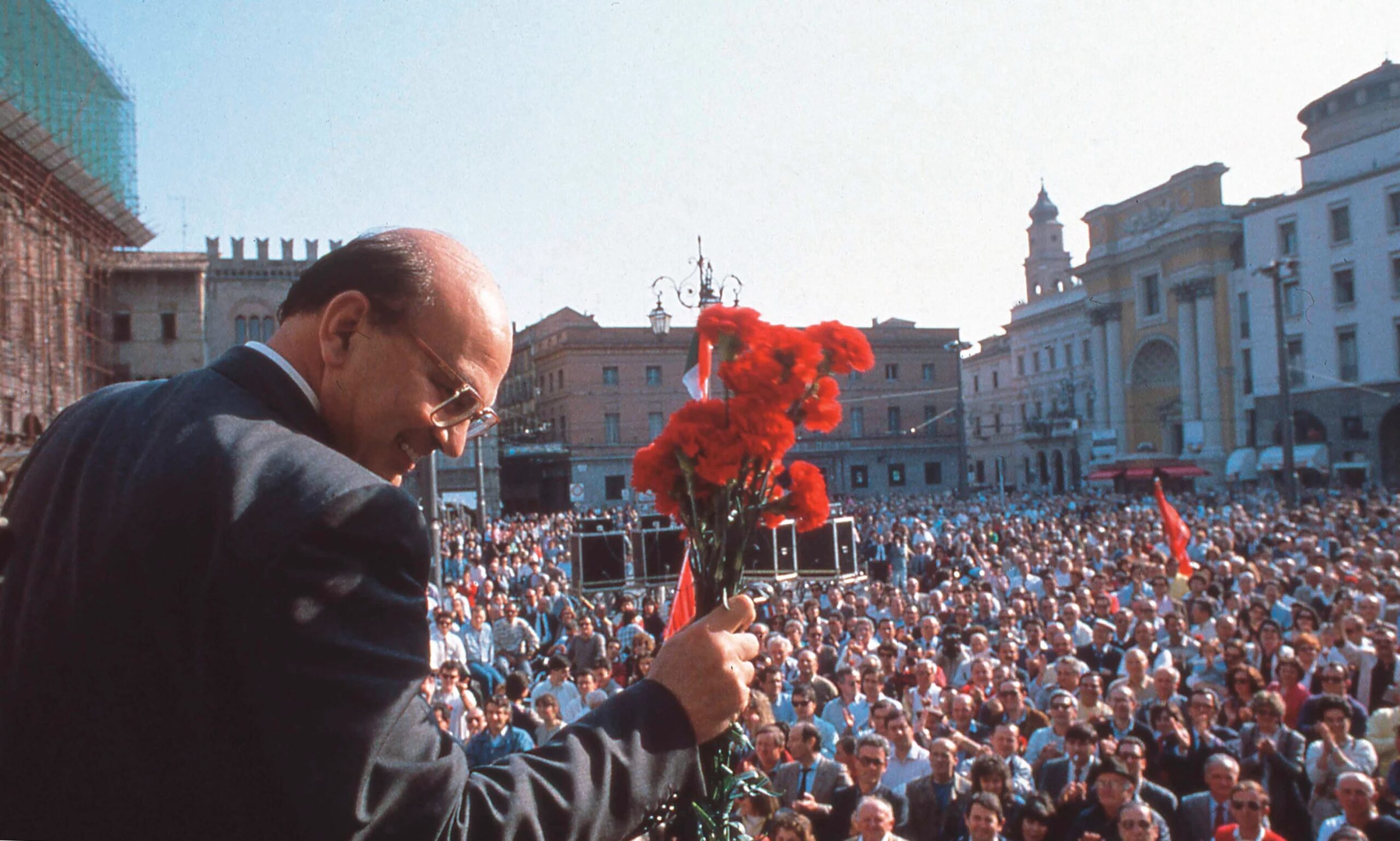
It immediately became clear that Bettino Craxi, just elected at the top of the PSI, would not be a “temporary” secretary. After his investiture (16 July 1976) he was keen to clarify that “we were not born yesterday and we do not intend to die tomorrow”. He was obviously looking at the weight of the political tradition he had to represent but it became clear that the quote also referred to the role they had entrusted to him. Of course, the PSI needed a ferryman capable of immediately pulling it out of that mess of contradictions into which it had gotten itself. Until that moment, the socialist leaders had aimed for an organic alliance with Enrico Berlinguer’s communists and, imagining they would benefit from it at the polls, caused the fall of the Moro government. The polls, which had predicted a good electoral success, were not confirmed. In the sense that the PCI recorded significant growth but the hypothetical socialist ally left half of the consensus on the street.
Francesco De Martino, who had led the party, was forced to resign but the choice of his successor did not seem like a small matter.
The currents that animated the team appeared trapped by their own prejudices. At the Midas hotel in Rome, they struggled to find a mediation name that, if not exactly liked by everyone, was acceptable to most of them. The stalemate that was being created was resolved when the men who were referring to Giacomo Mancini raised their voices. They proposed Craxi and demanded that the disagreements in principle be set aside. The immediately following reports recorded that climate of ultimatum and reported the “revolt of the forty-year-olds”. Someone – more venomous – ventured the hypothesis of a “Midas conspiracy”. The indication was accepted by Claudio Signorile who headed the “left” current and did not displease Enrico Manca who represented the young people. Of course: consensus, rather than explicit adhesion, should be understood as non-contrariance.
Only Riccardo Lombardi expressed himself negatively. He did not like “Nenni’s protégé” even though, in order not to give credence to the image of a divided party, he limited himself to abstention. Therefore that tall, robust, bald man, greedy regardless of the diabetes that tormented him, found himself on the command deck. Despite the precarious role that had been attributed to him, he accepted the position with the intention of being a real secretary. And he did it by wearing boxing gloves to attack the ideology that had been the cause of the debacle and replace it with another of the opposite nature.
Similarly and, almost in photocopy, he did when the impasse concerned the government in 1983. Political fragilities and economic uncertainties tied the hands of the Prime Minister of the DC, Amintore Fanfani, who found himself cornered, surrounded by mistrust, without a viable way out. The early elections (26 and 27 June) decreed one loser and no real winner. The Christian Democrats – electorally – ended up paying for everything by losing 18 senators and 37 deputies. The socialists gained 6 senators and 11 deputies with a result that was below expectations, but Craxi was able to transform disappointment into success.
On paper, the government of the “historic compromise” with communists and Christian Democrats allied would have been possible. But the hard core of the DC didn’t even want to take into consideration the hypothesis whereby, after a few skirmishes and a couple of “exploratory” assignments, he emerged: prime minister of a five-party party which, with Christian Democrats and Socialists, brought together Republicans, Liberals and Social Democrats.
Innovative and against the grain, he presented the program limiting himself to the general lines. However, he distributed an attachment of around twenty typed pages which, with greater punctuality, illustrated the most significant topics. Which is to say that there was no time for huge discussions. Anyone who wanted to learn more could do so on their own.
It was for this reason – with the intention of criticizing him – that they defined him as a “decisionist”, because he rejected the political mediations to which we were accustomed to go to the concrete and also get there in a casual way. He considered himself the heir of the Risorgimento and didn’t mind imitating Garibaldi who attacked with the bayonet, without wasting time counting how many were with him and how many were against.
The Palace never liked the brisk attitudes, bordering on contempt, where they suffered it rather than accepting it.
The various leaders were annoyed because it seemed that he had become the master of the power that had been handed over to him. Forattini began to draw his caricature by putting Mussolini’s big boots on him. He didn’t give a thought and accepted the challenge, so to speak. To sign some “notes” in the socialist newspaper Avanti! he chose the pseudonym of Ghino di Tacco, a lord from Radicofani capable of extorting travellers. Hiding behind the image of a brigand represented the certification of the fact that the judgments of the apparatus were indifferent to him.
Furthermore, that “Garibaldi style” appealed to people who asked for practicality and not chatter. To a large extent, it was the middle class who, in exchange for results, was willing to overlook a number of defects that were neither few nor trivial (including a non-negligible percentage of arrogance). He appeared resolute, determined, quick with reflexes. He gave the impression of wanting to govern seriously and, to achieve objectives, it was necessary to get down to business, including a note of bravado. Bullies are better than the powerless.
He knew what he wanted and didn’t need to beat around the bush to say it. He did not tolerate objections and demonstrated this with an oratory that was filled with quotations, even refined ones, but which was characterized by long pauses. Leaving the thought suspended – sociologists assure – is typical of the man who is sure that no one will take advantage of those gaps to interrupt him by “taking his time”. On the contrary: it is the space left to gather nods of consensus.
It is undeniable that his authority bordered on authoritarianism, but only the most resolute opponents did not recognize that, together with arrogance, he displayed the courage of the lion.
Putting his face to it, he fought for the No vote in the referendum (9 and 10 June 1985) which maintained the cut in the escalator (introduced by his government against inflation), freezing the automatic adjustment of salaries according to values measured in “contingency points”. Unions and communists launched themselves into the referendum campaign with the aim of restoring the status quo ante and putting Craxi on the ropes. Who, accepting the climate of assault on Fort Alamo, won. And, considering the context, he won by a landslide.
Even more decisive it was a few months later (7-12 October 1985) during the crisis provoked by Abu Abbas’ Palestinian terrorists who attacked the Achille Lauro ship, threatening a massacre (they killed Leon Klinghoffer, a paralytic American citizen of the Jewish faith). Convinced to surrender with the promise of freedom, once on the plane headed towards friendly countries, US President Ronald Reagan intervened to forcefully land them at the American base in Sigonella and take them into custody. That it was difficult to oppose the USA is evident even today and standing up to a tough guy like Reagan might have seemed unrealistic. But Craxi prevailed.
He belonged to that category of people capable of riding out events as long as they are the ones who trigger them and set them in motion. But his DNA did not have the shrewdness of someone who knows how to float if it is necessary to accept facts or if it is necessary to be towed.
When the Tangentopoli scandal exploded he was the privileged target of those who accused him. The charges were not of little importance even if – frankly – they erred in summaryness when they claimed to blame him “because he couldn’t not have known”. He, as long as he was able, accepted the challenge. Against the buckets of mud, other than running away, he displayed neither contrition nor resignation. Rather: he responded with threats or sarcasm. And from the benches of the Chamber (30 April 1993) he defended himself by reversing the accusations: who could proclaim themselves to be extraneous to that system? That same evening he was showered with coins as he left the Raphael hotel in Rome. It was at that point that he decided to take the road to Tunisia, considering himself in a sort of exile. Like the red-shirted heroes he liked. He never moved from Hammamet again and is buried in Hammamet.