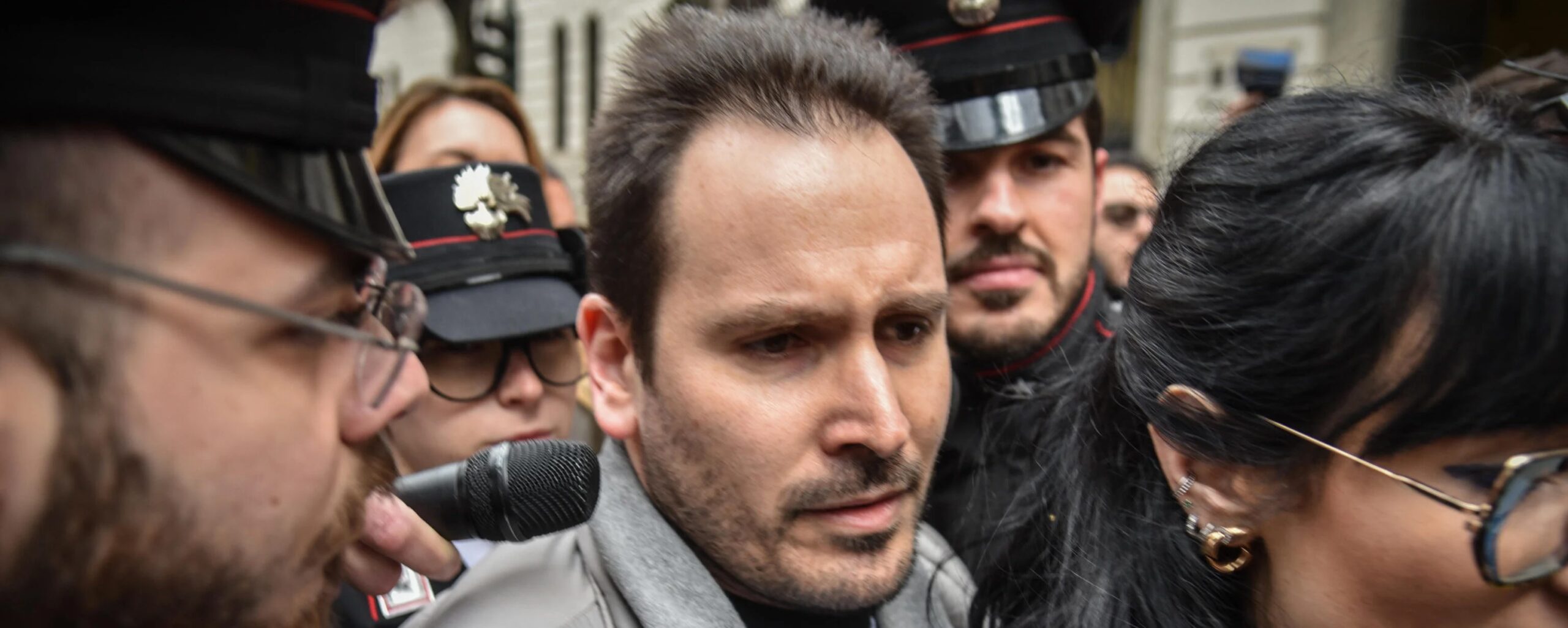
The Garlasco case enters its decisive month once again passing through the laboratory, because before deciding whether to ask for Andrea Sempio’s indictment, the Pavia Prosecutor’s Office has arranged for two new supplementary consultations on the most delicate and contested points of the entire accusatory reconstruction: the DNA found under Chiara Poggi’s nails and the compatibility between the suspect’s foot and the imprint left in the house on Via Pascoli by a shoe with a dot sole.
This is not a formal reopening of the investigations, nor the sudden discovery of a new finding, but a supplementary check ordered after the consultations filed by Sempio’s defence, which attempted to dismantle the very scientific elements on which the Prosecutor’s Office built an important part of its hypothesis. The investigations must be completed before September 28, the deadline indicated for the preliminary investigations, and will accompany the psychiatric report already entrusted to Professor Roberto Catanesi. HANDLE
The DNA under Chiara Poggi’s nails
The first assignment was entrusted to the geneticist Carlo Previderè and concerns the genetic material recovered under Chiara Poggi’s nails, a trace that has become central in the new investigation but still surrounded by technical issues that could determine its value before a judge.
The analyzes of the geneticist Denise Albani had highlighted a compatibility between the male genetic profile that emerged from the finds and the paternal line of the Sempio family, with twelve legible markers out of sixteen, but the sample was described as partial, mixed and degraded, conditions that require particular caution in the attribution and above all in the reconstruction of the moment and the ways in which that material would have ended up under the victim’s nails.
Genetic compatibility, in fact, does not automatically equate to individual identification and does not in itself allow us to establish whether the DNA was deposited during the attack, in a previous contact or through a secondary transfer. Sempio’s defense, which has always rejected any involvement of the suspect in the murder, maintains that the evidence cannot demonstrate violent contact with Chiara and recalls the possible contamination, the manipulation of the finds and the frequenting of the house by Marco Poggi’s then friend.
For the Prosecutor’s Office, however, the genetic data must be read together with the other elements collected during the new investigation and not as isolated evidence. The task entrusted to Previderè will therefore be to examine the objections presented by the defence, verifying their scientific foundation and clarifying how solid the relationship between that genetic profile and Andrea Sempio could be in a possible trial. HANDLE
Sempio’s dot shoe and foot size
The second study was entrusted to the anthropologist and medical examiner Cristina Cattaneo and concerns one of the most discussed traces of the crime scene: the footprint number 6, left on the floor of the house by a shoe with a dot sole, traced during the previous trials to a size 42 Frau shoe.
The anthropometric measurements carried out on Sempio were considered compatible, according to the prosecution’s reconstruction, with a size 42 or 43 shoe, but the defense contested this conclusion by arguing that the problem does not only concern the length of the foot, but above all its width. Sempio would always have declared that he wore the number 44 and, according to his consultants, the shape of his foot would not have allowed him to wear the model associated with the footprint found in Chiara’s house.
It is on this conflict between measurements, margins of error and characteristics of the footwear that the new integration will have to focus. The issue is not secondary, because establishing compatibility does not necessarily mean attributing the fingerprint to Sempio, but a possible physical incompatibility could weaken one of the connections that the Prosecutor considers relevant in the reconstruction of the morning of 13 August 2007.
The consultancy will therefore have to answer a precise question: could Andrea Sempio’s foot have entered the shoe that left that mark or do the dimensions and anatomical conformation make this possibility scientifically untenable? It is a seemingly simple question, but an important part of the confrontation between prosecution and defense will depend on the answer.
The third front: psychiatric consultancy
In addition to the DNA and fingerprint checks, the consultancy entrusted to Professor Roberto Catanesi is added, called to examine, on the basis of the available documentation, the possible presence of pathological conditions capable of affecting Sempio’s capacity to understand and will at the time of the crime, in addition to the possible existence of disorders relevant for the purposes of imputability and social dangerousness.
The prosecutor’s decision had provoked a reaction from the defense, which had interpreted it as an attempt to build the profile of a possible culprit without having yet consolidated the material evidence. The Pavia magistrates, on the contrary, had explained that the investigations were aimed at obtaining a complete, objective and scientifically founded reconstruction, also in light of the numerous consultancies filed by the suspect’s lawyers.
The psychiatric report, in any case, will not be able to demonstrate that Sempio committed the murder, because a psychological profile or a personality assessment do not replace proof of the fact. However, it could affect the assessment of imputability if the accusatory reconstruction passes the procedural scrutiny and the existence of pathological conditions attributable to the time of the crime is recognised.
Because the consultations arrive after the investigations are closed
The notice of conclusion of the investigations had been served to Sempio and his lawyers on 7 May, but the terms of the preliminary investigations were still pending and the Prosecutor’s Office therefore had the possibility of ordering further investigations. What pushed the magistrates towards new checks were the technical reports and the defense brief filed in the following weeks, through which Sempio’s consultants contested the DNA, the shoe print, the palm print number 33 and the meaning attributed by the prosecution to some monologues intercepted in the suspect’s car.
The Prosecutor’s Office thus chose not to ignore the objections, but to submit them to its experts to evaluate their rigor and scientific reliability. It is a passage that can be read in two opposite ways: according to the defense it demonstrates that the accusatory framework is not yet sufficiently solid, while for the investigators it represents the need to verify every dispute before bringing the file before a judge.
September 28th and the decision on the trial
The new reports should be filed by the end of September and, once this phase is concluded, the Prosecutor’s Office will have to make its decisions. The most probable outcome, based on the accusatory approach made known so far, remains the request for Andrea Sempio to be sent to trial, but the decision on the possible trial will be up to the judge, who will have to evaluate the overall validity of the documents and consultations.
Sempio continues to declare himself innocent and, until a possible final sentence, must be considered as such. Alberto Stasi, in the meantime, remains the only one definitively convicted for the murder of Chiara Poggi and the sentence against him remains fully valid, although the new reconstruction of the Pavia Prosecutor’s Office, which attributes the crime to Sempio alone, has paved the way for the preparation of a request for review.
Garlasco’s new chapter therefore moves on two judicial tracks that cannot be confused: on the one hand the possible opening of a trial against Sempio, on the other the attempt to call into question Stasi’s conviction. Before both can move forward, however, the Prosecutor’s Office must resolve the doubts that continue to focus on the most fragile and decisive evidence in the file, because the DNA, fingerprint and profile of the suspect will not only have to fuel a new reconstruction of the crime, but must withstand cross-examination in a courtroom.