
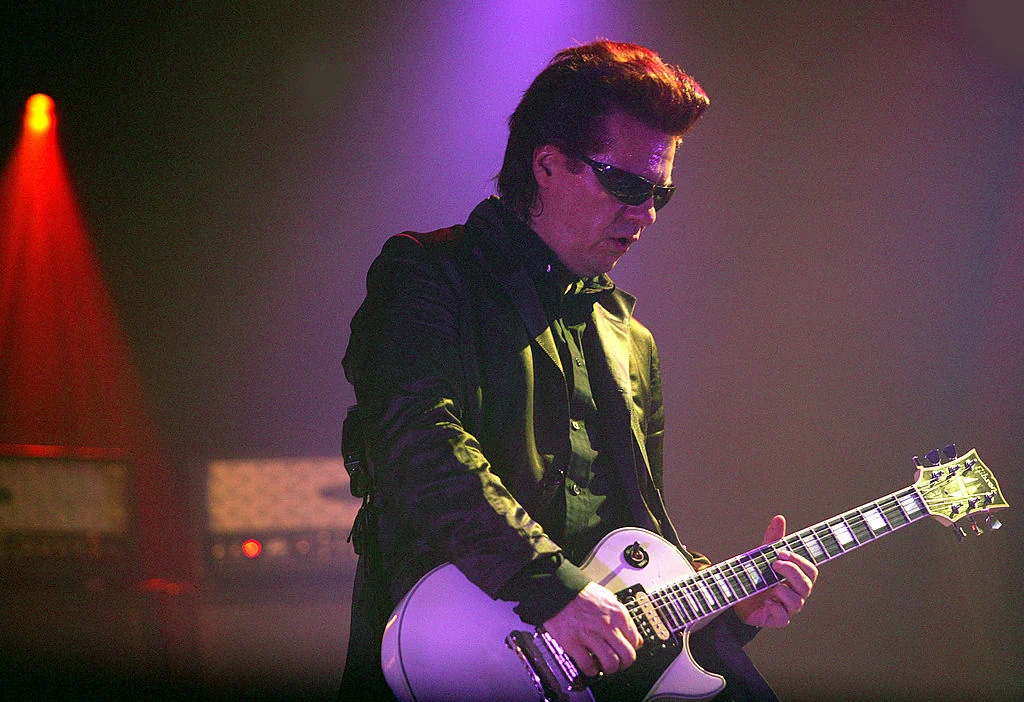
There are bands that become the symbol of an era and musicians who, even without always occupying the center of the scene, define its sound. Andy Taylor belonged to this second, precious category. With his guitar, his decisive character and a profoundly rock attitude, he contributed to giving Duran Duran that combination of elegance, energy and irreverence that would make them the absolute protagonists of the new wave season.
Andy Taylor died on November 23, 2026, at age 65, in his home, surrounded by family. The news was announced two days later by his wife Tracey and his adventure companions. He had been fighting metastatic prostate cancer for some time, a disease he spoke about publicly in 2022, when Duran Duran were welcomed into the Rock & Roll Hall of Fame.
Born in 1961 in Tynemouth, in the north-east of England, Taylor had found his path in the guitar from a very young age. His path took him to Birmingham, where in 1980 he joined Duran Duran, a group that was building an original musical identity, suspended between rock, electronic pop, glam suggestions and new romantic culture.
His presence was decisive. In a group in which synthesizers, image and melody had a central role, Andy represented the most direct link with the rock tradition. His guitar was not a simple accompaniment: it added tension, edges, dynamism. It was the element that kept Duran Duran’s pop sophistication from becoming too smooth.
With him in training came the years of international consecration. Albums like Rio and Seven and the Ragged Tiger marked an unrepeatable season, accompanied by songs that permanently entered the collective memory: Hungry Like the Wolf, Rio, Girls on Film, The Reflex. Songs in which Taylor’s guitar contribution dialogued with Nick Rhodes’ keyboards, John Taylor’s bass, Roger Taylor’s drums and the unmistakable voice of Simon Le Bon.
These were the years of MTV, of video clips that became an integral part of the musical language, of images that traveled together with the songs. Duran Duran interpreted that moment with a rare ability, becoming one of the most representative bands of international pop culture. Andy Taylor was one of its sonic architects, bringing an energy to the stage and studio that contrasted happily with the group’s sophisticated aesthetic.
But his story was not just that of collective success. In 1985 he participated in the Power Station project, together with John Taylor and singer Robert Palmer, an experience that allowed him to explore more muscular and direct rock. The following year he left Duran Duran, choosing to follow a personal path. In 1987 he released Thunder, his first solo album, confirming a musical vocation that had never been exhausted within the confines of the band.
The relationship with Duran Duran, however, did not end definitively. After a first reappearance in the nineties, Taylor returned to share the group’s path in the early 2000s. The reunion of the original lineup led to the album Astronaut, released in 2004. In 2006 came a new farewell, this time definitive.
It was not a linear career, nor without contrasts. But perhaps it is precisely this independence, this difficulty in accepting compromises, that tells a lot about the man and the musician. Andy Taylor was not just one of the five faces of one of the most photographed bands of the Eighties: he was a guitarist with a precise identity, capable of moving between pop, hard rock and new wave without losing his mark.
In 2022, when Duran Duran entered the Rock & Roll Hall of Fame, illness prevented him from attending the ceremony. In a letter read during the evening, he conveyed to his companions his affection and pride for the shared journey. It was a particularly intense moment, because it brought back to the center not only the success of the band, but the human bond built over the years.
His wife Tracey, in the message released after his death, remembered him above all as a husband, father and grandfather, underlining how family had always been his cornerstone. The comrades of Duran Duran instead remembered the fire, the personality and that ironic attitude not inclined to conventions that had contributed to making their sound special.
Listening to Rio or Hungry Like the Wolf again today also means rediscovering his presence. Not necessarily through a solo destined to steal the scene, but in that texture of guitars that gives body to the songs, makes them more alive, more nervous, more rock.
Andy Taylor leaves a legacy that goes beyond records and charts. He belongs to a generation of musicians who have been able to transform the contamination between genres into a new language, helping to redefine the relationship between rock, pop and image. His guitar has lived through an era, but has not remained a prisoner of those years.
Because some songs don’t get old. And within those songs, from today, there is also the memory of Andy Taylor.