The Edmund Mach Foundation experiments with a vine defense technique that uses sound to confuse insects
There is an institute in the heart of Trentino that has been studying vines, wine and everything related to them for over a century. The Edmund Mach Foundation of San Michele all’Adige, heir to the Agricultural Institute founded in 1874, has been one of the reference centers for Italian sparkling wines for decades. It was precisely this institution, in the 1980s, that developed the technical and scientific bases that transformed Trentodoc from a niche phenomenon to an internationally recognized denomination of excellence. The San Michele researchers trained a generation of winemakers aware of the potential of their territory for mountain bubbles. The name of the institution refers to Edmund Machits founder, a winemaker by vocation and a convinced advocate of sparkling winemaking techniques.
Today that same institution works on a different, but no less pressing front: how to protect vineyards from insects without resorting to agrochemicals.
The plague of Golden Flavescence
Flavescence dorée is undoubtedly one of the most dangerous plant diseases for European vines. It is a disease caused by a pathogen, transmitted by an insect vector: the leafhopper Scaphoideus titanus. This small but fearsome homopteran feeds on the sap of the vine and, during sucking, injects the pathogen into the plant. The result is a progressive drying out of the bunches, the rolling up of the leaves and, in the most serious cases, even the death of the plant. In the vineyards of Northern Italy, France and Switzerland the disease has already caused extensive damage. Fighting it means, first of all, containing the spread of the leafhopper.
The traditional method involves mandatory insecticide treatments, which are effective but have a clear environmental cost. This is where the Mach Foundation’s interest in a radically different approach arises.
How to fight this vine parasite
Insects communicate through vibrations. Before mating, the leafhopper emits vibrational signals that travel along the stem and branches of the vine: a kind of silent dialogue, invisible to the human eye but essential for the reproduction of the species. The idea of the San Michele researchers is rather simple in its logic: if the vineyard is flooded with disturbing vibrations, the insect signals are masked, mating does not occur and the population does not reproduce.
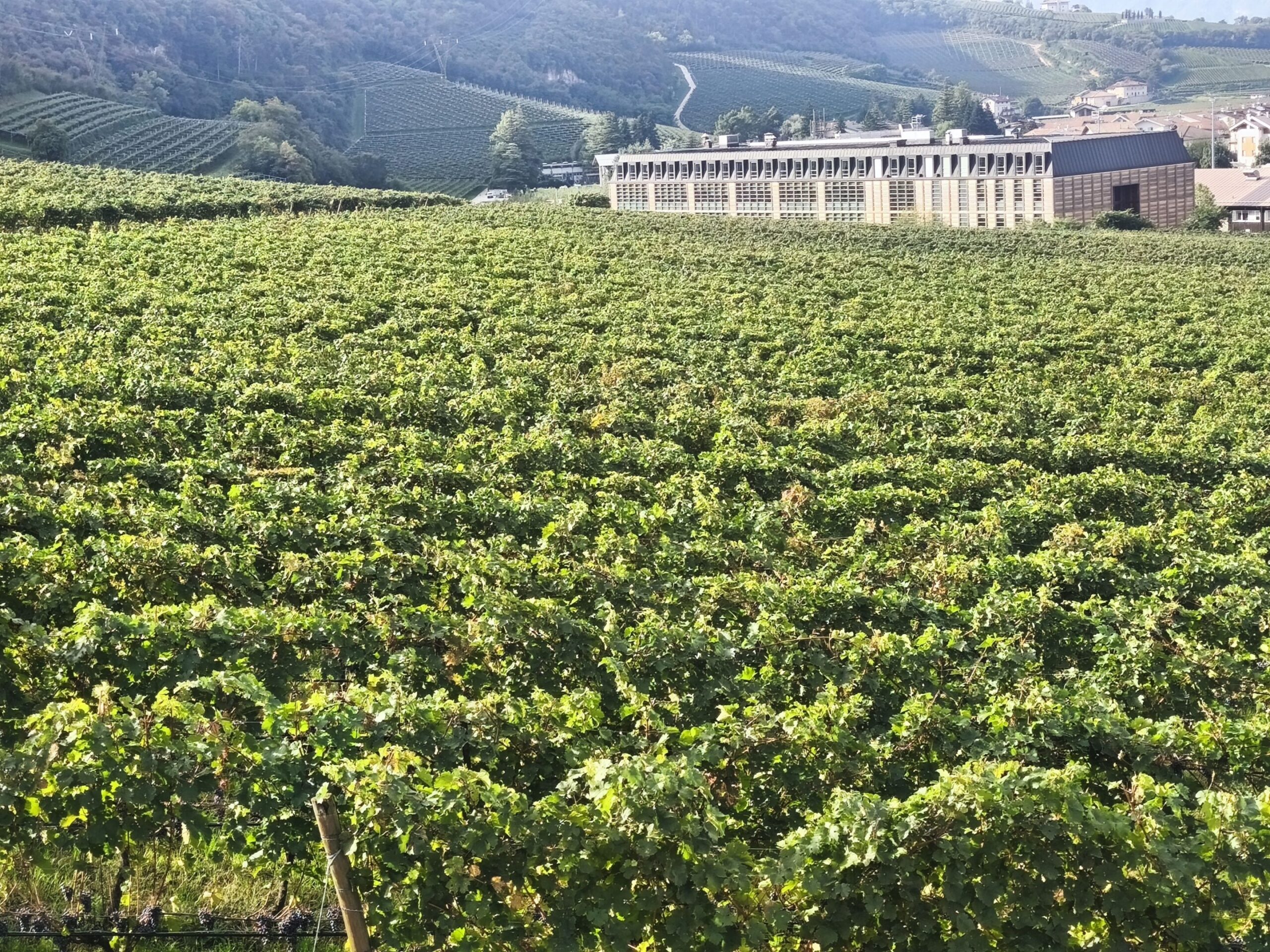
Since 2017, the Mach Foundation has been managing the world’s first vibrational vineyard, installed on the historic Weizeicher plot. In that plot of approximately one and a half hectares, emitters were placed capable of generating artificial vibrations that propagate through the plant, interfering with the communication of the buzzer. The positive results obtained over the years have encouraged the continuation of research.
A new generation of anti-parasitic technology
In the summer of 2026, the project took a significant step forward. The Weizeicher vineyard has been completely renovated with a new generation of emitters, more robust and reliable than its predecessors. At the same time, a second system was set up in an experimental vineyard in Telve, in Valsugana: here too approximately one and a half hectares of treated surface.
The new devices resolve some critical issues that emerged in previous seasons. For starters, they cope better with high summer temperatures, a determining factor in plains and valley bottom vineyards. They are also equipped with batteries that guarantee continuous operation throughout the night, when insect activity is intense. The solar power system has been enhanced to function even in conditions of reduced radiation, such as on the cloudy days typical of the mountains.
The development of research outside Trentino
The two vineyards of the Mach Foundation are part of a coordinated network that also includes plots in Piedmont, where the project is developed in collaboration with the Department of Agricultural, Forestry and Food Sciences of the University of Turin. The partners, moreover, share experimental protocols and field data, with the aim of collecting solid evidence on the effectiveness of the method on a larger geographical scale.
And the research isn’t limited to measuring reductions in mating between insects. Researchers also study how the vine responds to prolonged exposure to vibrational stimuli and what the overall impact is on the spread of disease throughout the vineyard. A multidisciplinary approach that crosses entomology, plant physiology and epidemiology, and which aims to provide a decisive turning point to make the terrible Flavescence dorée harmless.