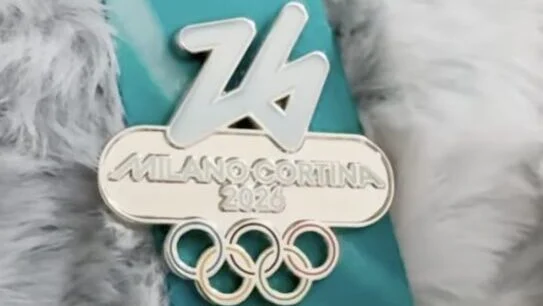
There is a detail that runs through the history of major global events with an almost touching consistency, despite remaining on the margins of the official narrative: a pin. Small, often enamelled, sometimes naive in design, other times surprisingly sophisticated. Pins don’t make noise, they don’t get on the podium, they don’t win medals. Yet, for over a century, they have held together the more human side of major international events.
Pin trading was born as a spontaneous, informal, almost instinctive gesture. A way to recognize each other, to say “I was there”, to overcome the barrier of language and nationality through a shared object. Over time, however, what was a ritual between athletes and delegations has transformed into something more complex: a real cultural languagecapable of narrating identities, territories, collective imaginaries.
Milano Cortina 2026 arrives at a historical moment in which this language has suddenly become central again. Not out of nostalgia, but because pop culture today seeks and immerses itself in traditions, making them its own and amplifying them.
In this ecosystem, social shares are not a side effect, but one natural extension of the ritual. Pin trading works because it is profoundly photogenic and, at the same time, narrative: each pin is a detail that asks to be shown, told, inserted into a larger sequence. Lanyards full of pins, improvised exchanges between strangers, “pin of the day” won at dawn, incomplete collections flaunted with pride: everything becomes contained, but without ever seeming constructed. The platforms amplify what arises offline, transforming the gesture of exchange into a shared micro-story, into a visual diary of the Games. It is not virality as an end in itself, but a form of collective memory in real time, made up of images, short videos, comments and mutual recognition. In an era in which the experience often risks exhausting itself on the screen, pin trading performs the opposite movement: it is born physical, relational, and only then becomes digital. It is this passage – from the real meeting to the online narration – that makes the Milano Cortina 2026 pins not only collector’s items, but shareable symbolscapable of living simultaneously in urban space and in the continuous flow of social media.
Milan Cortina 2026: the pin as a cultural map
Milano Cortina 2026 comes into play with an operation that goes far beyond the nostalgic recovery of an Olympic tradition. The Italian Winter Games don’t just resume pin trading: it they rewrite. They transform it into an urban device, into a cultural grammar capable of intertwining sport, identity, design and territorial narration. The brooch stops being a simple commemorative object and becomes one access key to the city, an explicit invitation to experience it, cross it, decipher it.
The official pins tell the story of Milan through its landmarks and its neighborhoods, composing a sort of pop atlas of the contemporary city. Not only the Duomo, Castello Sforzesco or San Siro, but also Brera, Isola, NoLo, Porta Venezia, Navigli: places that are no longer just backdrops, but protagonists. Collecting pins means moving through the urban space with a different gaze, going away from the obligatory routes, discovering a Milan made up of multiple, stratified identities, often far from the most predictable tourist imagination. Each pin becomes a stage, a condensed story, a graphic sign that dialogues with the territory and returns it in symbolic form.
Alongside this urban and almost “cartographic” dimension, the official Looney Tunes Pin Trading Center introduces a further, equally significant level: that of global pop culture. The collaboration between Warner Bros. Discovery, Honav and the International Olympic Committee brings a transversal, recognizable, intergenerational imagery to the heart of the Games. Bugs Bunny and Lola Bunny are not just costumed mascots, but real ones cultural mediators: familiar figures who lower the access thresholds, making a tradition that has its roots in over a century of Olympic history immediately comprehensible and participatory.
The result is a virtuous short circuit between high and low, between historical ritual and contemporary entertainment. On the one hand, pin trading retains its symbolic value of exchange, meeting, friendship. On the other hand, it is reread through the codes of pop, of the immersive experience, of shared play. It is anything but a naive strategy: talking to children, families and Looney Tunes fans means guaranteeing continuity to a tradition, ferrying it into the future without turning it into a museum.
In this sense, Milano Cortina 2026 uses pins as a cultural curator would: not to accumulate objects, but to build relations. Relationships between people, between generations, between languages. And above all between a city and the world which, for a few weeks, will pass through it not only as a spectator, but as a collector of stories.
From the Athens Olympics to the global era: a tradition that stands the test of time
The first Olympic pins already appeared at the Athens Games in 1896. They were not intended for collecting, nor for merchandising. They were signs of recognition, symbols of belonging, small objects full of relational value. During the twentieth century, with the media expansion of the Olympics, the pins became increasingly numerous, more elaborate, more representative.
But their function remains unchanged: to create connections. Every exchange is a meeting. Each pin tells a story that often outlives the event itself. It is no coincidence that many Olympic collectors still keep pins from countries that no longer exist, metal fragments of a vanished political geography.
In a world that is racing towards total dematerialisation, pins continue to resist because they are physical, limited, imperfect. And above all why they require presence.
The Italian turning point: Expo 2015 Milan
In Italy, the real change of pace arrives with Expo 2015. Milan discovers – perhaps for the first time consciously – that a pin can become a very powerful narrative tool. During the Expo, the pins don’t just celebrate the event: they become maps, clues, objects to search for, exchange, chase.
Each pavilion, each country, each institution produces its own pins, often in limited editions, often available only in specific places. The result is widespread, urban, almost playful collecting, which transforms the city into a terrain of exploration. It’s no longer about buying a souvenir, but about build a path. Expo 2015 anticipates a trend that seems very clear today: the public doesn’t just want to remember an event, they want it live in it.
When pop becomes system: the Disney model
Disney was the first to understand the cultural and economic potential of pin trading. In the Disney parks, exchanging pins is not a side activity, but a codified, regulated, encouraged ritual. A real ecosystem.
THE Disney Parks they transformed the pin into a serial narrative object: thematic collections, limited editions, iconic characters, employees actively involved in the exchange. It’s not just about selling, it’s about creating emotional loyalty. Each pin is a fragment of Disney history that passes from hand to hand.
It is a model that has taught many brands a fundamental lesson: the value lies not in the object, but in the experience that surrounds it.
Collecting as a cultural act, not as accumulation
The success of pin trading at Milano Cortina 2026 must also be read in light of a broader phenomenon: the growth of collecting as a cultural practice. Collecting today does not simply mean possessing, but searching, completing, sharing. It is a narrative act, almost autobiographical.
In this sense, Olympic pins work because they are accessible but never banal, popular but full of meaning. They talk about sport, cities, design, identity. And above all they tell stories meetings.
The profound meaning of a pin
In an era dominated by the immaterial, by images that flow and disappear, the Olympic pin remains. It is touched, preserved, passed down. It’s tiny, but sturdy. Like certain stories that don’t cause a stir, but last longer.
Milano Cortina 2026 has understood this: to speak to the world you don’t just need big events, but small objects capable of keeping people together. And sometimes, to talk about an Olympics, a pin is really enough.