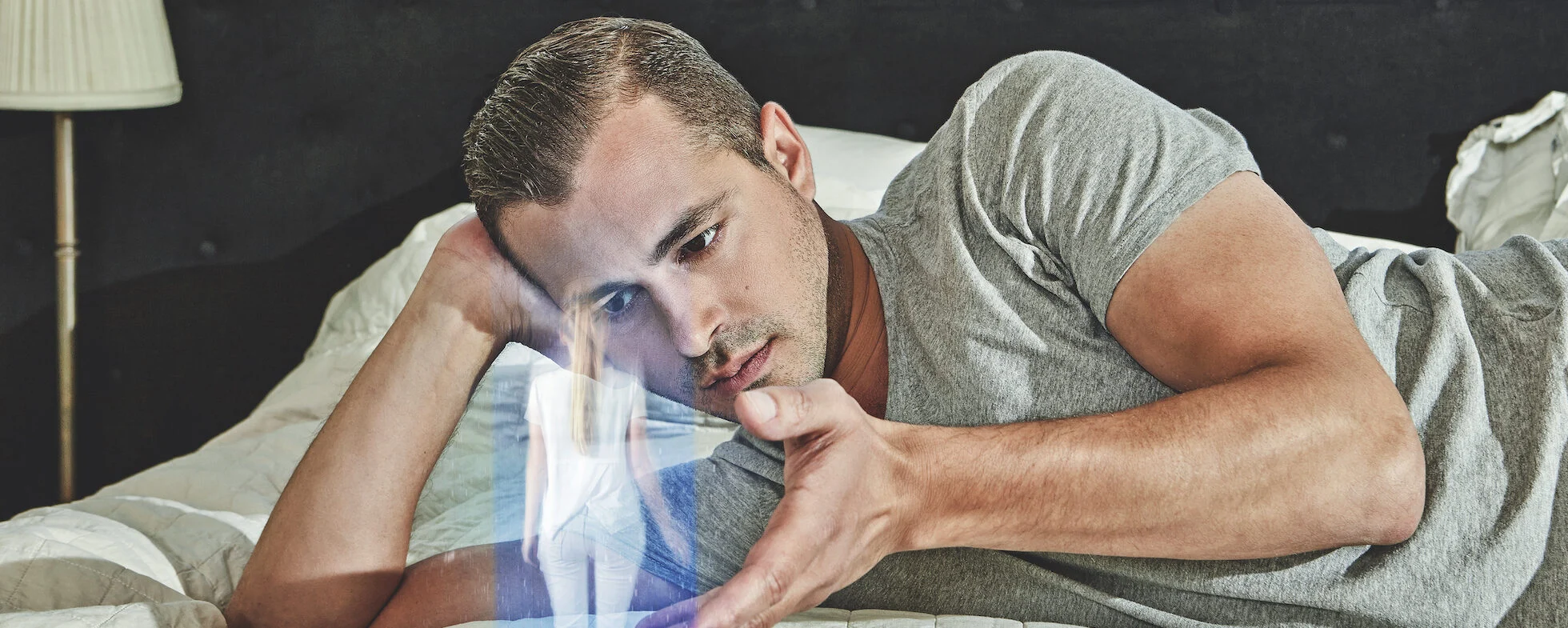
Receive messages, video calls and loving opinions from someone who is no longer here. It is possible today thanks to apps that study the dearly departed and reproduce their appearance, voice and personality. The new drift is called “Death tech”. And already millions can’t do without it.
A young Japanese couple loses their 7-year-old son and, unable to overcome their grief, asks an advanced artificial intelligence to return him to them in the form of a humanoid.
In California, a man discovers that his mother is about to leave due to cancer, so he comes up with a platform capable of creating a digital version of her with which to chat and talk on the phone.
The first case cited is the plot of Sheep in the box, a new film by Japanese director Hirokazu Kore’eda, just presented at the Cannes Film Festival; the second, a fact dating back to 2023. Two stories that highlight how the theme of digital resurrection belongs both to the imagery of dystopian cinema and to current events.
Thanks (or blame) to the spread of griefbots – from the union of “grief”, mourning, and “bot”, automaton – programs that allow you to send messages, call and interact in real time with the digital alter ego of those who are no longer here. According to the scientific magazine Nature, they are already used by millions of users around the world, especially in the United States and Eastern countries: a market, that of so-called death tech, which is estimated to go from over 35 billion dollars currently to almost 61 billion in 2030.
Also called “deadbots” or pain robots, they are based on artificial intelligence models trained to imitate the way a person speaks starting from posts on social media, videos, emails, voice recordings, photographs and conversations. In short, everything that every day, more or less consciously, we sow online and on our smartphones. The personality that resurrects from this digital heritage is so realistic that many continue to have a real relationship with it. «My mother and I», declared a griefbot user, «we are cinema enthusiasts and we talk about new films coming out». What makes avatars so convincing is above all vocal cloning, which through advanced deep learning algorithms is able to perfectly replicate the timbre, tone and inflection of a person. Singers, from Taylor Swift to Giusy Ferreri, know this well and, to avoid plagiarism, they are patenting their voice so as not to be cloned by artificial intelligence.
In America, the companies that produce griefbots are already numerous and constantly evolving: one of the most famous is the Californian You, only virtual, with which you can get a simulation of your loved one for free or an unlimited version with a subscription of 20 dollars a month. For now you can only chat and call, but it seems that video versions will also be available soon.
Then there is Eternos, a startup born in Silicon Valley in 2024, which helps people create digital twins accessible to friends and relatives even post-mortem (subscriptions start from 25 dollars), and the 2Wai app, which at the end of 2025 caused controversy with an advert in which it showed a woman pregnant with a child who, once an adult, will relate to the avatar of the deceased mother. Other platforms, such as Story file and Here after Ai, invite you to preserve your memories through interviews while you are still alive, while in China the company Super brain aims to develop avatars complete with cloned voice and animated face with which to interact through holograms or virtual reality.
Now it seems that Meta also wants to enter the deadbot market: in a patent approved at the end of 2025, Mark Zuckerberg’s company describes an artificial intelligence system capable of imitating a user when he is absent for too long or even after his death. If so, will Facebook and Instagram become social networks populated by digital ghosts? After all, the Oxford Internet Institute has estimated that by 2070 the profiles of dead people could surpass those of living users…
Many of these companies do not explicitly mention bereavement as the first occasion for use, not only to broaden the user base, for example towards people looking for virtual partners or psychological support, but also for ethical and legal issues that are still poorly regulated. «On the one hand there is the processing of personal data: digital replicas are often created without the deceased person’s consent during life, also using private material provided by friends, partners or relatives», comments Veronica Neri, professor of Media Ethics at the University of Pisa. «On the other hand, with the offer of paid services through subscriptions there is a commercialization of mourning: the emotional needs of those who suffer are monetized. Here moral responsibility towards people who find themselves in a vulnerable situation also comes into play.”
Those who support these technologies are convinced that they are effective tools for overcoming pain. Psychologists, however, are sceptical. “We still don’t know what effects interacting with a hyper-realistic reproduction of a dead person can have, even if those who use it are fully aware of their absence,” explains psychotherapist Silvia Francesca Pizzoli, researcher at the Pegaso Telematic University and the Catholic University of Milan. «In fact, in front of very convincing images or simulations we experience the so-called “sense of presence”, the same one we experience during a video game or a horror film: we know that what we are seeing is false, but we still dodge the blows or get scared». There certainly can be dangers. “There is a risk that a person will become addicted to this type of content and will no longer be able to stop relating to the deceased loved one who they cannot accept having lost.”
A not so absurd hypothesis: just in May, research conducted by Ipsos Bva reminds us that one in two young Europeans uses chatbots to discuss intimate or personal matters, preferring the PC to the psychologist, while in Venice a 20-year-old girl was admitted to the Serd, becoming the first full-blown case of artificial intelligence addiction in Italy. Data that says a lot about the power that AI can have on the human mind, even if a Eurispes survey dedicated to the immortality market partly supports the position of younger people: while millennials declare themselves intrigued by the phenomenon, Gen Z seems more wary and worried about a discussion of consent and privacy. In Europe, however, there is some more protection than in the rest of the world. “The European AI Act does not ban these technologies, but imposes very stringent principles on transparency, protection of psychological vulnerability and responsibility of platforms”, says the media ethics expert. «The central point is that artificial intelligence systems must be and remain “human-centric”, that is, designed to protect human beings and not to exploit their emotional fragilities».
A prudence that does not distinguish the current panorama, in which the logic of griefbots is leaving the private sphere to transform itself into entertainment and business.
At the last Los Angeles Comic Con, fans of Marvel cartoonist Stan Lee, who died in 2018, paid 20 dollars to photograph themselves and converse with a hologram of him, while in South Korea, digital ghosts are used to create an audience in the heartbreaking documentary series Meeting you, which since 2020 has told the story of people who meet missing children or parents through virtual reality.
What is the limit? Maybe there isn’t: in a Catholic chapel in Lucerne, Switzerland, an avatar of Jesus was even tested, installed in a virtual confessional, capable of communicating with visitors thanks to generative linguistic models. In two months, around 900 conversations were recorded. Who knows what the Pope thinks, who dedicated his first Encyclical to the pitfalls hidden behind artificial intelligence. It seems that the proposal for a digital alter ego reached Leo XIV, but that the offer was kindly declined…