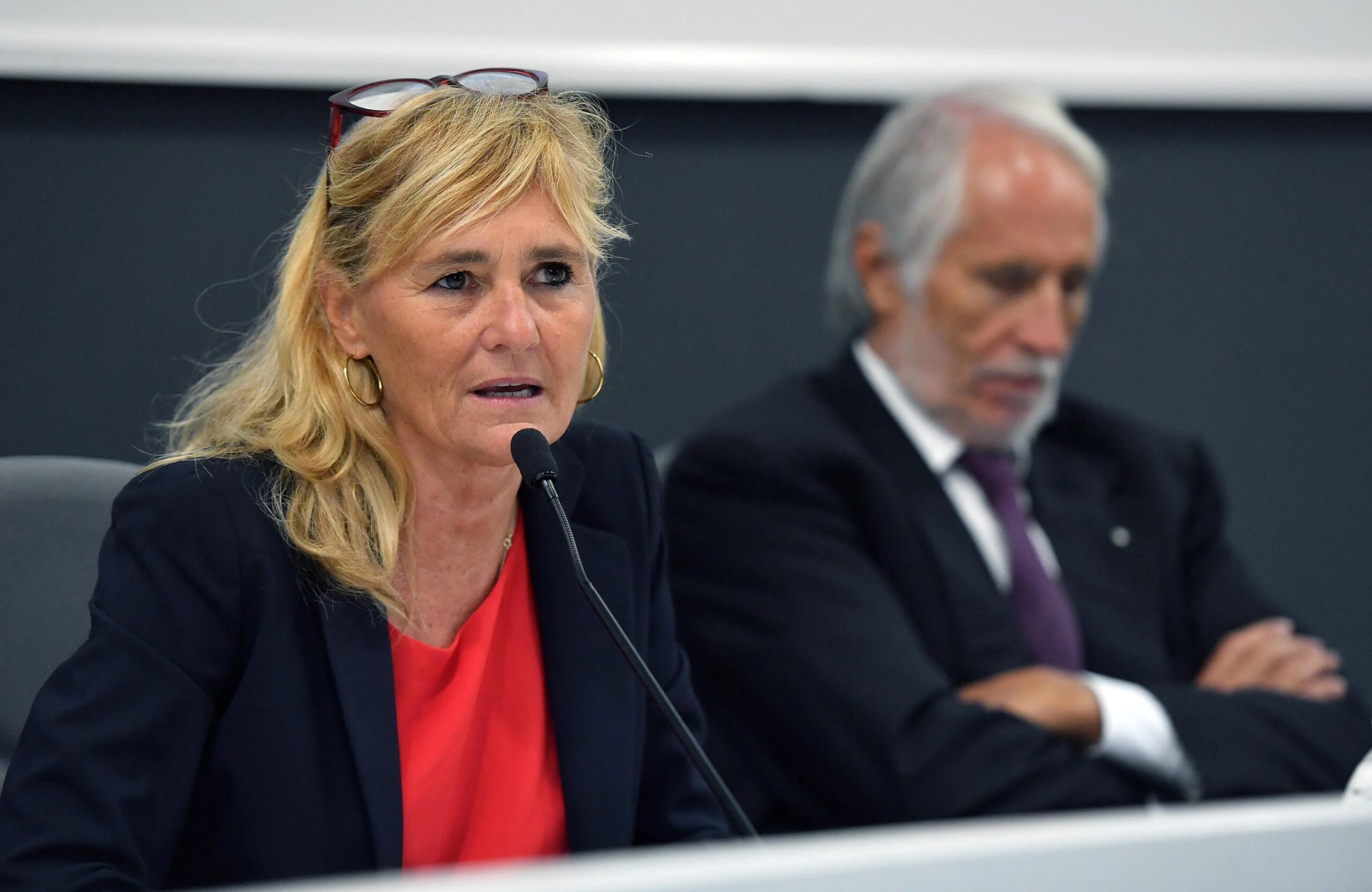
When Giovanni Malagò promised to rebuild the Italian national team he did not intend to limit himself to the choice of the coach, and the appointment of Diana Bianchedi as the new head of delegation from Italy confirms it: after weeks in which the new president of the FIGC has redesigned the technical and managerial architecture of the Azzurri several times, the last box bears the name of one of the most recognizable figures of Italian Olympic sport, twice Olympic champion in team foil, doctor, long-time and above all current manager deputy vice-president of CONI.
A choice which, in Malagò’s intentions, should represent much more than a symbolic appointment, because Bianchedi embodies exactly that attempt to bring football back into a broader Italian sports system which the new federal president considers one of the points of his management. But his position at the top of the Olympic Committee immediately transformed the decision into an institutional case: as reported by Corriere della Seraat CONI they are in fact verifying the compatibility between the role of deputy vice-president and that of head of delegation of the national team, while from the FIGC the response is that it would be a position of mere representationand therefore not comparable to a real federal office.
The distinction may seem technical, but it is not at all, because it directly affects the relationships between CONI, which in the Italian sports system exercises guidance and control functions over the federations, and the Football Federation, which is by far the most powerful and visible federation in the country. It is precisely the National Council of the Coni, of which Bianchedi is a member, that also has among its responsibilities functions that concern the federal system; at the same time, it should be remembered that the composition of the Board itself includes representatives from the national sports federations and that therefore the simple existence of a link with a federation does not automatically determine incompatibility.
The point, therefore, will be to understand how the position of head of delegation of the FIGC should be formally qualifiedand it is precisely on this ground that the two interpretations seem to diverge for the moment. According to the state of public information available, there is no official ruling that has already declared the two roles incompatible: there is a question to be verified and there is a federal position which instead tends to exclude the problem on the basis of the nature of the role.
Because Malagò chose Diana Bianchedi
The appointment, beyond the controversy just opened, is perfectly consistent with Bianchedi’s professional history and above all with the relationship built over the years with Malagò. The former Milanese foil player won the Olympic team gold Barcelona 1992 and Sydney 2000five world titles and two European ones, before progressively moving his career from the platform to sports governance, reaching positions in CONI, in the Rome 2024 candidacy project and above all in the organization of the Milan Cortina 2026 Games.
In Milan Cortina was one of the central people in the organizational machine, with the role of Chief Strategy, Planning & Legacy Officer, working once again side by side with Malagò, president of the Foundation. In June 2025 she was then elected to the CONI national council with 36 preferences and chosen as deputy vice-president of president Luciano Buonfiglio, becoming one of the most important figures in the current government of Italian sport.
It is precisely this curriculum that Malagò indicated as the reason for the choice. Presenting the operation, the president of the Football Federation underlined the need for football to no longer be considered “a separate reality”, identifying in Bianchedi a personality with international prestige and capable of building a connection between the national team and the rest of the sporting movement.
It is a political message even before a football one, because for decades Italian football has lived in a particular condition, so central economically and mediatically that it often seems like an autonomous system compared to other disciplines. Bianchedi, who comes from fencing and the Olympic universe, represents almost the opposite image: a manager who grew up in the multisport culture of CONI, with an international and organizational profile closer to the great Olympic events than to the traditional balance of Coverciano.
The last box of Malagò’s new Italy
The choice also comes at the end of one of the most eventful months in the recent history of the national team. Malagò became president of the FIGC June 22, 2026elected on the first ballot with 68.58 percent of the votes after the end of Gabriele Gravina’s management, and since his inauguration he has concentrated a significant part of his work on the reconstruction of the Italian technical area.
The first project had led to the arrival of Paolo Maldini as technical director and president of Club Italia, supported by Leonardobut that arrangement lasted very little. Andrea Pirlo’s candidacy for the bench was abandoned after the emergence of his collaboration with a Russian betting company and, within a few days, Maldini and Leonardo left the Federation; Malagò then completely changed course, calling back Roberto Mancini as technical commissioner and entrusting to Claudio Ranieri the role of technical director and president of Club Italia.
Mancini’s return has already represented a strongly identifying choice, because it brings back to the Italian bench the man of the 2021 European Championship but also the coach who was the protagonist of the sensational farewell in August 2023. Ranieri, on the other hand, should take on a broader role in defining the technical line and in the development of the national team system, while a staff has been built around the new coach in which several figures linked to Italy’s recent history have returned or joined.
In this structure the head of delegation would inevitably have a particular meaning. She is not the coach, she does not choose the squad and does not define the tactics, but she institutionally represents the national team in its external relations and accompanies a group which, after three consecutive missed World Cups, needs to rebuild not only a technical identity but also its symbolic weight.
The previous relationship between Malagò and Bianchedi
Then there is an element that makes the choice even less random: Malagò and Bianchedi have shared some of the most important operations in Italian sport in recent years. Bianchedi had worked on the candidacy of Rome 2024 and subsequently became one of the decisive people in the path of Milan Cortina, from the candidacy dossier to the construction of the organizational machine of the Games. Their professional relationship has therefore long crossed disciplines, institutions and major events, and the victory of the Olympic bid in 2019 had consecrated them as two of the faces of Italian success in Lausanne.
For Malagò, bringing her into the national team means in some way transferring a piece of that organizational culture to Coverciano, but it also means building a very visible bridge with the CONI led by Buonfiglio. And this is where the paradox of the whole story arises: the characteristic that makes Bianchedi particularly interesting for the FIGC, i.e. his central position in the Olympic system, is exactly what now makes it necessary to establish whether the two roles can coexist.
Furthermore, it is not the first time that the new federal management of Malagò has found itself facing a question of compatibility or institutional opportunity. The candidacy of the former CONI president to lead the FIGC was accompanied by the debate on the so-called pantoufflageuntil the opinion of the Anac which had excluded ineligibility on the basis of the applicable legislation.
Now the terrain is different and concerns Bianchedi, but once again the border between the institutions of Italian sport becomes part of the game. The FIGC maintains that the function of head of delegation is representative and therefore does not constitute an incompatible federal position; CONI wants to verify the issue before considering it closed.
And it is probably precisely this distinction that decides the future of the nomination: if the federal interpretation prevails, Bianchedi could simultaneously become the institutional face of the national team and the number two of the Olympic Committee, concretely creating that bridge between football and the rest of sport imagined by Malagò; if, however, the role is considered incompatible with the deputy vice-presidency of CONI, the new Italy will still have a box to fill. For a national team that finally thought it had completed its organizational chart, the summer of nominations may therefore not be over yet.