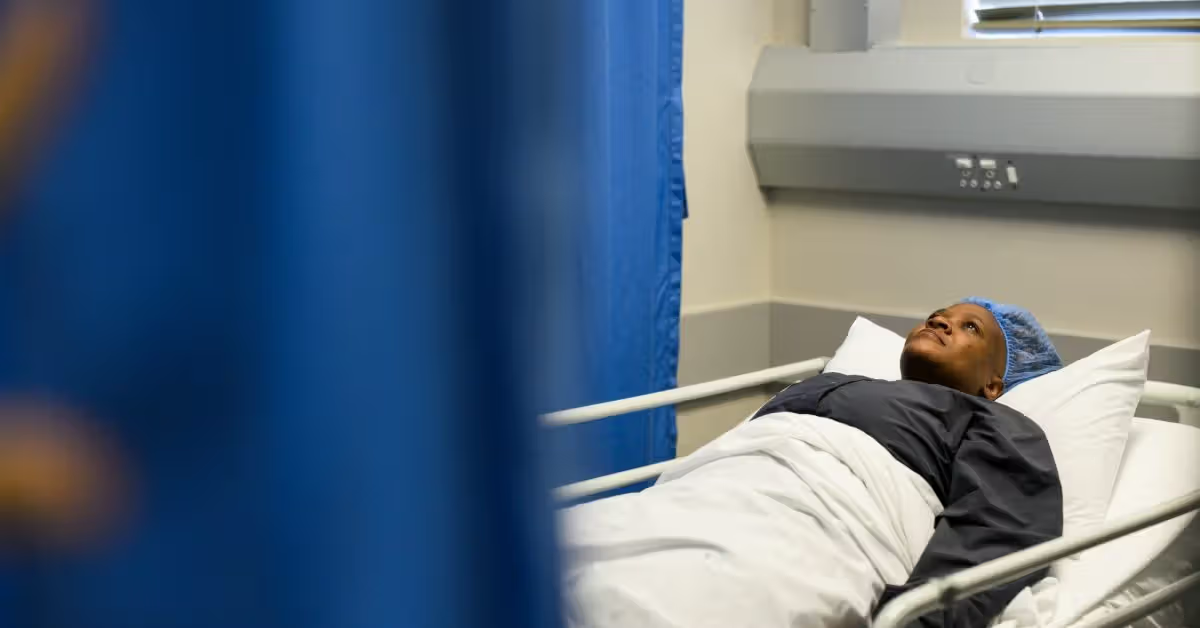
- On July 2, 2026, the World Health Organization (WHO) and the Institut National de Recherche Biomédicale (INRB) announced the start of participant enrollment for a new clinical trial investigating targeted treatments for infections with the Bundibugyo virus.
- The Bundibugyo virus caused the latest outbreak of Ebola in the Democratic Republic of the Congo (DRC) and Uganda.
- There is currently no vaccine for this particular viral strain, nor a targeted treatment.
- The trial, currently open for participants in the DRC, will be investigating three potential therapeutic approaches, with the aim of improving survival rates.
On Thursday, July 2, 2026, the World Health Organization (WHO)
The trial — called “Platform adaptive randomized trial for new and repurposed Filovirus treatments (
PARTNERS is further coordinated by research teams from the Institute of Tropical Medicine in Belgium and the University of Oxford in the United Kingdom, and is also supported by the Africa Centers for Disease Control and Prevention (Africa CDC).
Why is the trial necessary?
There is currently no preventive vaccine or targeted treatment for infections with the
“The current Ebola outbreak in the DRC is caused by a strain called the Bundibugyo virus, which is a distinct species of the Ebolavirus family without current vaccines or treatments,” Monica Gandhi, MD, MPH, an infectious disease specialist and professor of medicine at the University of California, San Francisco, explained to Medical News Today.
For the moment, healthcare professionals are only providing supportive care for Ebola patients, meaning that they are monitoring blood pressure and bleeding events, and attempting to prevent organ failure.
However, with
“By the time the WHO declared
a public health emergency of international concern On May 17, the virus had already spread considerably and – without any vaccines or treatment – the only way to contain the virus is isolation of someone who is sick, contact tracing, and quarantine of exposed contacts. Given the deadly nature of Ebola, a treatment and eventually, a vaccine, are of the utmost importance.”–Monica Gandhi, MD, MPH
What therapies are the clinical trial testing?
The trial is due to assess whether using the
“The first treatment, MBP134, is made up of two human monoclonal antibodies (ADI-15878 and ADI-23774) isolated from a survivor of the 2013-2016 West African Ebola outbreak,” Gandhi explained.
“MBP134 targets binding sites on the ebolavirus that are common to multiple strains, including neutralizing multiple strains, including Ebola (Zaire), Sudan, and Bundibugyo,” she detailed.
“A study in non-human primates show complete reverse of symptoms of a Sudan strain of Ebola with administration of MBP134. The second treatment, remdesivir, is a well-known antiviral used to treat SARS-CoV-2, the agent of COVID-19, and both treatments are being studied alone and in combination,” Gandhi added.
The WHO reiterated to MNT that the research teams decided on these therapeutic approaches after reviewing the existing evidence supporting their potential and safety, as well as evidence based on real-world outcomes from “previous outbreak responses,” following a
Furthermore, the trial is designed as a platform trial, meaning that further treatments can be added to the trial as they become available, if the WHO Technical Advisory Group deems there is enough evidence to support testing them in this context.
How long will the trial last?
While the PARTNERS trial is bringing hope for better outcomes for those infected with the Bundibugyo virus, the WHO emphasized that, in order to ensure efficacy and safety, the trial timeline must not be rushed.
“The clinical trial will take some time for results to be known — at least several months,” the WHO told Medical News Today.
Speaking to MNTGandhi expressed optimism about the results of this new trial.
“I am very hopeful that this important study has started, as treatments for this deadly disease are greatly needed,” she said.
“The time to complete the trial will depend on the number of cases and participation, but I imagine there will be brisk enrollment and patients willing to participate, so hopefully, we will see completion soon (maybe even) within a year,” Gandhi concluded.