There are summers that are remembered through the beaches, the concerts and the great departures, and then there is another Italian summer, older and deeply rooted in the territories, during which the squares stop being simple urban settings, the streets are covered with flags, the neighborhoods go back to being called contrade, rioni or sestieri and rivalries handed down for generations re-emerge in front of galloping horses, archers, flag-wavers and boats pushed by strength of the oars.
It is the summer of the Palios, a calendar that crosses Italy from Siena to Verbania, from Marche to Puglia, from cities of art to Alpine villages and seaside communities, showing how a word apparently linked to the past continues to indicate something very alive: not just a race, but the moment in which a territory stages its own history, reaffirms local affiliations and transforms the competition into a great collective ritual.
Before the race there was the pall
The word “palio” comes from Latin palliumthe cloak or drape of precious fabric that during the Middle Ages was given to the winner of races, tournaments and other competitions organized especially on the occasion of religious festivals. Over time, the name of the award came to indicate first the competition and then the entire celebration, including processions, blessings, banquets, investitures, trials and public ceremonies.
The palio, therefore, was not born as a sporting cup in the modern sense, but as an object capable of bringing together material value, religious meaning and civic prestige, so much so that even today the painted cloth remains the symbolic center of many events. In Siena it is the Drappellone, familiarly called “cencio”, an original work created on silk and intended for the winning Contrada, in which the city coats of arms, the symbols of the Contrade and the Marian iconography linked to the festival must coexist.
It is precisely this overlap between the sacred and the profane, competition and devotion, history and daily life that explains why the palii have resisted, while many other popular traditions have slowly disappeared or have been reduced to shows for visitors. Here the public does not just observe a re-enactment: it participates in a geography of belonging that continues to organize relationships, family memories and local identities.
Siena, the Palio that overshadows all the others
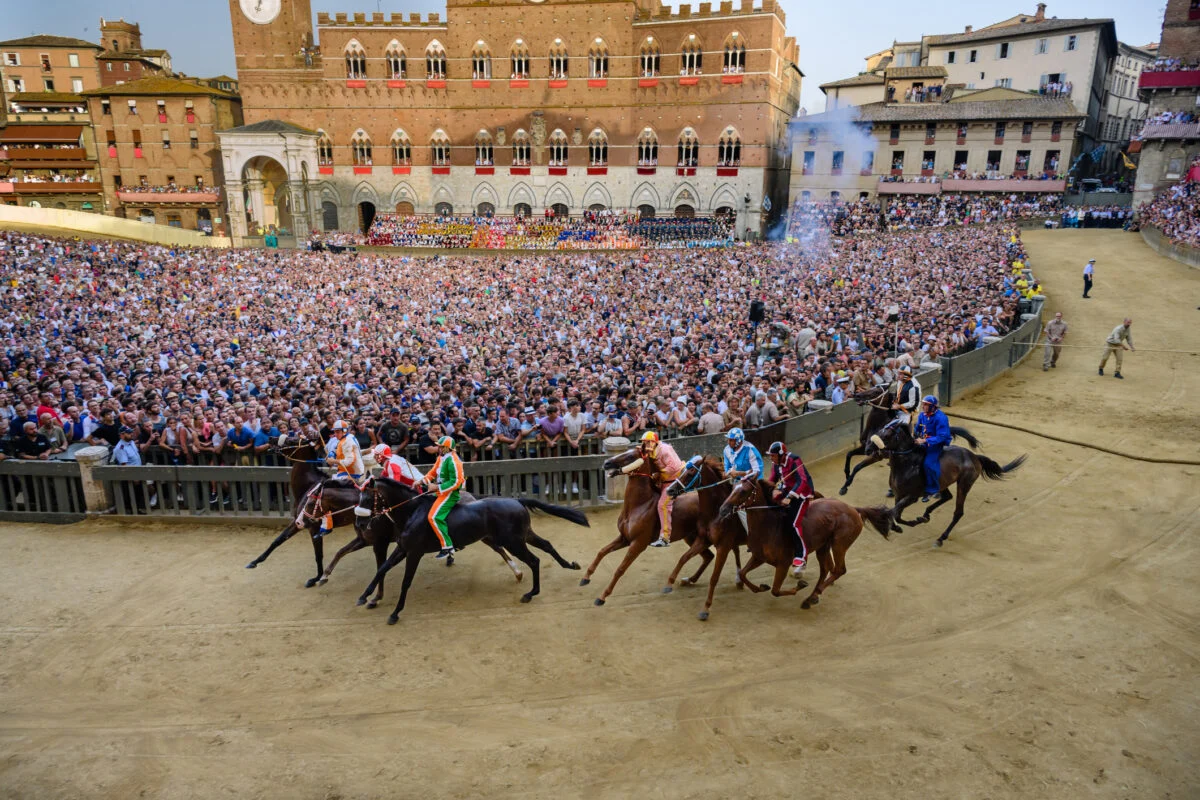
When we talk about palii, our thoughts inevitably turn to Siena, where Piazza del Campo becomes the center of a system of passions twice every summer which involves the seventeen city Contrade throughout the year and reaches its peak in the races dedicated to the Madonna di Provenzano and the Madonna Assunta.
The first event of 2026, initially scheduled for July 2nd and postponed to the following day due to rain, was won by the Contrada dell’Aquila; the second will arrive on Sunday 16 August, when ten Contrade will return to compete for the Drappellone dell’Assunta created by the Romanian artist Teodora Axente.
The race, with the jockeys mounted bareback and the horses called to complete three laps of the square, constitutes the most visible moment of the Palio, but it is only the final act of a much longer civil liturgy, made up of draws, assignments of the horses, trials, propitiatory dinners, blessings and strategies. The origins of the festival are intertwined with the history of the Republic of Siena and with the medieval celebrations of the Assumption, when a “palio in the long run” was run along the city streets and the winner received a precious cloth. The stable form of the July race dates back to the seventeenth century, while the appointment on August 16 was institutionalized at the beginning of the eighteenth century.
However, reducing everything to the speed of the horses or the spectacular image of the crowded square means not fully understanding Siena, where the Contrada is not only worn during the days of the Palio, but represents a community in which people are born, grow up and build relationships that continue well beyond the duration of the race.
When the palio descends into the sea
The Italian tradition does not only race on land, because in coastal cities and lakes the horse is replaced by boats, while the districts take on the name of villages and the race field becomes a body of water.
On August 2, La Spezia celebrated the 101st edition of the Palio del Golfo, the rowing challenge that every first Sunday of August brings together thirteen villages on the waters in front of the Morin promenade. The boats used are handcrafted hulls inspired by gozzo boats, built specifically to be more agile and faster, but the origin of the competition can be traced back to the spontaneous challenges between the crews of the work boats that returned with fish and mussels, the “muscles” that for generations have represented one of the riches of the La Spezia gulf.
The regatta transformed a practice linked to daily work into a declaration of maritime belonging, preserving the rivalry between Portovenere, Le Grazie, Fezzano, Cadimare, Marola, La Spezia and the other communities overlooking the Gulf of Poets. Here too the race is only part of the celebration, preceded by the parades of the villages and concluded, according to a now consolidated custom, by the fireworks display on the sea.
Verbania and the galleons illuminated on the night of August
On Lake Maggiore the palio instead takes on a nocturnal dimension, constructed through the reflections of the lights on the water and the colors of the galleons advancing in front of the lakeside of Pallanza. On the evening of August 14th, Verbania will host the 52nd edition of the Palio Remiero in Notturna, one of the most evocative events on the eve of Ferragosto, capable of attracting crews from lake and marine locations for over half a century.
The program includes the finals of the fifth Palio Remiero Internazionale in Notturna, the fourth Palio Remiero dei Campanili and the tenth edition of the Palio in Rosa, while the evening regattas will take place along a competition field delimited by luminous buoys. At 10.30pm the Borromeo Gulf will finally be illuminated by pyromusical fireworks, which will close the event by transforming the lakefront into a natural audience.
The Palio of Verbania is relatively young when compared to the medieval celebrations of Siena or Fermo, but it tells the same cultural process: a community chooses a competition, links it to its landscape and transforms it into an event capable of being passed down, until the race becomes inseparable from the place in which it is held.
Oria, the return of the court of Frederick II
In Puglia the summer of the palii instead leads to Oria, where the historic center symbolically returns to the time of Frederick II of Swabia. The tradition recalls a proclamation that the emperor issued in 1225 to establish a tournament between the four districts of the city, an episode reconstructed through the historical procession and the competitions that award the flag.
On Saturday 8 August the historical procession of Frederick II will cross the city with around a thousand participants, including ladies, nobles, men-at-arms, knights, falconers, archers, musicians and flag-wavers; the following day, at the Campo del Torneamento, the four districts will face each other in the tests with pike, sword, shield and mace, followed by the athletes’ races which will determine the winner of the Palio.
Unlike Siena, where the entire tension culminates in the race, in Oria the challenge is built through a plurality of tests that restore the image of a Frederickian city, transforming for a few days the medieval past into a space shared by the contemporary community.
Fermo, the Palio dell’Assunta in the heart of Ferragosto
On August 15th the scene will move to Fermo, where the Cavalcata dell’Assunta will reach its 45th modern edition, while harking back to much older documents and celebrations. An act from 1182 testifies to the commitment of some castles subject to the city to bring a palio every year on the occasion of the feast of the Assumption, while an illuminated page of Missale De Firmonibusbuilt in 1436, offers one of the most important historical representations of the Cavalcade.
On the evening of August 14th the procession in fifteenth-century costume will reach the Cathedral for the blessing of the Palio, while on the afternoon of August 15th the participants will cross the city to the race field, where at 5pm the horse race will be held, divided into two heats and a final.
Also in this case the religious component does not constitute a simple decorative element, but is the very matrix of the event, because the competition was born within the patronal celebrations and continues to connect the devotion for the Assumption to the public representation of the Contrade.
From Ascoli to Feltre, a tradition that changes shape
The summer of 2026 has already passed through Ascoli Piceno, where the Quintana took place on 11 July in honor of the Madonna della Pace and on 2 August for Sant’Emidio, with the knights of the six city districts competing, and Feltre, where between 31 July and 2 August the four districts competed in archery, in the relay, in the tug of war and in the equestrian race.
They are different events in terms of origins, rules and dimensions, but united by a common grammar, in which the neighborhood does not just represent an urban subdivision, the banner is not just a prize and the victory does not belong only to the athlete or jockey, but to an entire community.
Because the Palios continue to speak to Italy
The strength of the Palios does not lie in the illusion that time can be stopped, because behind the costumes, banners and medieval formulas there are associations, volunteers, families, artisans and young people who work for months, use social networks, sell tickets online and record every moment with smartphones. Modernity does not erase tradition, but becomes the instrument through which tradition seeks new spectators and, above all, new heirs.
Each territory has adapted the palio to its own geography and memory: Siena runs in the square that summarizes its municipal history, La Spezia and Verbania entrust the competition to water, Fermo inserts it into the solemnity of the Assumption, Oria links it to the figure of Frederick II, while Feltre distributes the victory between strength, precision, speed and equestrian ability.
From the Oria procession on August 8th to the Verbania regatta on the 14th, passing through the Palio dell’Assunta in Fermo on August 15th and that in Siena on August 16th, Italy returns to show one of its deepest identities: a country in which the bell tower continues to be an emotional border, rivalry becomes memory and a simple cloth can still contain the pride of an entire city.