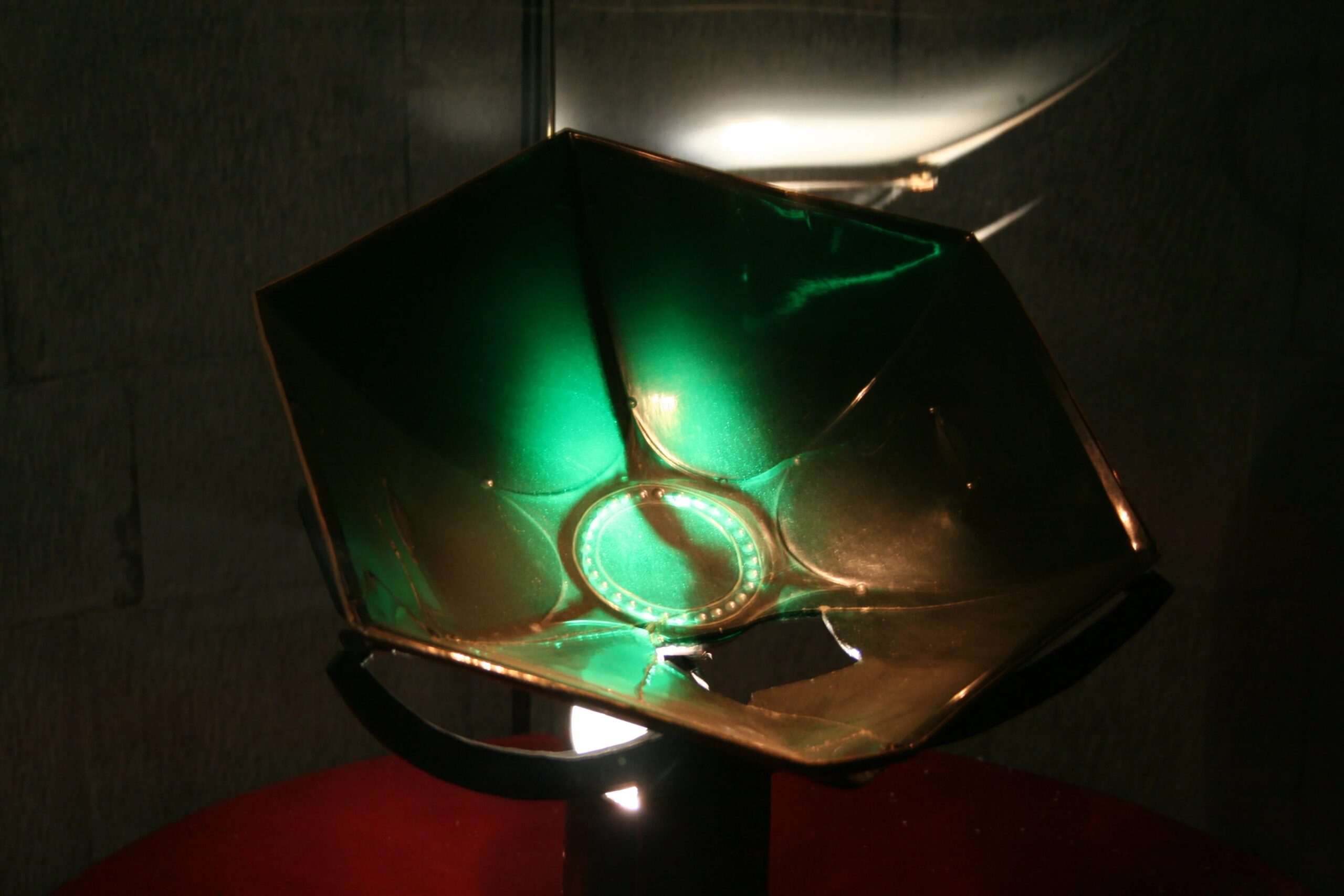
To find one of the possible “Holy Grails” of Europe you don’t need to follow King Arthur’s trail to the ruins of a British castle, look for a forgotten chapel in the Pyrenees or decipher symbols hidden inside some Templar abbey. Just enter the heart of Genoa, reach the Cathedral of San Lorenzo and go down to its Treasure Museum, where behind a display case there is an object that, at first glance, might seem even less spectacular than its history promises: a large hexagonal container, about forty centimeters wide, of an intense and transparent green, crossed by the scars left by a breakage that occurred more than two centuries ago.
It’s the Sacred Catinoone of the most enigmatic artefacts linked to the Italian Middle Ages and one of the relics on which, over the centuries, a legend has been built capable of intertwining the First Crusade, the Last Supper, a gigantic emerald and even Napoleon Bonaparte. For a very long time, the Genoese were in fact convinced that that container had been made from a single precious stone and that it was nothing less than the dish used by Jesus during the Last Supper, a tradition that would end up transforming it into the Genoese version of the Holy Grail.
A treasure that arrived in Genoa from the Crusades
The story begins in 1101when the Genoese took part in the conquest of Caesarea, on the coast of the Holy Land, within that season of military and commercial expansion following the First Crusade. He is leading the expedition Guglielmo Embriaconicknamed Testadimaglio, member of one of the families destined to become central in the medieval history of Genoa and already protagonist of the Crusader campaigns in the East.
According to the tradition accepted by most sources, it was during the capture of Caesarea that the Genoese came into possession of the mysterious green container which would later arrive in Liguria. A medieval narrative tells that the artefact was found in a building in the city and that, faced with that extraordinarily intense colour, the conquerors mistook it for an enormous emerald, deciding to bring it home as one of the most precious objects of their loot.
The story, however, already has an initial gray area at this point. In fact, Treccani recalls that Caffaro di Rustico from Caschifellonea Genoese chronicler contemporary to the events and a privileged witness of the Republic’s exploits in the East, does not mention the Sacred Catino in the story of the division of the spoils of Caesarea, a silence that has led historians to question the precision of the tradition according to which it was Embriaco himself who led it to Genoa in 1101. It is one of those details that make the story even more interesting: the Catino enters the Genoese Middle Ages surrounded by mystery practically from the moment of its appearance.
Like a green vessel it became the Holy Grail
However, for that dish to become something much bigger than precious war booty, time and, above all, a story were needed.
After arriving in Genoa, the Sacro Catino seems to almost disappear from the news for a long period, until its legend definitively takes shape in the Middle Ages through authors such as Jacopo da Varaginearchbishop of Genoa and famous author of Golden Legend. It is in this cultural environment, dominated by the cult of relics and the search for objects capable of establishing a material contact with the life of Christ and the saints, that the green container is progressively linked to the Last Supper.
Not a simple cup, therefore, as modern cinema and literature have accustomed us to imagine when we pronounce the words “Holy Grail”, but a basin or plate in which Christ would have consumed the paschal lamb together with the apostles. Other versions of the legend even went so far as to associate it with the container used by Nicodemus to collect the blood of Jesus after the crucifixion.
The material contributed to making everything even more extraordinary: for centuries it was believed that the Catino had been sculpted in a single gigantic emerald. In an era in which the origin, color and rarity of an object could contribute to building its miraculous character, a container of that size made from a single precious stone must have seemed almost impossible.
Its value became such that it was not displayed as a normal liturgical object: according to the Treasure Museum of San Lorenzo, in the past the relic was only displayed in the cathedral on first day of Lent.
And naturally it didn’t take long to attract the attention of those who wanted to own it.
Then came Napoleon
Over the centuries there were various powerful people who looked with interest at the Genoese treasure, but it was Napoleon Bonaparte to really succeed in the undertaking. At the beginning of the 19th century the Sacro Catino was requisitioned and transferred to Paris together with many other works and precious objects stolen during Napoleon’s expansion in Europe.
And it was precisely in Paris that the legend of the emerald suffered its hardest blow.
In the 1806 the container was subjected to analyzes which established that it was not made of a gigantic precious stone: it was green glass. What for generations had appeared as an emerald practically impossible to find in nature owed its color to the composition of the material. In fact, the Genoa Museum today describes it as an artefact made with green colored glass and modeled in the characteristic hexagonal shape.
One might think that that discovery definitively destroyed the myth, but the story of the Sacred Catino is much more interesting precisely because it didn’t happen.
Being made of glass does not in fact mean being modern, nor even devoid of archaeological value. Its origin continues to be the subject of discussion and the different reconstructions proposed over time have placed it in different eras and areas of the eastern Mediterranean. The current profile of the Museums of Genoa indicates one Syrian manufacture and a possible dating around the 1st century ADspecifying however that the dating remains debated; other reconstructions have proposed later periods.
And it is precisely this uncertainty that prevents history from simply transforming into the chronicle of a medieval fake.
The return journey that destroyed him
Then there is a last chapter that seems written specifically to fuel the legend. After the fall of Napoleon, the Sacro Catino was returned to Genoa, but the journey home turned into a disaster.
In the 1816when the artifact finally returned to the city, it arrived shattered into several pieces; some sources speak of ten fragments and one part now lost, while the Genoa Museum believes it probable that the breakage occurred during the return journey, on the route between Paris and Turin. The container was subsequently recomposed, but still today it retains a visible gap, almost a material scar from Napoleon’s journey.
It is perhaps precisely this detail that makes the Sacred Catino more fascinating than many perfectly preserved objects: in front of the reliquary one observes not only something that comes from a remote past, but an artefact on which the different eras it has passed through have been physically imprinted, from the medieval Mediterranean of the Crusades to the Genoa of the great relics, up to the Napoleonic requisitions and the birth of the modern scientific analysis of works of art.
But then is it really the Holy Grail?
The historically correct answer is that there is no evidence that the Sacred Catino was used by Jesus during the Last Supperjust as there is no historical demonstration capable of identifying with certainty a real object with the Holy Grail of medieval traditions.
Yet to dismiss it simply as “the Grail that turned out to be made of glass” would be to miss the most interesting part of the story.
Because the Sacro Catino is truly an ancient object coming from the East, it was already in Genoa in the Middle Ages, it was venerated for centuries as one of the most precious relics of the city, it was believed to be a gigantic emerald and it aroused enough interest to end up in the hands of Napoleon. Even its exact origin remains debated.
Today it is still there, in the Treasure Museum of the Cathedral of San Lorenzo, with its almost unreal greenery and the fractures of the journey from France perfectly visible. We don’t know if it was ever on a table in Jerusalem two thousand years ago, but we know that for almost a millennium men, chroniclers, bishops, conquerors and emperors thought it was worth taking possession of, protecting it or telling its story.
And after all, this is exactly how the great medieval legends are born: not when we can prove everything, but when enough space remains between what we know and what we will perhaps never be able to know for the mystery to continue.