From atomic clocks to GPS satellites to 5G: everything about rubidium, the highly reactive metal extracted from lithium which costs up to 138 dollars per gram
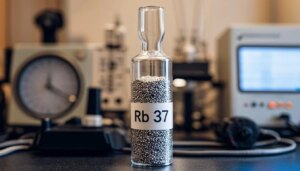
Among the raw materials less known to the general public, there is one that is forcefully returning to the spotlight for its irreplaceable role in the most advanced technologies. Let’s talk about rubidiuma soft, silvery alkali metal often considered a niche resource, is actually a key component for various products in the hi-tech sector.
What is rubidium
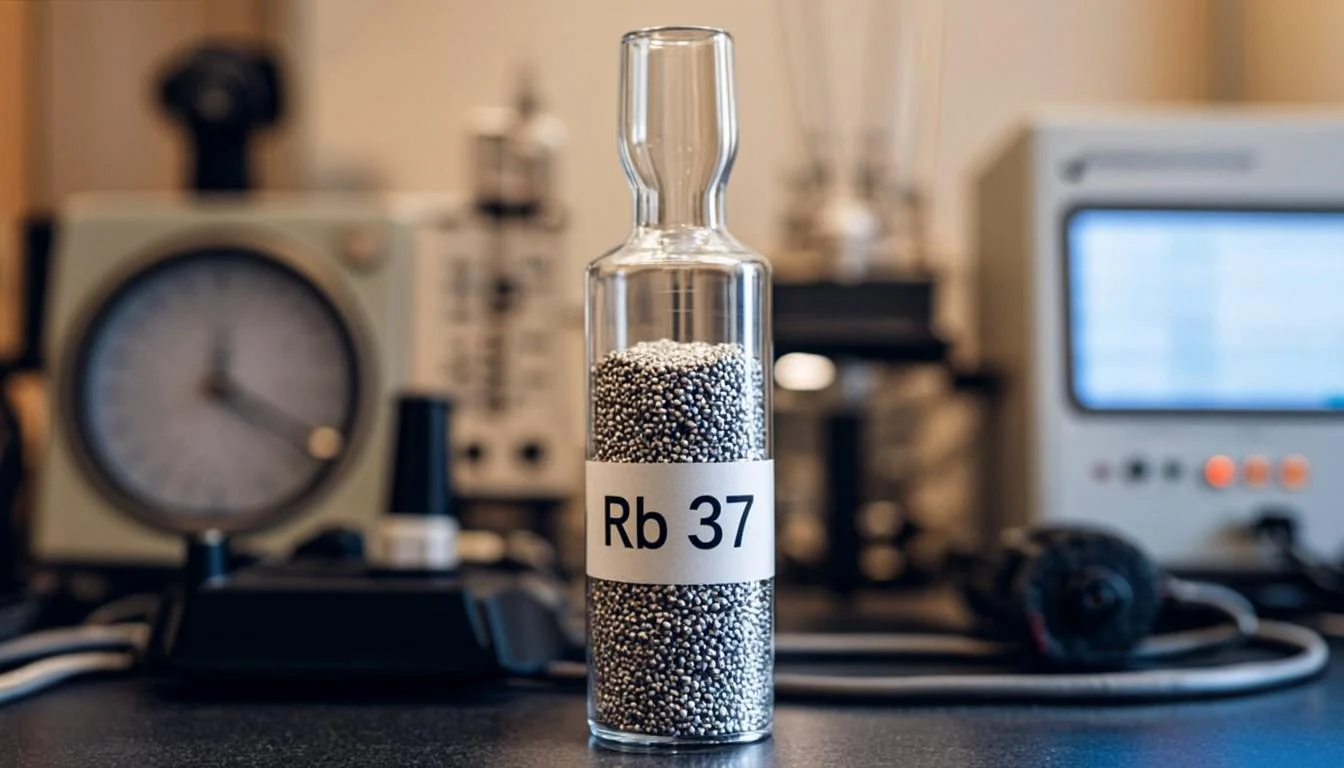
As mentioned, rubidium is a soft metal silvery in colour, with a very low melting point of around 39.3 °C and an extraordinary reaction capacity; it ignites spontaneously in air and reacts violently (almost explosively) with water.
Its discovery occurred in 1861 by Robert Bunsen and Gustav Kirchhoff, thanks to spectroscopy. Its name, however, comes from Latin rubidus“intense red”, was given to him for the red lines present in its spectrum.
As in the case of other critical mineralsalso the rubidium it is mainly produced as by-product of the extraction and refining of other minerals, in particular of lithium and of cesiumwhile there are no mines dedicated to its production.
Its functions
Despite the relative scarcity of this metal, its functions are numerous. The most important use concerns the atomic clocks: rubidium oscillators exploit a transition of rubidium-87 atoms and guarantee very high precision, with costs and dimensions much lower than those of cesium clocks.
We find them on board navigation satellites such as GPS And Galileowhere an error of just one microsecond is equivalent to approximately 300 meters of position error, but also within data centers and in telecommunications networks, including 5G, where they maintain synchronization between base stations when the satellite signal fails.
Rubidium then plays a role in defense sector. Rubidium frequency standards are used in secure communications, radar, receivers Military GNSS and electronic warfare systemsbecause they ensure a precise time reference even when the GPS is disturbed or inhibited.
Metal is also the protagonist of quantum researchwhere rubidium atoms cooled to almost absolute zero act as qubits in neutral atom computers, while vapor cells serve for very high sensitivity magnetometers.
There is also no shortage of applications in special glasses for optics, in nuclear medicine (with rubidium-82 used for cardiac PET) and, in the experimental phase, in perovskite solar cells.
Who produces rubidium
Since it is mainly mined as a by-product of the processing of other minerals, its availability remains limited and strategically crucial.
According to the annual report of United States Geological Surveyrubidium production is tiny, opaque, and concentrated mostly in China. The other two countries cited as producers are Germany and Russia, but it remains impossible to estimate the quantities produced.
There dominant position of China in extraction and refining it is guaranteed by the lithium and cesium pegmatite deposits (from which rubidium is produced) present in the Chinese regions of Jiangxi and Sichuan, with the Chinese giants Sinomine Resource Group and Ganfeng Lithium also operating in Canada and Africa.
The cost of rubidium
Unlike other metals such as gold and copper, rubidium is not traded on traditional commodity exchanges. In fact, since the volumes traded are very small, There is no official wholesale market quotationbut the reference prices come from the catalogs of individual specialized suppliers and vary based on purity, format and packaging.
According to data published in the Usgs 2025 report, a 1 gram vial of rubidium metal, with a purity of 99.75%, was sold for around $138. In the case of a 100 gram vial, however, the price rose significantly 2400 dollars.
Like all materials used in the hi-tech sector, therefore, rubidium also charges “its weight in gold”, indeed, even more than gold.