- Melanoma can go unnoticed because it can develop in hidden areas or mimic other skin conditions.
- Earlier detection of subtle changes in skin lesions, such as moles, can improve outcomes for skin cancer.
- Medical News Today trials an AI-enhanced imaging service and speaks with a dermatologist about when to start skin cancer screening and the ABCDE method for identifying signs.
Skin cancer remains one of the fastest-rising cancers, with melanoma incidence rates in the United States alone having increased by approximately 150% since the early 1990s. Skin cancer rates are also projected to climb through 2040, with melanoma estimated to become the
The biggest obstacle to detecting skin cancer earlier is that many moles and skin lesions may not produce symptoms such as pain or itchiness, or may be hidden in places such as under the nails, the palms of the hands, or the soles of the feet. This makes skin self-examinations and professional screening all the most important.
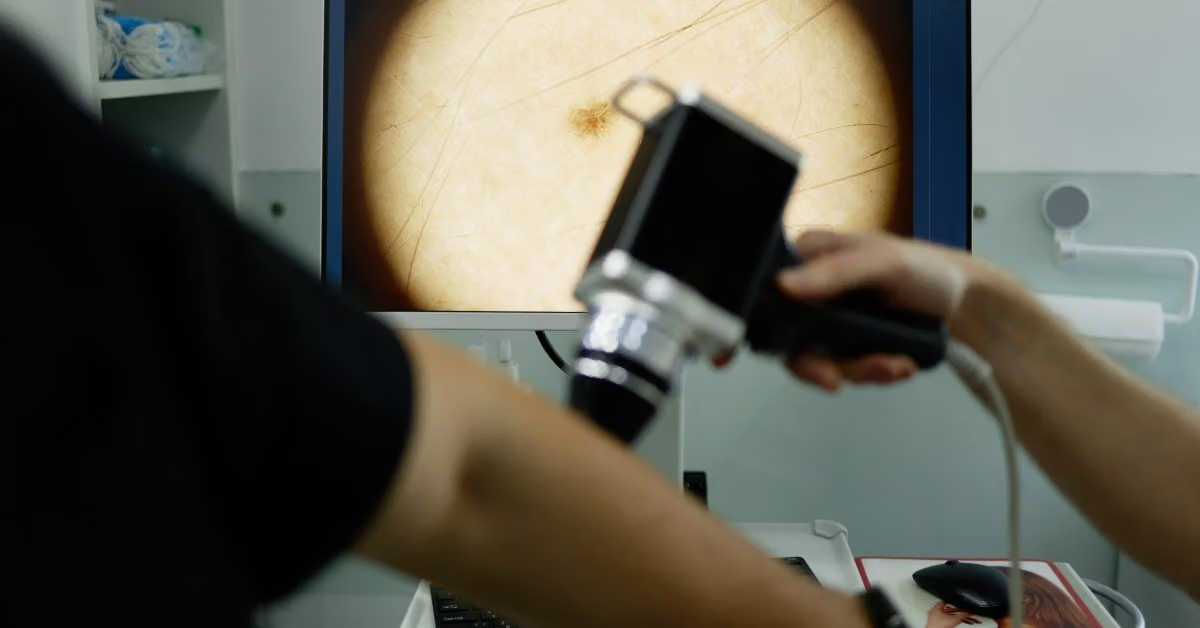
Medical News Today got to trial advanced artificial intelligence (AI)-assisted dermoscopy using the Canfield IntelliStudio3 system at the Cadogan Clinic in London and report on the experience.
We also talked with Susan Mayou, MD, senior consultant dermatologist and co-founder of the clinic, about skin cancer screening and how to check moles, as well as how AI supports long-term surveillance in dermatology.
How an AI-assisted mole checking appointment goes
I was first welcomed to my appointment with Susan Mayou, MD, consultant dermatologist, and co-founder of the British Cosmetic Dermatology Group. During this appointment, I got to ask Dr. Mayou various questions, including:
- What are the biggest warning signs of skin cancer?
- How often should people go for skin cancer checks? Does this change depending on medical/family history?
- What age(s) should people start going for skin cancer checks?
I’d like to disclose that as an individual, I have a slightly increased risk of certain skin cancer types, so I was personally invested in testing this service.
We first marked every single mole on my body, and then Dr. Mayou circled a few that looked a little out of the ordinary for further examination. (As a disclaimer, she did say that none of them looked particularly problematic, but for the sake of this scan, she chose a few to examine with a dermatoscope first and then to be scanned by the AI-assisted imaging machine.)
This took around 10 to 15 minutes, and then we moved on to the scanning room. After creating a profile for me as the patient, the machine took 360-degree, high-resolution photos of my body, focusing on the circled areas. This whole process, again, took another 15 minutes.
The close-up pictures provided a detailed analysis of the characteristics of the mole, including size, color, shape, and symmetry/irregularities, and made assessments of what kind of lesion they may be, ie, benign, sun spots, etc.
All the injuries were then recorded in a comprehensive report, which did not include photos of the body, just the injuries themselves. This helps them document changes over time.
ABCDE method to check for skin cancer
Apart from seeing a dermatologist for professional screening, conducting regular skin self-exams is also important for detecting melanoma early.
Moles are common skin growths that are usually harmless. They form when pigment-producing cells called melanocytes gather in the skin. Changes in them, however, can indicate hormonal changes, aging, and cancer.
Dermatologists have developed the ABCDE method to check for differences between normal and suspicious moles, which includes the following criteria:
- Asymmetry: When one half of the mole does not match the other, and the shape looks uneven.
- Border: When the edges of the mole are blurred, ragged, or notched.
- Color: When the mole presents with multiple colors or has an even color distribution.
- Diameter: When a mole is larger than 6 millimeters.
- Evolution: When a mole changes in size, shape, color, or other symptoms such as itching and pain over time.
As not all melanomas are black or dark in color and may also be pink, red, or white in more atypical cases, getting professional screening remains paramount.
“The most important warning sign is change. If a mole or lesion changes in size, shape, or color, it should be assessed, particularly if the change occurs over weeks or months,” Mayou said.
“I advise patients to look out for the ABCDE signs: Asymmetry, an irregular Border, uneven or multiple codors, a changing or increasing diameter, and ANDevolution or change over time,” Mayou explained, adding that “Another useful warning sign is the ‘ugly duckling’ sign, where one mole looks noticeably different from the others.”
She also listed a few other skin symptoms that should prompt further assessment:
- Bleeding injuries
- Crusting injuries
- Itching injuries
- Pain in injuries
- Lumps
- Lesions that repeatedly break down, particularly if they do not heal
- New lesions that look unusual or clearly different from surrounding moles
“Ultimately, you don’t need to be able to diagnose a skin cancer yourself. If something looks different, is changing, or simply doesn’t look right to you, it is better to have it assessed than to wait and see,” Mayou added.
When to start screening for skin cancer
As for when people should start checking their skin and starting screening, Mayou said an individualized approach was necessary and that a universal endorsement was not adopted for the general population.
“There isn’t a single age at which everyone needs to start having routine professional skin checks. For people at average risk, being familiar with your own skin and checking it regularly is important from adulthood,” she explained.
“A professional assessment becomes particularly worthwhile if you have risk factors for skin cancer or notice a new or changing lesion,” she added.
Who should be extra cautious about skin cancer?
However, you may single out certain groups and people with certain features that may make them more susceptible to skin cancer to exercise extra caution.
“People who should be particularly vigilant include those with fair skin, a history of significant sun exposure or sunburn, numerous moles, atypical or unusual-looking moles, a personal or family history of melanoma, or a weakened immune system,” she said, adding that people with a history of skin cancer should have a separate, and appropriate follow-up program.
Addressing the myth that Black or brown skin is immune to skin cancer, Mayou pointed out one particular challenge:
“It is important to remember that melanoma can occur in anyone, however, and not just in people with fair skin. Skin cancer can also be more difficult to recognize on darker skin, which makes awareness of unusual or changing lesions particularly important.”
What dermatologists think about AI-assisted processes
We asked Dr. Mayou what she thought about using AI in her work, particularly the AI-assisted mole-checking service.
“One of its biggest is the ability to document and compare lesions over time. Subtle changes in a mole that may not be obvious to the naked eye can become much easier to identify when high quality images are compared with previous assessments,” she explained.
“AI can also help to flag injuries that warrant closer attention, providing another layer of information to support clinical decision making,” she added.
Mayou emphasized, however, that AI-assisted mole mapping was merely an additional tool in a dermatologist’s arsenal, and that it cannot replace clinical assessment.
“For me, (the) important point is that AI should complement, rather than replace, the expertise of a dermatologist. A skin examination involves much more than analyzing an individual image. We consider the patient’s history, risk factors, the appearance of the lesion, and the wider pattern of their moles, as well as any changes they may have noticed themselves.”
Mayou said that developments surrounding AI tech and other new technologies, especially for detecting skin cancer, were encouraging, with increasing accuracy. However, she added that the strongest approach was human expertise supported by technology.
“(I) would be cautious about describing any AI system as infallible. Accuracy can vary considerably between technologies, and performance can be affected by the quality of the images, the type of lesion being assessed, and the characteristics of the patient,” she told us.
Where AI may fall short
“There are also still gaps in the evidence, particularly in real-world populations and across different skin tones. NICE has specifically highlighted the need for further evidence regarding the performance of automated systems in people with Black and brown skin.”
—Susan Mayou, MD
“AI can help identify patterns and changes, but the final clinical interpretation should sit with an appropriately trained healthcare professional,” she said.