Three minutes. This is enough today to erase centuries of history. The latest coup was carried out a few days ago, in a symbolic place of Italian culture: the Magnani Rocca Foundation, in Mamiano di Traversetolo, in the province of Parma. A rapid, surgical action, conducted by professionals. The thieves entered, struck and left without leaving any obvious traces. The spoils are impressive: Les poissons, an oil on canvas by the impressionist painter Pierre-Auguste Renoir dating back to 1917; Still Life with Cherries by Paul Cézanne (1890) and Odalisque on the Terrace by Henri Matisse (1922). Three masterpieces worth millions, disappeared – according to the investigators’ reconstruction – in less than three minutes. Where are they located? Nobody knows.
It sounds like the plot of a movie, but it’s a much more widespread reality than you might imagine. The numbers, moreover, leave no room for interpretation. The latest available data, updated to 2024, speak of 274 thefts, an increase compared to 267 the previous year. On average, one every 36 hours. But the most alarming data concerns the overall number of stolen goods: 12,120 objects including paintings, manuscripts, sculptures and archaeological finds, compared to 3,483 in 2023. It means that every day, in the last period, 33 works of enormous historical and cultural value have disappeared.
And even these numbers only tell part of the story. According to recent Interpol estimates, the international trafficking of works of art generates a turnover of around 6 billion euros. A significant portion of these flows passes through Italy, which has always been a crossroads of an unparalleled artistic heritage. It is no coincidence that the Carabinieri Command for the Protection of Cultural Heritage was established in 1969, today considered a model at an international level. Investigators can count on a unique tool: a database that collects over 7,900,000 illicitly stolen cultural assets. Of these, approximately 1,200,000 remain to be recovered.
The headquarters of the Command is located in the heart of Rome, in Trastevere. Here there is a real vault: a place where the recovered works are kept before being returned to their legitimate owners. An almost surreal environment, where centuries of history are crossed in just a few steps: sculptures, paintings, thousand-year-old finds. It is here, for example, that the two sarcophagi and eight Etruscan urns from the 3rd century BC found in Città della Pieve, in the province of Perugia, have long been preserved. A farmer had accidentally discovered a hypogeum: without the intervention of investigators, those finds would have ended up on the clandestine market. Yet, despite the effectiveness of the recovery operations, the work to be done remains enormous.
According to what Panorama reports, today there is a list of the ten most sought-after works. At the top, practically always, there is The Nativity by Caravaggio, which disappeared from the oratory of San Lorenzo in Palermo in October 1969. A theft believed to be of mafia origin, so much so that in recent legislatures the Anti-Mafia Commission has also dealt with it. The reconstructions of the repentants are disturbing. The painting – according to the words of justice collaborator Giuseppe Grado – would have been stolen by an independent “battery of thieves” who, in exchange for “4-5 million”, would have given the painting to Stefano Bontade; therefore it would have been sent to Cinisi by Gaetano Badalamenti, and then flown to Switzerland where «to be sold more easily, it would have been cut into several parts». At the center of it all is a trafficker, whom Grado himself would have recognized in the Anti-Mafia, whose identity remains secret. An ongoing investigation could shed light.
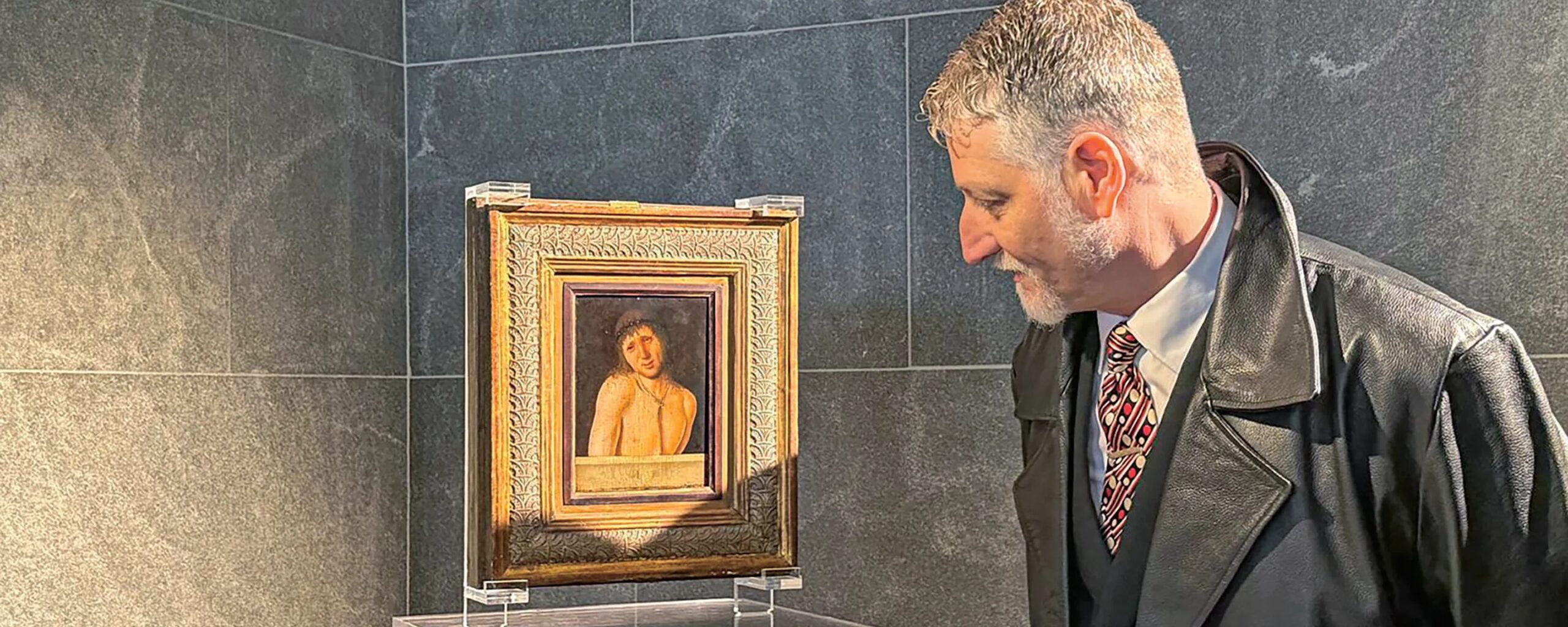
Next to Caravaggio, a long list of missing masterpieces. There is the Madonna del Sewing by Francesco Cozza, stolen from the Church of San Bernardino in Molfetta in 1970. The Madonna dell’Orto by Giovanni Bellini, which disappeared in Venice in 1993 and for which Felice Maniero was initially suspected. And again Cristiano Banti at the spinet of Giovanni Baldini, stolen from Florence in 1995. A two-faced herm from the 2nd century. A double-sided watercolor by Cézanne (Path between the rocks and Landscape on the lake). A sanguine depicting Saint John the Baptist attributed to Leonardo da Vinci. Until last year, this most wanted list also included an Ecce Homo by Antonello da Messina, stolen in 1974 from the Broletto museum in Novara for a value, at the time, of 300 million lire. The painting, after fifty years of research and investigations, has finally been found. Two weeks ago the Minister of Culture Alessandro Giuli personally went to the United States to bring it back to Italy and today it is exhibited in the Senate.
We are therefore talking about works whose value is difficult to quantify because, outside the legal market, their price becomes abstract. And then the question is inevitable: where do these masterpieces end up? “Often years later we find them perhaps in museums or galleries abroad”, explains an investigator who wishes to remain anonymous. «The sales over the years are varied: perhaps initially they are resold on the illegal market, more and more often on the dark web. And then, after various sales, they perhaps arrive at auction houses. Without even the owners knowing that that work, in reality, comes from Italy and is the result of theft.”
A mechanism that is confirmed in concrete cases. Like that of Lorenzo Delleani’s painting Landscape with figures and storm in the background from 1899, stolen in 1982 and recovered only recently. The work had been put up for sale by a woman who had inherited it from her father, completely unaware of its illicit provenance. It was returned to GAM in Turin.
Other times, however, the works end up directly in international public collections. And this is where diplomacy comes in. Over the last year, according to the latest report seen by Panorama, Italy has initiated over 20 proceedings with various European countries, from the United Kingdom to Norway. Some have concluded positively, others remain open.
Among the most emblematic cases is that of the Victorious Athlete, a Greek sculpture from the 4th century BC, probably created by Lysippos. Also known as the Athlete of Fano, it was recovered from the sea off the coast of the Marche region. Today, however, it is exhibited at the Getty museum in Los Angeles. A dispute has been ongoing between Italy and the United States for years. The Court of Cassation established Italian ownership and the European Court of Human Rights also confirmed this position, rejecting the appeal presented by the American museum. Despite this, the gallery continues to oppose the restitution.
Another very complex process concerns the seven archaeological finds identified in the collections of the Louvre, in Paris. A case blocked by a regulatory obstacle: French legislation does not allow the de-ownership of cultural assets by administrative means. And it is for this reason that now, according to what we read in the dossier, “we are proceeding along a double track, namely the judicial one and the diplomatic one”.
Even more intricate is the story of the fragments of a clay throne from the Greek-archaic period, now kept at the Kunsthistorisches museum in Vienna and believed to come from the archaeological site of Morgantina, in Sicily. The Enna Prosecutor’s Office initiated criminal proceedings and forwarded an international letter rogatory to Austria to obtain the return of the artefact, but Austria rejected the request. For this reason, “a diplomatic dialogue was initiated with the museum for the return of the artefact, which goes hand in hand with the request for an opinion from the State Attorney’s Office”.
Also singular is the case of the astrolabe from 1455, stolen in 1797 by Napoleon’s troops from the Basilica of San Zeno Maggiore in Verona and then passed through various private collections, until it was exhibited in various international museums and antiques fairs. In 2022 it was put up for sale at the prestigious antiques shop Daniel Crouch Books in London. The criminal proceedings ended with dismissal due to the “lack of reciprocity between Italy and the United Kingdom regarding crimes linked to the illicit export of cultural goods”. Today the path of cultural diplomacy is being attempted with the involvement of Eurojust (the EU Judicial Cooperation Agency).
Finally, fortunately, there is no shortage of positive signs. As in the case of the marble bust of Emperor Alexander Severus, identified in Germany. «Following a new impulse from the judicial authorities» we read in the report «the German authorities have contacted the undersigned ministry and negotiations for the return of the find are still underway».