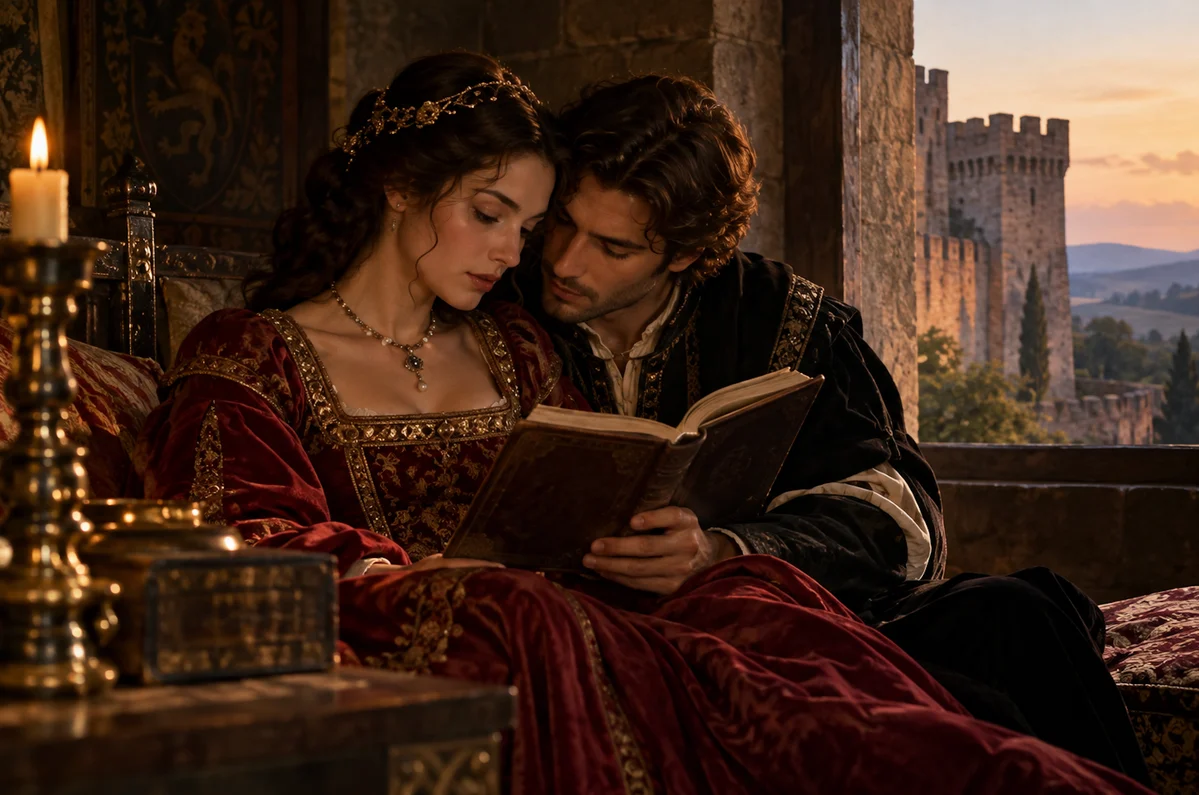
There are books capable of changing a life. And then there are books that, at least in literature, become the beginning of a tragedy. What Paolo Malatesta and Francesca da Polenta were reading together, on an unspecified day in the second half of the thirteenth century, belonged to the second category. It told of knights, of impossible promises and of a love that should never have existed, that between Lancelot, the most celebrated of the knights of the Round Table, and Guinevere, wife of King Arthur. A story born in the French chivalric imagination, destined to find a second life in medieval Italy and to become, thanks to Dante Alighieri, the symbol of a feeling as irresistible as it is destructive.
The place where tradition places this story is the Gradara Castle, in the Marche region, a few kilometers from the border with Romagna. An imposing fortress, surrounded by two walls, with crenellated towers and elegant environments which still today convey the atmosphere of a Middle Ages made up of intrigues, marital alliances and family rivalries. A castle which, behind the romantic image built over the centuries, preserves a decidedly darker memory: that of two murdered lovers and of a murder that poetry would transform into a universal myth.
Paolo and Francesca, when love became a question of power
To understand the tragedy we must forget, at least for a moment, the romanticism with which we are used to looking at it. Francesca da Polenta was not a heroine free to choose her own destiny, but the daughter of a powerful Ravenna family, destined for a marriage that responded above all to political needs. Her husband, Giovanni Malatesta, known as Gianciotto, belonged to the dynasty that dominated Rimini and other territories between Romagna and Marche. The wedding represented an alliance between families, one of the tools through which power was built and maintained in medieval Italy.
Paul, brother of John, was instead the protagonist of a forbidden feeling that would span the centuries. According to literary tradition, an attraction was born between him and Francesca which was destined to turn into a clandestine relationship. And precisely this relationship would have been at the origin of their violent death at the hands of Gianciotto, generally placed by scholars in the 1280s.
We don’t know for sure where the murder took place. Tradition indicates Gradara, which belonged to the Malatesta possessions and where Francesca may have stayed, but there are no documents that allow the fortress to be definitively identified as the scene of the crime. This did not prevent the castle from becoming, over the centuries, the symbolic place of their story.
The forbidden book: what does Lancelot and Guinevere have to do with it?
The most surprising part of the story, however, concerns the book that Paolo and Francesca were reading. Not a religious text, not a collection of love poems, but one of the romances of the Arthurian cycle, belonging to the French tradition of Lancelot, in which love and chivalric loyalty continually came into conflict.
Lancelot was the ideal knight, brave, faithful, willing to sacrifice everything for his sovereign. Yet he kept a secret capable of undermining the entire balance of the kingdom of Camelot: he loved Guinevere, the queen, wife of the man to whom he had sworn loyalty. It was a devastating contradiction for the chivalric universe, in which duty and honor should have prevailed over any personal desire.
The parallel with Paolo and Francesca is immediate. They too lived a love incompatible with family and social bonds, they too found themselves faced with a choice between sentiment and the loyalty imposed by conventions. And it is precisely this similarity that transforms reading into something more than a simple pastime.
Dante, in the fifth canto of the Inferno, puts one of the most famous confessions in literature into Francesca’s mouth: «One day we read for pleasure». The two are alone, they leaf through the pages, they look for each other with their eyes, they turn pale while the story of the protagonists of the novel seems to reflect more and more closely what they are both experiencing.
Then comes the decisive step. Lancelot kisses Ginevra and Paolo, overwhelmed by an emotion that he can no longer hide, repeats the gesture. Francesca says that “my mouth kissed me trembling”.
It’s the kiss destined to change everything. Literature stopped being just a story told by others and transformed into a real gesture, in which the two readers recognized and finally declared their own desire.
Galeotto was the book: the character hidden behind Dante’s most famous phrase
However, there is a detail that makes the connection between the Arthurian legend and the Italian tragedy even more fascinating. When Francesca pronounces «Galeotto was the book and who wrote it», Dante is not simply using a figure of speech. He is referring to a specific character from the Lancelot tradition.
Galeotto is in fact the Italian form of the name Galehaut, a fundamental figure of Lancelot in prose, the knight who favors the love encounter between Lancelot and Guinevere, acting as an intermediary between the two. Without his intervention, that love would have encountered even greater obstacles in manifesting itself.
In Dante’s story, the book takes on exactly the same function. He becomes the involuntary accomplice of Paolo and Francesca, the intermediary who allows two people incapable of openly declaring themselves to find in the words of others the courage to recognize what they feel.
From here also comes the meaning that the expression has retained in the Italian language: being a convict means encouraging a sentimental encounter, often unexpected or forbidden.
But in the case of Paolo and Francesca there is a fundamental difference. The book is not only the medium of a love, it is also the narrative element that accompanies the two towards a tragedy. Not because reading materially causes murder, but because Dante builds around those pages the moment in which desire exceeds a threshold from which there is no turning back.
An honor killing before this definition even existed
The dark side of the story emerges precisely in the contrast between the delicacy of the kiss and the brutality of the death. Tradition says that Gianciotto, having discovered the relationship between his wife and brother, killed them both. A violence that belongs to a society in which marriage was often a political contract and the female body was also considered an instrument for protecting family honor.
It is possible to read the episode through the category of honor killing, even knowing that it is a later definition, and above all without confusing the social justifications of violence with its responsibility. According to tradition, the person responsible for the killing is Gianciotto, not the book, not Lancelot and not even the feelings of the two lovers.
Dante, however, performs an extraordinary operation. It places Paolo and Francesca in the second circle of Hell, among those who have subordinated reason to desire, but at the same time makes them protagonists of a story capable of arousing very deep compassion. Francesca speaks, remembers and suffers; Paolo remains next to her, crying. At the end of the meeting, pilgrim Dante is so overwhelmed by pity that he loses consciousness.
The poet does not erase the dimension of sin, which remains central to the moral architecture of the Comedy, but restores to the two lovers a human depth such as to make them survive, in the readers’ memory, the same infernal condemnation.
Francesca’s room in Gradara, between history and legend
Today, anyone who visits the Rocca di Gradara can enter the so-called Francesca’s Room, one of the most evocative rooms of the castle. There you will find the lectern which evokes the book of the tragedy, the furnishings and even a trap door linked to the story of Paolo’s escape attempt.
Yet here too the story is intertwined with the construction of the myth. The current layout of the room dates back to the restorations carried out in the 1920s by Umberto Zanvettori, who wanted to recreate a medieval atmosphere also taking inspiration from the tragedy Francesca from Rimini by Gabriele D’Annunzio, performed for the first time in 1901.
We are therefore not faced with a crime scene preserved intact for seven centuries, but with a cultural reconstruction, the result of a tradition that has continued to reinvent and interpret the story. And this is perhaps precisely the most interesting part of Gradara’s history: the way in which a medieval episode, with still uncertain circumstances, became a heritage of the collective imagination.
Lancelot and Guinevere belonged to a legendary universe of knights, tournaments and distant castles. Paolo and Francesca were instead figures linked to families and the power struggles of thirteenth-century Italy. Dante managed to bring these two worlds together through a single gesture, a kiss read on the pages of a novel and repeated in poetic reality.
Seven centuries later, while the walls of Gradara continue to dominate the Marche hills, the most interesting question is not only whether Paolo and Francesca really kissed in one of the rooms of the castle. It’s how an invented love story, that of Lancelot and Guinevere, was able to give shape to a real tragedy, to the point of becoming inseparable from it.
Because in Gradara the legend of King Arthur has not survived through the exploits of a knight or the search for the Holy Grail. She survived through a book, two lovers and a kiss that literature has made eternal.