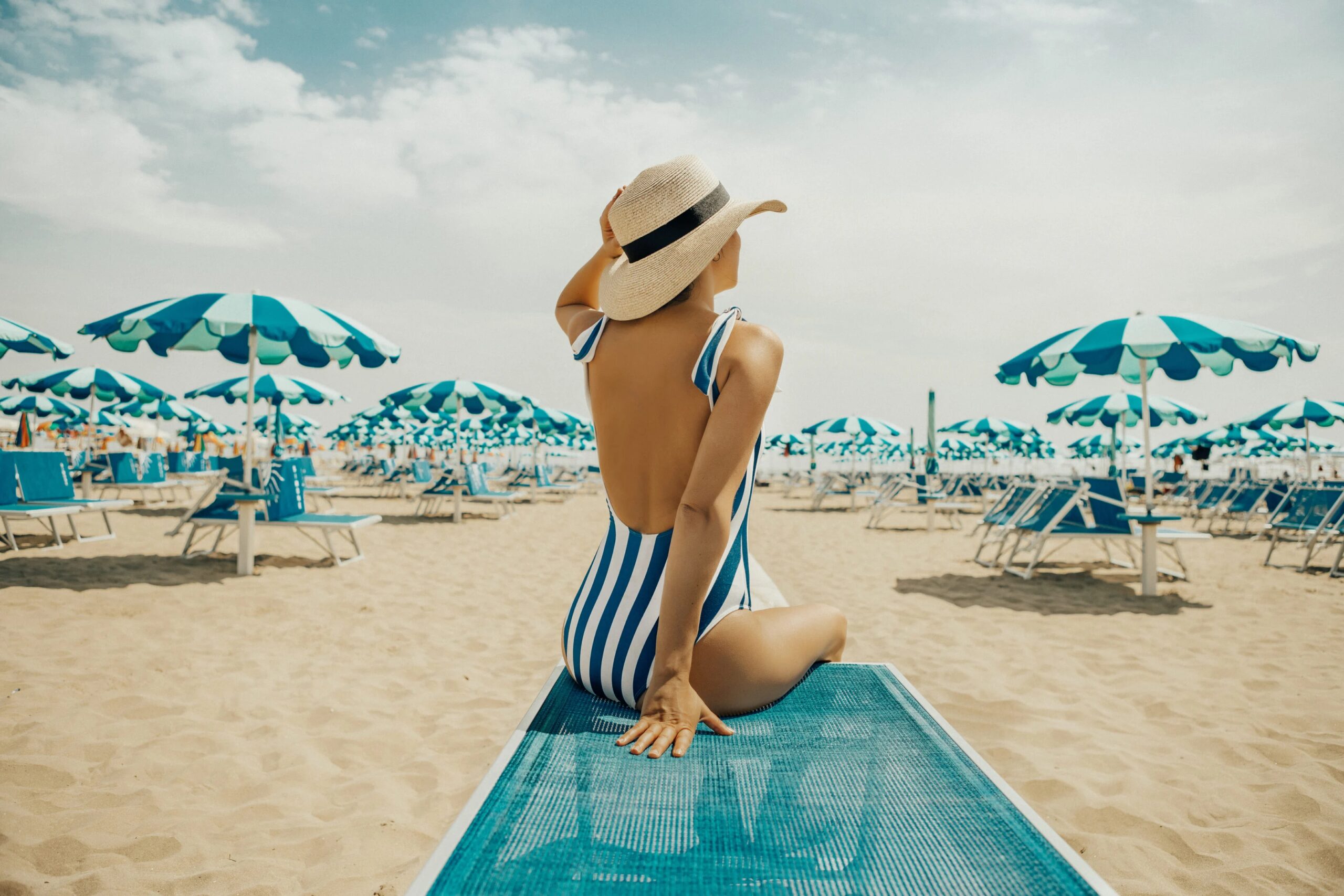
The Italian summer begins even before arriving at the beach: faced with the estimate of an umbrella and two sunbeds. Even in 2026, the national ritual of beach holidays presents a higher bill. According to the new survey by Altroconsumo, the prices of beach establishments have increased on average by 6% compared to 2025 and by 24% in the last five years. In some places, price increases reach up to 16%.
The data photographs a now structural phenomenon. Going to the seaside, especially in the central weeks of summer, is no longer just a question of destination, but also of budget. The difference between one location and another can reach almost 200 euros for a week with umbrella and sunbeds. A distance that weighs on families and promptly reopens the debate on beach concessions, free beaches and economic accessibility of the sea.
How much does it cost to go to the beach in summer 2026
The survey examined 222 beach establishments distributed in ten Italian locations: Lignano, Rimini, Senigallia, Viareggio, Palinuro, Alassio, Gallipoli, Alghero, Taormina-Giardini Naxos and Anzio. The rates were collected for the first week of August, from 2 to 8 August, asking for the cost of an umbrella and two sunbeds in the first four rows.
The result is an increasingly expensive seaside Italy. The average tariff in the monitored locations went from 182 euros in 2021 to 225 euros in 2026, with an increase of 24% in five years. In the last year alone, the average increase was 6%.
The cost also changes based on the location on the beach. In the first week of August, the first row costs on average 238 euros. The second one drops to 229 euros, the third to 219 euros, while from the fourth row onwards the average price stands at 210 euros. Numbers that confirm how the place closest to the sea has, in fact, become a small premium category.
Alassio is the most expensive, Lignano is the cheapest
Among the locations analysed, Alassio is confirmed as the most expensive. For a week in the front row with an umbrella and two sunbeds you spend an average of 368 euros. Considering the average of the first four rows, the cost still remains the highest in the survey: 340 euros.
Immediately after come Gallipoli, with an average of 324 euros, and Alghero, where a week in the factory costs on average 274 euros. At the other extreme is Lignano, which is the cheapest location among those monitored, with a weekly expense of 164 euros.
The prices recorded in Rimini and Senigallia are also lower, where the average cost for a week remains under 160 euros. A wide range, which shows how the choice of location can have a decisive impact on the final cost of the holiday.
Where price increases are strongest
The heaviest price increases are recorded in Taormina and Giardini Naxos, where the increase compared to 2025 reaches 16%. Followed by Alghero, with +14%, and Gallipoli, with +10%. In the other locations examined, the increases are more contained, between 2% and 7%.
The point, however, is not just the annual increase. It is the trajectory of recent years that tells of the transformation of the equipped sea into an increasingly demanding expense item. Between inflation, management costs, tourist demand and the scarcity of truly accessible alternatives, the lido has become one of the most evident symbols of the high cost of holidays.
The problem of free beaches
In theory, faced with rising prices, the simplest solution would be to choose the free beach. In practice, however, free spaces are often limited, peripheral or devoid of essential services. And it is precisely here that the political and social knot of the Italian seaside system opens up.
Altroconsumo recalls the case of Spotorno, where the Municipality has increased the share of free beaches guaranteeing minimum services such as cleaning, lifesaving, cold showers and bathrooms. A model that tries to overturn the idea of the free beach as a residual area, transforming it instead into a dignified and central space for tourism.
The issue does not only concern the price of the umbrella. It concerns the right of access to the sea, which in a country surrounded by coasts should remain a usable asset and not an increasingly expensive privilege.
What Italians choose
According to the consumer survey, 37% of Italians prefer the equipped beach, i.e. establishment or free for a fee, while 35% mainly choose the free beach, with or without services. More than a quarter of those interviewed declared themselves open to both solutions.
Those who choose the establishment do so above all for the services and equipment, indicated by 80% of those interviewed. Those who prefer the free beach, however, do so mainly because it is free, a reason indicated by 79%, but also for the freedom to decide where to go every day, indicated by 63%.
The data confirms an evident divide: on the one hand the need for comfort, services and safety; on the other, the need to contain costs and maintain freedom of access which factory prices are making increasingly complicated.
The crux of beach concessions
Ultimately, the big question of concessions remains. According to Altroconsumo, the current system continues to penalize citizens: despite concessions often awarded at low costs, consumers pay increasingly higher rates to use private establishments.
Among those who know the topic of beach concessions, 63% believe that a reform should lead to a reduction in prices for customers. Furthermore, one in two consumers underlines the need to introduce periodic replacement in the management of beaches.
The topic is not new, but rising prices make it more urgent every summer. Because the sea, a public good by definition, risks becoming more and more expensive at a time when many families are already cutting expenses, vacation days and consumption.
Summer 2026, therefore, does not only bring more expensive umbrellas. It also brings a question that is increasingly difficult to ignore: how much must a citizen pay to access an equipped beach, and how much of the Italian sea must truly remain free?