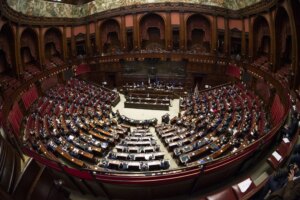
Now that Carnival is approaching, with all its masks, there is a strong urge to ask those who govern us to drop theirs. Enough with the talk of convenience, with the poses, with the hypocritical staging: the king is now naked
What is the prevailing sentiment or sensation in this historical and political moment, among people, in relations between public and private, in the consideration of those who have public roles and support issues of general interest? The most widespread perception, even if often implicit and unaware, is that we find ourselves in front of or inside a Great Performance, with its jargon and its poses. Everyone plays a part, says the predictable and obvious things that conform to their role, never surprising by saying something different from the cliché and the mask they wear. And the Carnival which is now arriving is the right time to denounce this permanent theater of masks.
We participate or witness a performance in which reality, truth, authenticity, history do not matter at all; an assigned or coveted part is played, a pre-cooked and false lexicon is used, an altered and domesticated story is used, certain things are said and others are omitted because it is convenient. Not only in the vulgar sense of convenience, but also in the hypocritical sense of convention, good manners, opportunities for rank. The political leaders and their peons act, the opinion makers and in general those who appear in the media act, the intellectuals and public figures of all kinds act. Including prelates and magistrates. Anyone who gets on a stage, that is, anyone who speaks beyond the strictly private sphere, must assume a posture, a movement, a language that does not correspond to what he really is, thinks or wants, but to what is required in that moment in his position. They don’t really express what they believe and think but they stick to a canon, to a series of precautions, careful not to offend protected susceptibilities, not to touch any delicate points; they support theses that are functional at the moment, capable of generating minimal profits or at least accessing a threshold of common acceptability. They are situationists, they say things based on the conditions of place, time and the profit margins that can be obtained from saying it. But always inside their uniform or livery. A thesis espoused yesterday is overturned today because your opponent now supports it, in an unscrupulous war of positions. Identity, heritage and one’s history are quickly set aside, abjured or reversed, because it is more useful that way.
In this way, when faced with less than credible reconversions it is natural to observe: but why didn’t you say it before that you thought this way, why did it take you so long and are only saying it now because you have reached that position of power, why did you delude so many if you didn’t believe what you said?
Many current examples could be given, from reversals in terms of justice and career separations, to fascism and anti-Semitism, from international alliances and tensions to issues of security and the family. Meloni recites, even if she appears truthful, and her allies and subordinates recite, even at the top of the institutions; recite Conte and Schlein, their affiliates and many public figures who parade in the media. The intellectuals act and do not dare to go beyond the dominant prejudices but stick to them, they do not question what puts their role at risk but only say what consolidates it within a habitat, of an established power. The most astute ones use what Theodor Adorno called the “jargon of authenticity”; it is a jargon that simulates truthfulness but is intimately false and lying.
Once upon a time there was a profession explicitly assigned to this task: the lawyer espoused the cause he was entrusted with, he might not intimately believe in it or not believe his client, but his work led him to defend it and to embrace consequent theses in the legal forums: now that profession has spread almost universally, it responds only to the fee and not to true convictions. The idola fori, of which Bacon spoke, coincides with the idola tribus and the idola theatri. Idols are the prejudices or lexical forms adopted to assume or maintain a role. The woke code, the politically correct are the updated re-edition of these fictitious and prefabricated thoughts; that language is also part of the Great Performance.
In the times of Marx and Nietzsche, two great debunkers, the bearers of hypocrisy and bigotry were called philistines; but they were a class of clerics, of scholars or apparently so, perhaps of professors, in any case of wealthy bourgeois; today their acting is a requirement for anyone who appears on the stage of power and public relations. There is no political statement that has any bearing on identity, historical truth and the authenticity of passions and beliefs; everything is reduced to tactics and results, the need to please even at the cost of hiding and pursuing practical goals.
One of the most serious effects that this acting produces in people is widespread distrust and therefore general distrust. And its direct consequence is abstention from voting, disaffection towards the institutions, the collapse of credibility of the ruling classes – politicians, governors, magistrates, bishops, communicators…
The audience should show even more openly signs of impatience with this continuous acting. We are not stupid and we are not children. At least spare us the hypocrisy or we will desert your theaters more and more.