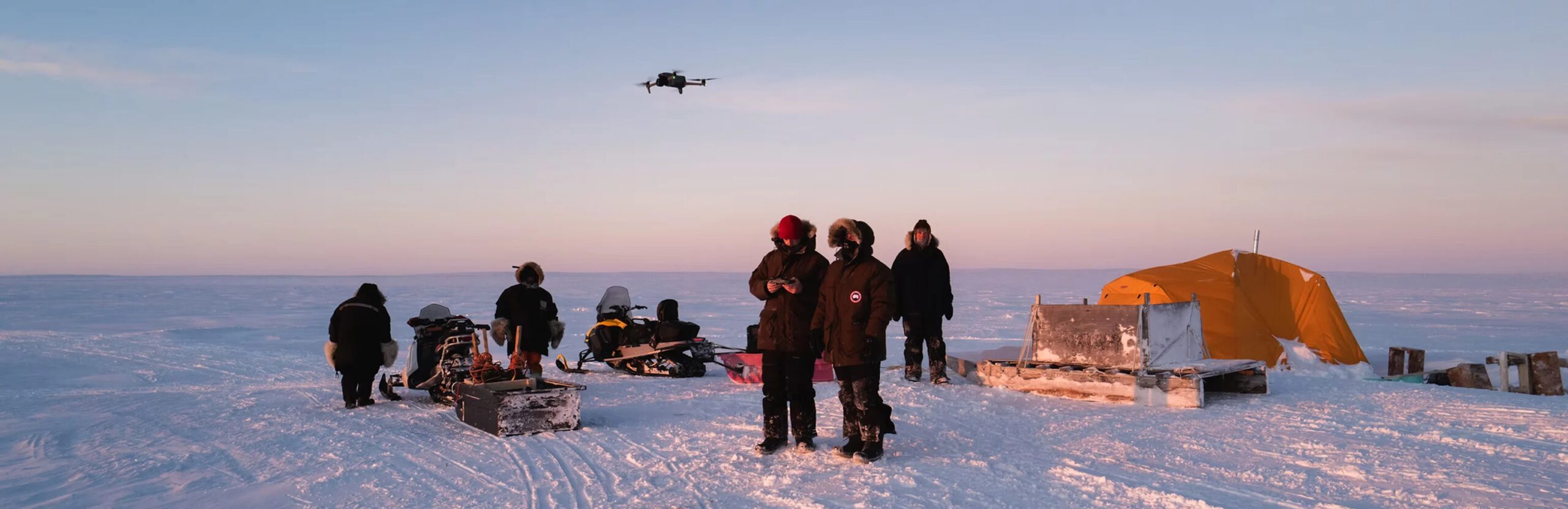
By pumping hundreds of thousands of cubic meters of seawater onto the sea ice, scientists are trying to thicken it to reduce global warming. It works a little
Refreezing the Arctic: if the idea seems absurd to you, know that the experiment is underway on a small scale and the results are satisfactory. The aim is to maintain the sea ice’s ability to reflect solar radiation into space for longer, reducing heat absorption by the ocean and attenuating one of the main mechanisms accelerating global warming. In short, the more solar radiation is reflected, the lower the heat.
The experiment, underway in the Canadian Arctic, near Cambridge Bay, in the territory of Nunavut, is being conducted by a large team of researchers linked to the Real Ice project, developed together with British research institutes and the University of Cambridge. During the coldest months of the year, holes are drilled into the sea ice and submersible pumps draw seawater from the ocean level below, bringing it to the surface. This is distributed on the ice and freezes rapidly in contact with the polar air, forming a new layer that is added to the natural one.
The operations are repeated several times during the winter on delimited and monitored areas, compared with nearby areas left intact to precisely measure differences in thickness, structure and behavior during the summer melting season. In some experimental campaigns, tens of thousands of cubic meters of sea water were pumped over surfaces of about a quarter of a square kilometre, with increases in the thickness of the ice reaching several tens of centimeters compared to natural conditions in the most successful cases.
Every summer the Arctic loses large portions of its sea ice, a phenomenon that worries the scientific community because sea ice is a key element of the global climate system. Its clear surface works like a natural mirror: it reflects up to 80-90% of solar radiation into space. As the ice shrinks, it gives way to the dark ocean below, which instead absorbs much of the sun’s energy, raising the temperature of the water and triggering further melting. This positive feedback mechanism is known as the “albedo effect” and is one of the main accelerators of Arctic warming. The researchers’ intervention, which takes place during the winter, when temperatures can consistently drop below -20°C and even reach -40°C, was tested on a limited area, divided into several experimental and control areas, to precisely measure the differences between treated ice and natural ice. Overall, hundreds of thousands of cubic meters of sea water were pumped, distributed through repeated intervention cycles.
The risk that this type of research seeks to contain is that of an almost ice-free summer Arctic, the so-called “Blue Ocean Event”, which various climate models potentially place in the coming decades if greenhouse gas emissions continue at current rates. An ice-free ocean would mean a sharp increase in solar energy absorption, with knock-on effects on atmospheric currents, ocean circulation and the frequency of extreme events in the Northern Hemisphere.
«The results observed in the field show measurable differences between treated and untreated areas. At the end of the season, the ice subjected to “artificial flooding” is on average thicker, with increases of around 30-32 centimeters compared to the control areas” says Edward Blanchard-Wrigglesworth, atmospheric scientist leading the project, “and it is also more reflective, with a measurable reduction in melting compared to untreated ice”.
Alongside the scientific interest, however, numerous unknowns remain. The impact on ecosystems under the ice, possible alterations in surface salinity, energy and logistical costs and, above all, the fundamental question: the risk of considering geoengineering as a substitute for reducing emissions. We must be clear: this type of intervention cannot stop climate change, but at most slow down some of its effects if carried out on a large scale.
The only truly decisive lever remains the reduction of global greenhouse gas emissions. However, if even just a part of the Arctic summer ice could be preserved for longer thanks to interventions of this type, the climate system would absorb less energy in the short term, gaining precious time in an already extremely critical transition phase. From this perspective, it is not a question of “refreezing” the Arctic in a definitive sense, but of intervening on a fragile balance to slow its collapse, while the rest of the global energy system tries to change direction. Or, at least, so we hope.