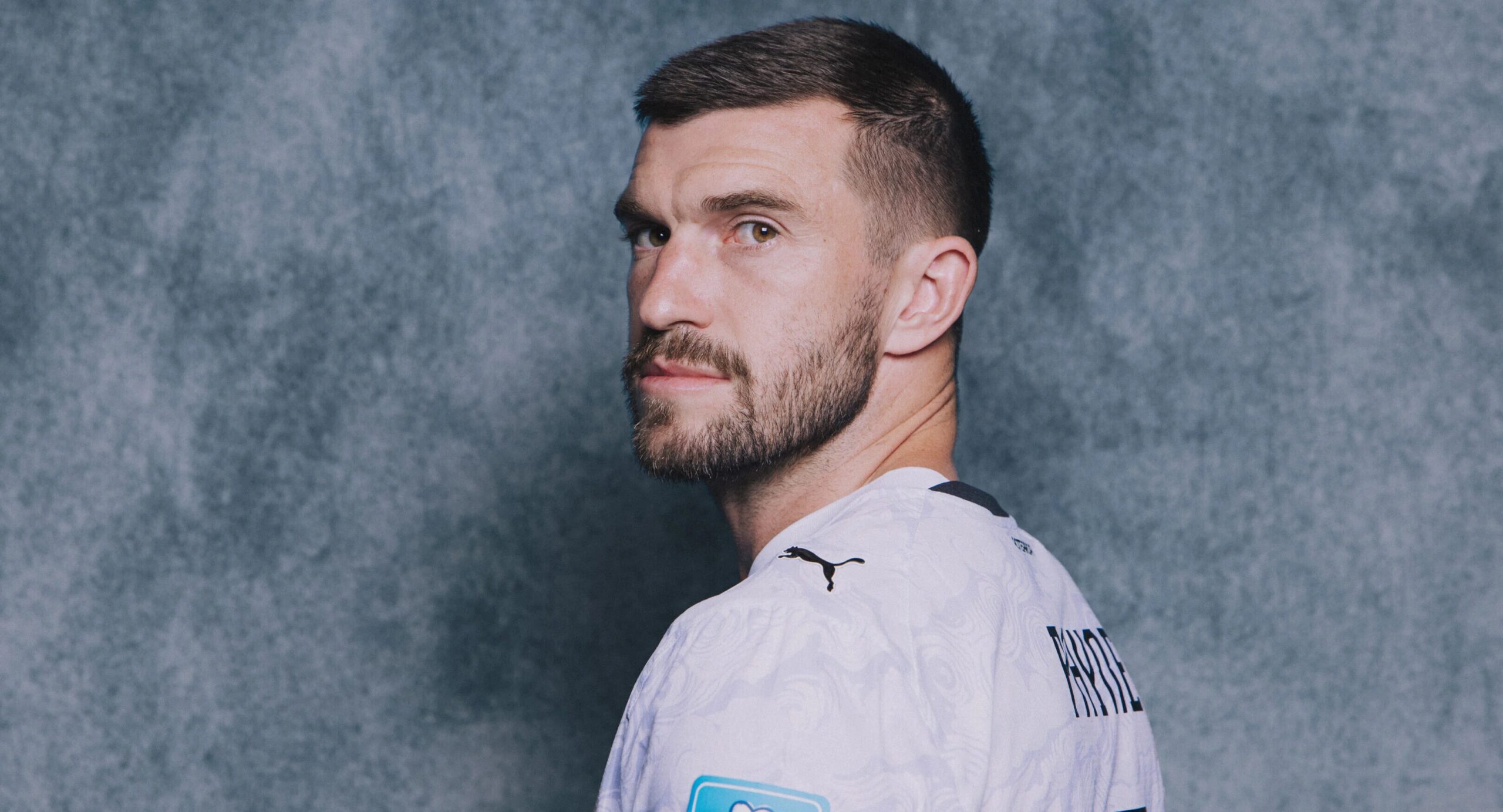
There are stories that football builds with goals, with tears, with falls in the penalty area and with the nights in which a foot decides the fate of a nation, and then there are stories that contemporary football delivers directly to the algorithm, leaving it up to the social networks, even more than the scoreboards, to establish who deserves to become a face, a catchphrase, a small lateral myth within the great machine of the World Cup. This is the case of Tim Payne, a 32-year-old New Zealand defender, player for Wellington Phoenix and the New Zealand national team, who until a few weeks ago was a name known above all by fans of oceanic football and who, suddenly, found himself in one of the most curious parables of the 2026 World Cup: that of the almost invisible footballer who became, in the space of a few days, a global social media phenomenon.
The point, of course, is not just football. Indeed, perhaps football here is almost the pretext, the frame, the illuminated field within which something happens that belongs much more to contemporary pop culture: the transformation of a normal, serious, not very media-focused athlete, far from the hyper-produced aesthetics of international superstars, into a character observed by millions of people who knew nothing about him until the day before. Not the new Messi, not the new Cristiano Ronaldo, not the predestined cover talent, but the unexpected face of a World Cup which, even before being played to the end, has already demonstrated how fame today can arise in a lateral, ironic, sudden and almost sentimental way.
The “lesser known” footballer became the most searched for
The spark came from Argentina, not from a goal in the ninetieth minute. Valen Scarsini, a creator known on social media as El Scarso, began looking for what could be the least known player of the 2026 World Cup, identifying the perfect candidate in Tim Payne: few followers, little international exposure, a solid career but far from the noisiest spotlight, the ideal profile for a collective experiment capable of transforming anonymity into popularity. From there, the mechanism did what social media does best: it took a small story, made it shareable, gave it a name, a face, a goal and a community ready to participate.
Payne, who had just over 4,700 followers on Instagram, saw his account explode in an almost surreal way. First hundreds of thousands, then millions. In just a few days, the New Zealand defender went from being a player followed by a niche of fans to a name capable of appearing in the feeds of half the world, with such rapid growth that he surpassed, at least in terms of digital curiosity, much more well-known figures in New Zealand sport and public life. It is the type of phenomenon that perfectly describes our times: you don’t necessarily need to already be famous to become famous, you just need to be chosen by the right story at the exact moment in which the world wants a simple, funny, clean and viral story.
Who is Tim Payne: career away from the spotlight
Yet Tim Payne is not a character invented by the internet, nor a footballer who ended up there by chance. Born in New Zealand, raised in football between Auckland City and Waitakere United, and also played for Blackburn Rovers at a very young age, Payne has built his career far from the great European narratives, crossing clubs, championships and seasons with that type of solidity that rarely becomes glamorous but which, in real football, weighs heavily. Today he plays for Wellington Phoenix, a club in the Australian A-League, where he is considered an expert, reliable element, capable of occupying multiple roles and giving balance to a team that has experienced an important phase of its growth in recent years.
His official profile describes a 32-year-old footballer, born in Papakura, 1.79m tall, defender, a point of reference for New Zealand and linked to Wellington Phoenix by a three-year renewal signed in December 2024, until the end of the 2027-28 season. Not exactly the resume of a meteor. Rather that of a professional who has experienced football in its less glittering and perhaps truest form, the one made up of training sessions, away games, contracts, injuries, returns, expectations, qualifiers and matches that do not end up in global trends but build a career.
This is why its virality works. Because it does not arise from the star’s pose, but from the contrast between the normality of the character and the sudden enormity of the audience watching him. Payne doesn’t come before global audiences as an athlete built to please, he doesn’t seem to chase attention, he doesn’t play the part of the designated protagonist. He simply finds himself at the center of a gentle storm, one of those stories in which the internet decides to take a lateral name and bring it to the center of the scene, almost for fun, almost out of affection, almost to demonstrate that the World Cup does not only belong to the millionaire champions, but also to the faces that no one had foreseen.
The social boom that talks about the new World Cup
The Tim Payne case also says a lot about how the World Cup has changed. Once upon a time, popularity almost always arose from the pitch: an overhead kick, an impossible save, a celebration that entered the imagination, a match that transformed a player into a national hero. Today, however, glory can arrive before the kick-off whistle, outside the stadium, inside a platform, through a video, a challenge, a community that decides to follow a person not because he has already done something memorable, but because his anonymity suddenly becomes an irresistible narrative.
It is a new form of sports celebrity, less linear and more emotional, in which curiosity counts almost as much as talent, the face as much as the statistics, the personal story as much as the result. Tim Payne did not go viral because he scored the goal of his life, but because someone described his being “not very famous” as a collective possibility: to make him famous, to accompany him, to follow him, to transform him into the symbol of a World Cup seen not only from the stands and televisions, but also from phones, from comments, from screenshots, from memes, from online searches and from that very contemporary instinct that leads millions of people to want to participate in a phenomenon while it is happening.
In this sense, Payne is the perfect anti-star turned star. He doesn’t have the constructed aura of the superstars, he doesn’t have the golden past of the predestined, he doesn’t bring with him a gigantic commercial machine. If anything, it has something rarer: the surprise effect. And it is precisely the surprise effect that generates attention today. In a football where everything seems already written, where the most famous faces are global brands even before athletes, a New Zealand defender who goes from a few thousand followers to millions becomes an almost liberating story, because it reminds us that the public still loves to discover, adopt, elect someone from nothing and transform it into a small collective obsession.
New Zealand, the All Whites and an unexpected showcase
For New Zealand, this unexpected exposure also has symbolic value. The All Whites arrive at the 2026 World Cup with a very different footballing history compared to the great powers of the tournament, without the media habit of Brazil, Argentina, France, England or Germany, and with a national team which, for the international general public, often remains on the margins of the great footballing story. The Payne boom, although born from an almost playful social dynamic, also shone a light on that movement, leading millions of people to wonder who he was, where he played, what his history was and what role he had in the New Zealand national team.
This is where the phenomenon becomes more interesting than simple follower counts. Because virality, when it works, doesn’t stop at the number. He opens a door. Payne has become a name searched for, commented on, shared, but together with him, the Wellington Phoenix, the New Zealand national team, the All Whites, a piece of football less traveled by the routes of big European business, also entered the conversation. And so an experiment born for fun ended up giving real visibility to an athlete and, indirectly, to an entire football periphery which in the World Cup finds its most important opportunity to exist before the world.
Of course, it remains to be seen how long it will last. Social media is very quick to create a phenomenon and equally quick to consume it, moving your gaze from one face to another with the same ease with which you change videos. But this is precisely why the Payne case is fascinating: because it does not necessarily promise eternal fame, it does not claim to rewrite the history of football, it does not ask to be taken too seriously. Rather, it tells of the way in which a sudden, fragile and very powerful celebrity is born today, capable of transforming an expert defender into a global character without going through the traditional channels of sporting consecration.
Tim Payne is the most unexpected face of the social World Cup
Every World Cup has its heroes. Some lift trophies, others miss penalties, still others become memes, symbols, catchphrases, lateral icons of a tournament that lives both on and off the field. Tim Payne belongs to this last category, that of characters who had not been announced, who did not appear in the favorites lists, who no one had prepared for the cover and who for this very reason end up telling something more authentic about the relationship between sport, the public and the digital imagination.
His story does not erase the football played, but accompanies it with a very contemporary question: who decides who becomes famous today? The goals, of course. The victories, again. Talent, always. But also an Argentine creator, a successful video, a community that has fun, an algorithm that pushes, a global audience that wants to adopt an outsider and bring him to the center of the scene. Tim Payne, defender of New Zealand, is not only the footballer who went from 4 thousand followers to millions during the 2026 World Cup. He is the perfect reminder of a football that is no longer played only on grass, but also in the gigantic digital curve of social media, where sometimes it is enough to be the least known man of the tournament to suddenly become the one everyone wants to know.