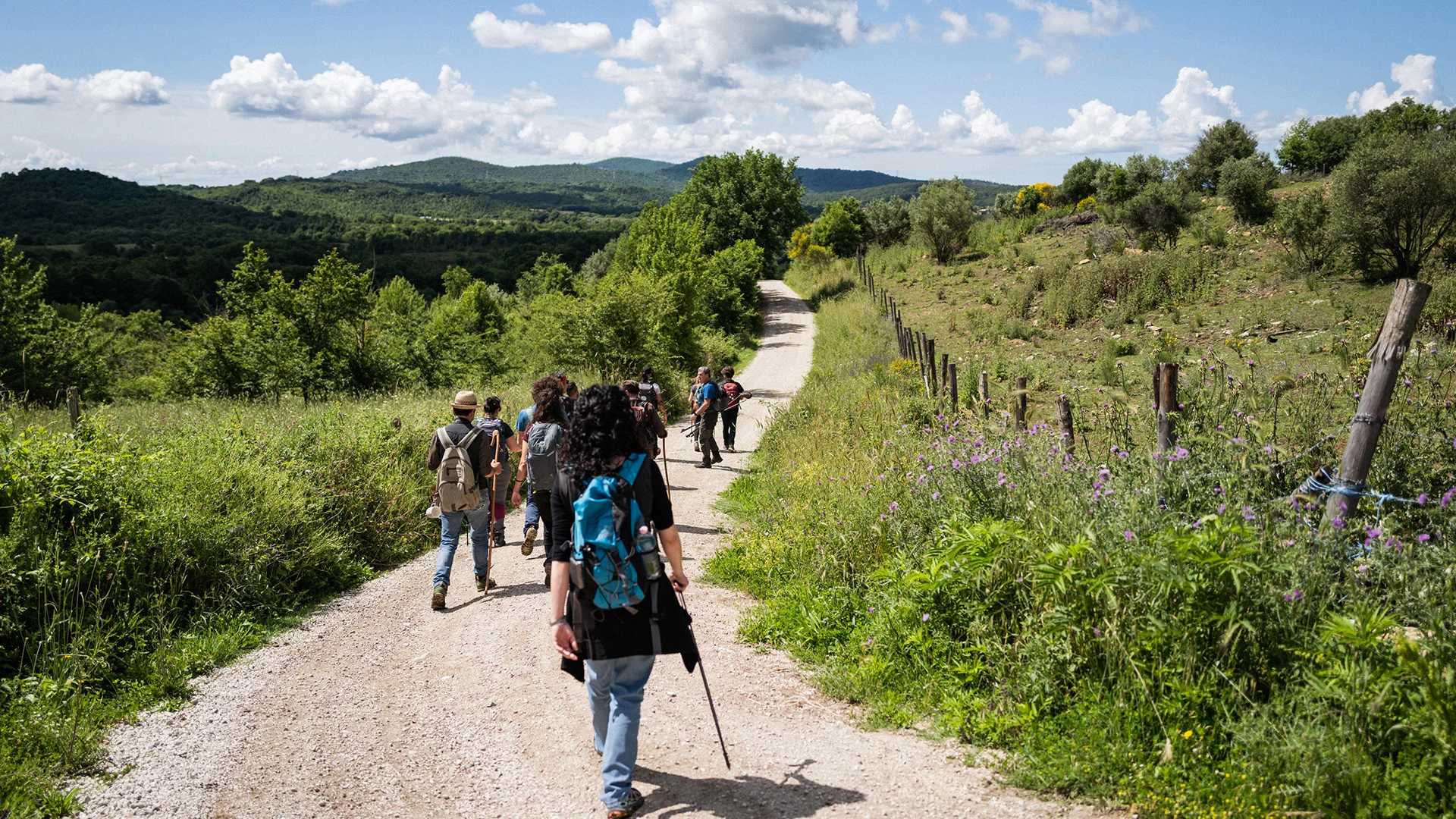
The international promotion of the great historical and religious routes that cross Italy is strengthened. Under the coordination of ENIT SPA – National Tourism Agency, in conjunction with the Ministry of Tourism, “Ancient Paths of Italy” takes shape: an integrated action, financed by the European Union – NextGenerationEU, dedicated to the valorisation of five itineraries of European importance – the Via Francigena, the Via di Francesco, the Cammino di San Benedetto, the Romea Strata and the Via Romea Germanica – with the aim of positioning Italy in a structured way among the international walking destinations.
Walking is now one of the fastest growing travel modes in Europe. The Cultural Routes Program of the Council of Europe, launched in Strasbourg in 1987 with the first recognition of the Routes of Santiago de Compostela, has built over the years a network of over forty certified supranational itineraries, identifying historical routes as a vehicle of shared heritage, intercultural dialogue and sustainable tourism. Italy participates in this system with a qualified presence: the five paths at the center of the new promotional action connect, in different ways and at different times, to this European framework and converge geographically towards Rome, connecting to the historical heart of Western pilgrimage.
Via Francigena
The Via Francigena is the most internationally recognized Italian historical path. In 1994 the Council of Europe certified it as a Cultural Route, like the Camino de Santiago. The route is based on the travel diary of Archbishop Sigeric of Canterbury, who in 990 AD wrote down the 79 stages (mansiones) of his return from Rome. The overall itinerary extends for approximately 3,200 kilometers from Canterbury to Santa Maria di Leuca, through England, France, Switzerland, Italy and the Vatican City. The Italian stretch from the Gran San Bernardo Pass to Rome measures approximately 1,000 kilometers divided into 45 stages, and passes through Valle d’Aosta, Piedmont, Lombardy, Emilia-Romagna, Liguria, Tuscany and Lazio. Among its most distinctive landscapes are the rice fields of Lomellina, the Cisa Pass, the Val d’Orcia, the Crete Senesi and the Tuscia of Viterbo. The management of the itinerary is entrusted to the European Association of the Vie Francigene (EAVF), recognized by the Council of Europe as the reference body.
Via di Francesco
The Way of Francis is a system of routes that unites the most significant places in the life of Francis of Assisi (1182–1226). It is divided into two main routes that converge in Assisi. The Northern Way, from the Sanctuary of La Verna to Assisi, extends for approximately 190 kilometers through the Foreste Casentinesi National Park, the Upper Tiber Valley, Sansepolcro, Città di Castello, Pietralunga, Gubbio – site of the famous episode of the wolf – and Valfabbrica. The Via del Sud, from Rome to Assisi, covers approximately 300 kilometers in 19 stages through the Sabine countryside and the Valle Santa Reatina, where the four Franciscan sanctuaries of Greccio, Fonte Colombo, La Foresta and Poggio Bustone meet, before climbing to the Valnerina and descending along the Spoleto Valley. The sanctuary of La Verna, in Tuscany, is universally associated with the event of the stigmata, received by Francis in 1224. At the end of the journey, at the Basilica of San Francesco in Assisi, the pilgrimage certificate, called Testimonium, is issued.
Way of St. Benedict
The Path of Saint Benedict, defined in its current route thanks to the documentation work of Simone Frignani, unites the three fundamental places in the life of the founder of Western monasticism: Norcia, his hometown (around 480 AD); Subiaco, where he lived for over thirty years and founded thirteen monasteries; Montecassino, where around 529 he founded the abbey which represents the reference point of the Benedictine Order and where, according to tradition, he wrote the Rule and died in 547. The route extends for around 300 kilometers in 16 stages on foot between Umbria and Lazio, crossing the Sibillini, Reatini, Simbruini, Lucretili and Ernici mountains, and touches places of particular spiritual and cultural density: Cascia, linked to Santa Rita; Rieti; Subiaco with the Sacro Speco and the Abbey of Santa Scolastica, considered the cradle of Italian printing for having hosted the first active printing press in Italy in 1465; Casamari; Arpino, birthplace of Cicero; Roccasecca, linked to the figure of Thomas Aquinas. Benedict of Norcia has been the patron saint of Europe since 1964, by proclamation of Paul VI with the apostolic letter Pacis nuntius.
Romea Strata
The Romea Strata is the most recent route to enter the system of Cultural Itineraries of the Council of Europe, which certified it on 17 June 2025. The route reconstructs the network of routes that led pilgrims to Rome from Central-Eastern and Baltic Europe. The overall development exceeds 4,000 kilometers across seven countries (Estonia, Latvia, Lithuania, Poland, Czech Republic, Austria, Italy), with 245 stages and over fifty UNESCO sites connected to the route. The main Italian stretch, from Tarvisio to the junction with the Via Francigena in Fucecchio, extends for approximately 1,000 kilometers in 47 stages through five regions – Friuli Venezia Giulia, Veneto, Emilia-Romagna, Tuscany and Lazio – and is flanked by branches that also include Trentino-Alto Adige and Lombardy. Among the most significant nodes: the Sanctuary of Monte Lussari, Concordia Sagittaria, Venice, Padua, the Abbey of Nonantola, Pistoia – where the only relic of San Giacomo Maggiore existing outside of Spain is preserved – and Bolsena. European coordination is entrusted to the European Romea Strata Association (AERS).
Via Romea Germanica
The Via Romea Germanica was certified as a Cultural Itinerary by the Council of Europe in 2020. The modern route reconstructs the journey described by Abbot Albert of Stade in the Annales Stadenses of 1236, in which a dialogue between two friars evaluating the possible roads to Rome becomes an opportunity to precisely document the route taken by the author. The overall itinerary extends for approximately 2,200 kilometers from Stade in Lower Saxony to Rome, in 94–97 stages through Germany, Austria and Italy. The Italian stretch measures approximately 1,050 kilometers from Brenner to Rome and crosses Trentino-Alto Adige, Veneto, Emilia-Romagna, Tuscany, Umbria and Lazio, connecting to the Via Francigena in Montefiascone. Among its hubs: Bressanone, Trento, Valsugana, Padua, Ferrara, Ravenna – with the Byzantine heritage recognized by UNESCO – the Casentinesi Forests, Arezzo, Cortona, Orvieto, Civita di Bagnoregio, Viterbo and Sutri.
An integrated vision
The coordinated promotion of the five paths responds to a specific need: to give systemic visibility to a heritage which, up to now, has found communicative expression in a fragmented way, with only the Via Francigena having a structured international recognisability. “Antichi Cammini d’Italia”, launched by ENIT in collaboration with the Ministry of Tourism, aims to fill this gap, positioning Italy as a European reference for slow cultural tourism. The strategy is based on an updated reading of the contemporary traveller: a person who seeks experiences even before destinations, who practices slowness as a conscious choice and who recognizes the journey – historical, naturalistic, spiritual – as a bridge between shared heritage and personal research. Five ways, one direction: Italy discovered on foot.