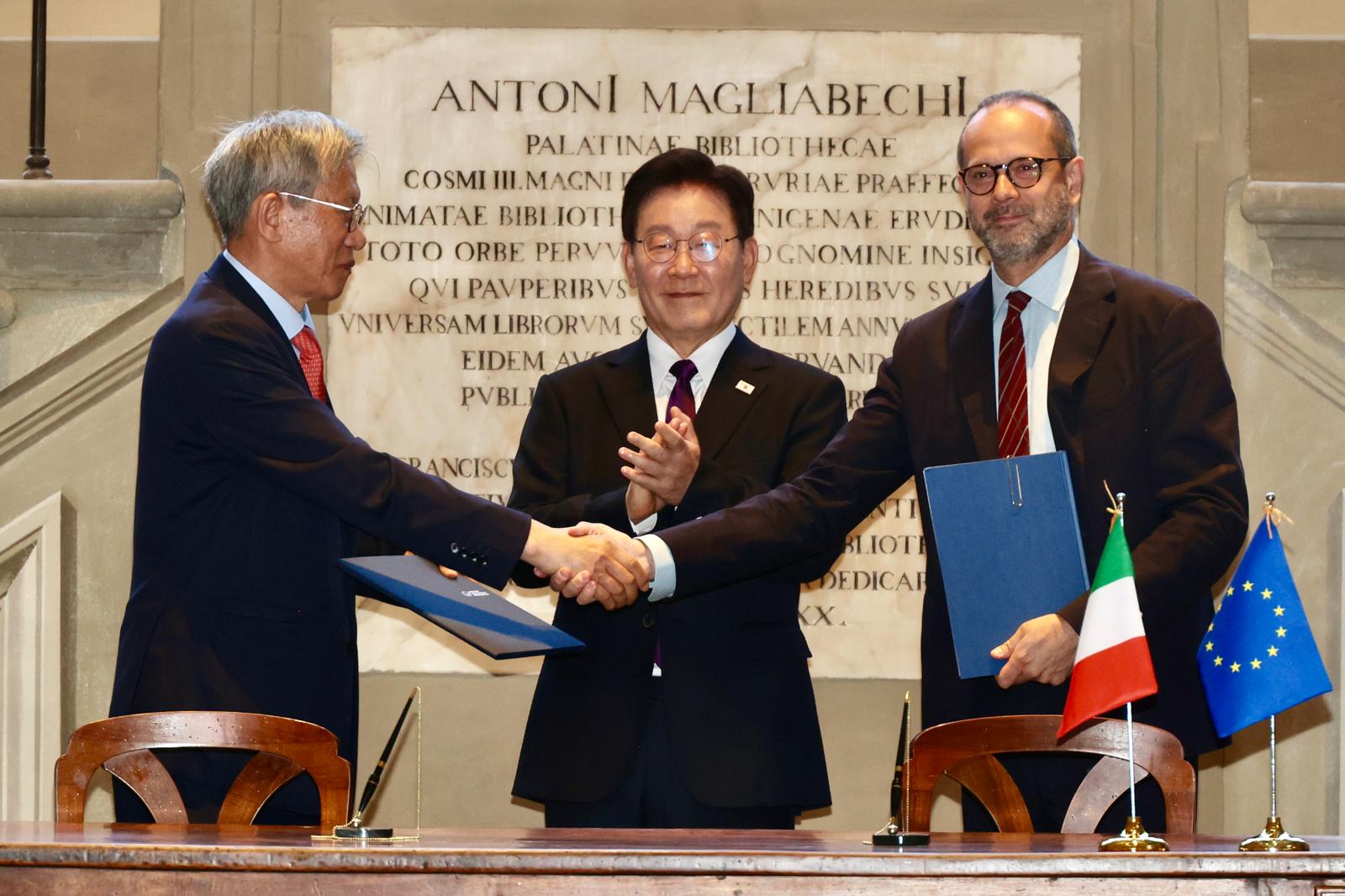
While the spotlight was on the institutional meetings between South Korean President Lee Jae Myung, the President of the Republic Sergio Mattarella and the Prime Minister Giorgia Meloni, a transition was taking place in Florence that was destined to leave its mark in the long term. Among the rooms of the Uffizi, cradle of the Italian Renaissance and one of the most famous museums in the world, South Korea and Italy have laid the foundations for a new season of cultural cooperation that goes far beyond a simple collaboration between museum institutions.
The signing of the agreement between the Uffizi Galleries and the National Museum of the Republic of Korea represents the most visible piece of a broader phenomenon. Having consolidated its global presence through music, cinema, television series and creative industries, Seoul is increasingly investing in cultural diplomacy. And Italy, from the Uffizi to the Egyptian Museum in Turin, has become one of the most interesting partners in this strategy.
The signing took place in the Magliabechiana Library of the Uffizi in the presence of President Lee Jae Myung, First Lady Kim Hye Kyung, Foreign Minister Cho Hyun, the Ambassador of the Republic of Korea to Italy Kim Choon-goo and the Ambassador of Italy to Korea Emilia Gatto. The director of the Uffizi Galleries Simone Verde and the director of the National Museum of Korea You Hong-jun signed the agreement, officially launching a collaboration that will include exchanges of collections, exhibitions, educational activities, research programs, conservation and restorations.
Lee Jae Myung’s visit and the new phase of relations between Rome and Seoul
The stop at the Uffizi is part of the state visit that Lee Jae Myung made to Italy, one of the most significant diplomatic moments since the inauguration of the new South Korean president.
During the official meetings with Mattarella and Meloni, Italy and South Korea decided to further strengthen an already very solid relationship on an economic, industrial and technological level. The two countries have announced their intention to elevate bilateral cooperation to a “special strategic partnership,” the highest level under South Korean diplomacy.
Culture plays an increasingly important role within this relationship. It is no coincidence that an agreement was signed during the presidential visit intended to involve some of the most prestigious museum institutions of the two countries.
Over the past twenty years, South Korea has built one of the most effective systems of soft power in the world, transforming culture into a tool of international influence. Cinema, television, music, literature, fashion and the creative industry have helped redefine the country’s image on the global stage. Today Seoul seems ready to take a further step forward, focusing increasingly on historical heritage and large cultural institutions.
From the Uffizi to the National Museum of Korea
The agreement signed in Florence involves one of the most important European museum institutions and the main museum in South Korea.
The National Museum of Korea, located in the heart of Seoul, houses hundreds of thousands of artifacts that tell the story of the Korean peninsula from ancient times to the contemporary age. It is one of the most prestigious cultural institutions in Asia and in recent years it has accelerated its internationalization process, increasing collaborations with museums and foundations around the world.
The agreement with the Uffizi will allow the two institutions to develop joint projects, organize exhibitions, share expertise in the field of conservation and create new opportunities for cultural exchange between Italy and South Korea.
The choice of Florence is not random. The Uffizi represents one of the symbols of Italian culture in the world and houses works that have contributed to defining the history of Western art. Building a direct relationship with this institution means for Seoul to further strengthen its presence within the major international cultural circuits.
According to what emerged during the visit, the agreement could also pave the way for future exhibitions dedicated to the masterpieces kept by the Florentine museum. A hypothesis that testifies to the ambition of the project and South Korea’s growing interest in the Italian artistic heritage.
The role of the Egyptian Museum of Turin
But Florence is not the only Italian city involved in this new season of cooperation.
A few days before President Lee Jae Myung’s visit, the Egyptian Museum of Turin announced an important project aimed at the Korean public. In 2027 the traveling exhibition “Revealing Ancient Egypt” will arrive first at the Sejong Museum of Art in Seoul and then at the Keimyung University Haengso Museum in Daegu.
The exhibition will include 343 artefacts coming largely from the Turin museum’s deposits and will offer the Korean public unprecedented access to one of the most important Egyptian collections in the world.
Looking at the two projects together, a trend clearly emerges. South Korea does not only look at contemporary Italy, but also at that historical and artistic heritage which continues to represent one of the country’s most powerful tools of cultural attraction. From the Renaissance preserved in the Uffizi to the archeology of the Egyptian Museum, Seoul is investing in cultural relations capable of creating value and dialogue in the long term.
Italy at the center of the new Korean Wave
To truly understand the meaning of these agreements we need to look at what has happened in recent years.
If a decade ago South Korea occupied a marginal space in the Italian cultural imagination, today concerts, festivals, exhibitions, cinema, literature and institutional collaborations tell a completely different reality. The signature at the Uffizi was not born in a vacuum: it is the result of a cultural relationship that has become increasingly intense and structured over the years.
The Korean cultural presence in Italy has grown impressively. Milan has become an increasingly frequent stop for tours and concerts by Korean artists. Fan meetings are recording increasingly important numbers. Festivals dedicated to Korean culture attract thousands of visitors. Universities expand Korean language and studies courses. The number of Italians interested in Korea continues to increase.
In recent years the Italian public has witnessed the arrival of a growing number of K-pop concerts, showcases, events dedicated to Korean culture and meetings with artists who until recently seemed unattainable. At the same time, events such as the Florence Korea Film Fest have transformed into one of the main European points of reference for Korean cinema, helping to build an increasingly deeper cultural dialogue between the two countries.
It is no coincidence that during his visit to Tuscany Lee Jae Myung mentioned the Florence Korea Film Fest, underlining the role that the festival has played since 2003 in the promotion of Korean cinema in Europe and hoping for new opportunities for collaboration after the film co-production agreement between Italy and South Korea.
What we are observing is the natural evolution of the Korean Wave. The first phase was dominated by pop culture: music, cinema, television series, webtoons and streaming platforms. The new phase instead appears more structured and institutional, made up of museums, academic collaborations, cultural programs and large international projects.
In other words, Seoul is no longer just exporting content. It is exporting culture as an infrastructure of international relations.
A cultural bridge destined to grow
Lee Jae Myung’s Italian visit and the agreements signed in recent days tell a story that goes beyond diplomatic news.
For years the bridge between Italy and Korea has been built through cinema, television, music and the growing curiosity of the European public towards the Asian country. Today that bridge is widening.
The works housed in the Uffizi could one day reach Seoul, while hundreds of artefacts from the Egyptian Museum are already preparing to meet the Korean public. At the same time, concerts, festivals, cultural events and academic collaborations continue to bring together two geographically distant but increasingly connected countries.
It is the signal of a Korean Wave that is entering a new, more mature and more ambitious phase. A phase in which South Korea not only exports entertainment, but builds cultural relationships destined to last well beyond a television season, a song or a box office success.
If the first phase of the Korean Wave passed through screens, streaming platforms and concert stages, the second seems to want to enter museums. And the signature at the Uffizi suggests that Italy could be one of the main European laboratories of this evolution.