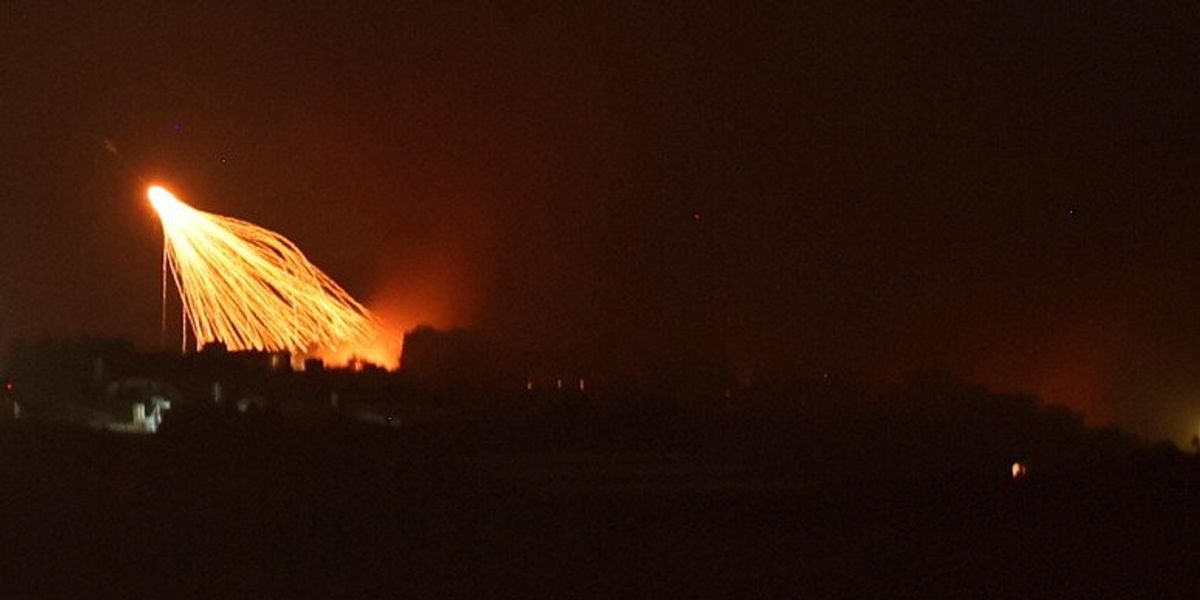
The silence of the Arab countries following the death of the leader of Hezbollah, Hassan Nasrallah, and then continuing with the invasion of Southern Lebanon (and incursions in Yemen and the Gulf of Aden), says too much about the true feeling that lies in entire Middle East. Why doesn’t anyone complain or threaten Jerusalem anymore? Why was it that in Syria and in certain areas of Iran and Lebanon itself, the announcement of the leader’s death was even greeted with jubilant processions? Why hasn’t Washington DC used its diplomatic strength to prevent or at least condemn the land invasion of Israeli troops?
Perhaps because we were too quick to read every single Israeli action – however brutal – as a senseless madness that the Netanyahu government, clouded by the thirst for revenge and nothing else, carried out against everything and everyone. Instead, as the hours and days pass, we discover that, in the meantime, the so-called “axis of resistance” – as the union of Shiite militias in the quadrangle of Iran, Iraq, Syria and Lebanon was defined by the Iranian ayatollahs – is in a phase so declining that the terrorist attacks of 7 October 2023 were perhaps the swan song of that jihadist alliance which for decades terrorized the region and fueled rivers of blood.
And then, that more than one head of state in the Middle East does not at all disdain the iron fist of Bibi Netanyahu, who “is doing the dirty work for us” as an Arab intelligence source reported, perhaps exaggerating a little. In less than a week, in any case, as is well known, the first anniversary of the Hamas massacres against Israelis will occur; perhaps then it will be possible to make a first credible assessment of how the two great protagonists of the conflict – ideological as well as religious and political-economic – are facing and managing the crisis.
In the meantime, however, some certainties can already be highlighted: the apparent humiliation of the Israeli intelligence, which had been surprised by the Palestinian jihadists and did not seem to have understood how concrete the threat was in the months preceding 7 October, now takes on a very clear light. different: that of a revenge on the field which at the same time becomes a severe punishment. The synchronized explosion of mobile phones, walkie talkies and wireless devices supplied to Hezbollah militiamen, so to speak, was an operation that will remain in the history of the secret services for its originality and effectiveness: in a single blow, in fact, Jerusalem beheaded the entire chain of command, putting the Lebanese militiamen’s logistics and communications line in darkness. All of this, it has now been understood, was a prelude to the killing of the most esteemed, elusive and protected leader of the “axis of resistance”, Hassan Nasrallah.
Not only that. Already at the time of the Israeli attack on the Iranian consulate in Damascus last April, the action of the IDF (the Israel Defense Forces) was portrayed by most as a senseless escalation between Tehran and Jerusalem which would have led the two arch enemies to a direct confrontation. Instead, right then it became clear that the king was naked. The king in this case is the theocrat who towers over Persia, namely Ayatollah Ali Khamenei: faced with the precipitation of events, the Supreme Leader has shown himself to be so impotent, so much so at home – with women leading the emancipation of society Iranian and with the rest of the people who demonstrate together with them in the streets, fueling hopes of Iranian secularization – as for abroad, which is increasingly growing the front of those who maintain that the defeat of the Shiite clergy who commands in Tehran is no longer unthinkable.
Tehran, to tell the truth, as a response to the IDF’s provocation at the time had launched a massive attack against Israel with dozens of drones and missiles, but the Israeli air force and defense systems had neutralized 99% of the approximately 300 projectiles launched by the ‘Central Asia. Result? A burning humiliation for the Pasdaran themselves, the military elite forces that share power with the ayatollahs, who have made it clear to the world that their weapons are blunt in the event of a direct confrontation. Prime Minister Benjamin Netanyahu, after that series of missile exchanges, confirmed that the State of Israel was “ready for any scenario”. We have now understood what he meant.
In fact, while in these hours the Israeli troops are finally entering Southern Lebanon without encountering resistance – the Beirut army has withdrawn and so have the UN peacekeepers -, the world is starting to better understand what is really happening in the Middle East: the invasion of Gaza was only the appetizer of a general settling of scores that not only Netanyahu, the Zionists, the ultra-Orthodox Jews and the Israeli hawks desired. The other Arab states also want it, and not only have they not defended the Palestinians and Lebanese, but there is the concrete possibility that they have become complicit in the cleansing of those elements which are now inconvenient and anachronistic for those who – like Saudi Arabia, Jordan, the Emirates, Qatar and Iran itself – wants to make the Middle East an economically developed and prosperous region.
It would be enough to reread the words pronounced by the crown prince of Saudi Arabia, Mohammed Bin Salman, on the leadership of Iran, to understand it: «Khamenei is the new Hitler. He wants to expand and realize his project in a very similar way to Hitler who, at the time, wanted to expand into Europe. Many nations around the world and in Europe did not realize how dangerous Hitler was and I do not want similar events to happen in the Middle East.”
And again, regarding Palestine, the crown prince, during a visit by the US Secretary of State to Saudi Arabia last January, had said verbatim: «Am I personally interested in the Palestinian question? Not to me”, adding that 70% of the Saudi population “is younger than me” and therefore has never even heard of the Palestinian issue.
If we add to the words of the Saudi leadership the certainties of the King of Jordan Abdullah – who argued at the UN General Assembly that his country “will never become an alternative seat for a Palestinian state” and that if anything the idea of Jordan as an alternative homeland for refugees comes from “extremists who are bringing our region to the brink of total war” – it is better understood how there is no embarrassment at the top of Middle Eastern institutions about the ongoing war, nor even a condemnation of the actions soldiers of Jerusalem.
Indeed, some even in the parts of Damascus – a failed state however still today supported by Russia and increasingly – there are those who see the definitive defeat of Hezbollah as a relief and a possibility of creating a nation finally free from the yoke of religion and concept of jihad (although, to tell the truth, it is rather the rebels of Aleppo who rejoice in Israel’s actions, hoping that the dictator Bashar al Assad, who emerged unscathed from the civil war, will soon fall as well).
Finally, Iran itself – which in these hours is trying to save face by launching new ballistic missiles towards Israel, an attack that the American media and intelligence sources had anticipated in recent hours – is divided between the factions of those who intend to live still in the religious obscurantism that characterized the second half of the twentieth century in this region and those who want to make a clean sweep of the past, to let the Abraham Accords on the recognition of Israel – the true and only motive for the Hamas attack on 7 October – become reality . Perhaps, some people malign, it was the Iranians themselves who “sold” Hassan Nasrallah to the Israelis, to get rid of those who oppose “progress” and secularism.
Be that as it may, the Middle East is today facing the judgment of History, and the future prosperity of the various countries that compose it will depend precisely on how each of them manages the ongoing war. Above all, however, all eyes are on Persia: what will Tehran do? Will give in to cupio dissolve or will he finally emancipate himself from proxy wars, which have already cost him too much, and come to terms with Israel, returning to doing big business as already happened before the Islamic Revolution?