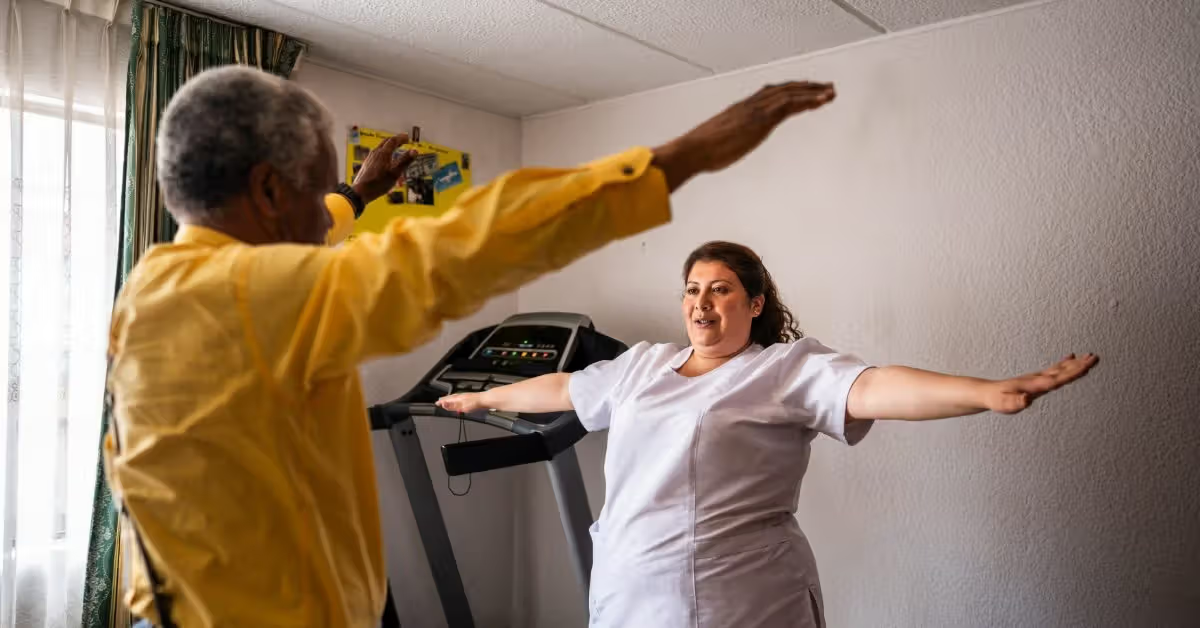
- Exercise-based cardiac rehabilitation could help reduce the risk of heart attacks and all-cause hospital admissions in people with coronary heart disease, according to a recent review.
- Common exercises in the review included aerobic exercise, static cycling, and circuit training.
- Home-based and digital exercise programs were shown to be as effective as traditional in-person rehabilitation, offering increased flexibility and accessibility.
Cardiovascular diseases (CVDs) are the
A recently updated Cochrane review published in September examined whether cardiac rehabilitation could impact health-related quality of life, disease status, and mortality in people with CVD.
It was determined that cardiac rehabilitation helped reduce the relative risk of heart attacks and hospital admissions.
Home-based and digital rehab programs were also found to be as effective, increasing accessibility for individuals unable to attend in-person sessions.
“This review confirms that exercise is a great tool for improving the overall health of people with coronary heart disease,” said senior review author Rod Taylor, PhD, Professor of Population Health Research (General Practice & Primary Care) at the University of Glasgow, in the press release.
Cardiac rehabilitation led to 28% relative reduction in heart attacks
The researchers found that exercise-based cardiac rehabilitation led to a 28% relative reduction in the risk of heart attacks.
The review focused on 107 randomized controlled trials, involving a total of 26,886 people with coronary heart disease. The purpose was to assess whether exercise-based cardiac rehabilitation was more effective at improving outcomes compared with unstructured exercise.
In addition to lowering the relative risk of heart attacks, exercise-based cardiac rehabilitation also reduced all-cause hospital admissions by around 35%.
The review also found that, within 6 to 12 months, one heart attack is prevented for every 71 people who participated in exercise-based cardiac rehabilitation.
Rigved Tadwalkar, MD, a board certified consultative cardiologist and medical director of the Cardiac Rehabilitation Center at Providence Saint John’s Health Center in Santa Monica, CA, shared some thoughts with Medical News Today on how to interpret this finding in practical terms.
“In practical terms, this is fantastic. A Number Needed to Treat (NNT) of 71 to prevent a major event like a heart attack in such a short window is a massive return on investment,” said Tadwalkar, who was not involved in the study.
I have added the following:
“To put that in perspective, we frequently prescribe daily medications that have comparable or even higher NNTs over much longer timeframes. (…) Achieving an NNT in the 70s in less than a single year proves that structured movement is a highly potent primary medical therapy. When I see a patient recovering from a heart attack, I explain that participating in rehab is just as critical to their survival as the daily pills in their pillbox.”
It is important to note that, as the authors point out, only 17% of all participants were women, presenting a potential limitation in the results of the research.
Does the type of exercise matter?
The most common exercises in the review included:
- aerobic exercise
- static cycling
- walking
- circuit training
The studies in the review presented a variety of exercise frequencies and intensities, as well as gym- and home-based workouts.
“Aerobic exercise is the bedrock of cardiac recovery,” explained Tadwalkar. “It directly improves endothelial function and builds cardiovascular endurance.”
However, he also added that “one area historically underutilized in traditional programs is strength training. The data increasingly shows that resistance training is incredibly relevant for long-term longevity. Building and maintaining muscle mass improves metabolic health and overall daily functioning, which is especially critical for older adults recovering from a cardiac event.”
Home-based and digital programs as effective
In the press release, lead author Grace Dibben, PhD, research fellow (General Practice & Primary Care) at the University of Glasgow, explained that “(e)xercise-based cardiac rehabilitation is an inexpensive and cost-effective intervention, but right now it’s underfunded and unprioritized.”
In addition to studies focusing on hospital- and community-based programs, the review included 27 studies of home-based cardiac rehabilitation.
The researchers expressed that home- and hybrid-based models could be delivered effectively, with remote and digital programs providing increased flexibility and accessibility.
“The latest data shows that home-based and digitally supported programs are essentially the same in terms of clinical effectiveness as traditional in-person facility models,” Tadwalkar told MNT.
“This is huge for our field. Asking a working adult to commute to a hospital clinic three times a week can be a logistical nightmare. By leveraging smartwatches, remote coaching, and continuous digital monitoring, we can deliver world-class care to patients who would otherwise fall through the cracks.”
Is it always safe to exercise following a heart attack?
Dibben addressed the potential concerns some people might have about exercising after a heart attack.
“Many people lose confidence after a heart attack or cardiac procedure and worry that physical activity could be dangerous. Appropriately prescribed exercise is not only safe for most patients, but can play a vital role in recovery and long-term heart health,” she explained in the press release.
Speaking with MNTTadwalkar added that “(i)t is remarkably safe, provided the heart attack has been treated appropriately first. Whether a patient was managed conservatively with medication or invasively with stents or bypass surgery, the acute phase needs to be resolved.”
He explained, “Once a cardiologist has done all the necessary checks to ensure stability, exercise plays a vital role in recovery. The key is starting with a professional evaluation and progressing gradually under clinical guidance.”
Tadwalker concluded with the following:
“I really want clinicians to start viewing cardiac rehab as an absolutely vital piece of the puzzle. (…) Cardiac rehab is no longer an antiquated concept. We are moving rapidly into digital and hybrid models that make this space cutting-edge. We finally have the tools to make these programs relevant and accessible to a vastly wider patient population.”