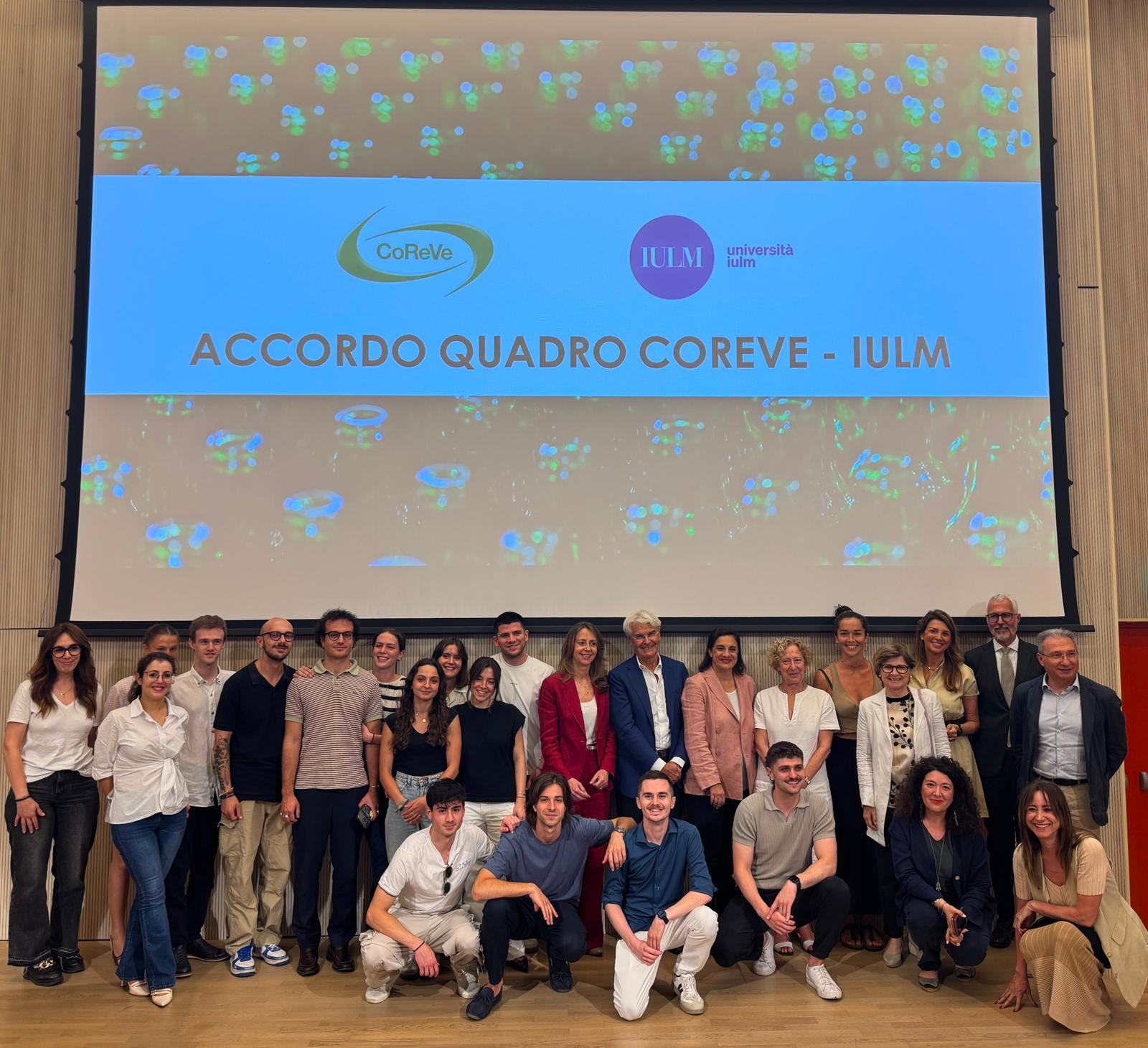
Sustainability is not enough to declare. You have to know how to tell it. And possibly do it well, without slipping into the liturgy of green slogans, those that fill the slides but empty the meaning of the words. The framework agreement signed between CoReVethe Glass Recovery Consortium, e IULM Universitypresented in Milan in the Sala dei 146 of the University.
The objective is clear: to promote a culture of sustainability based on quality information, creativity and participation, bringing the themes of the circular economy, resource recovery and environmental sustainability into university courses. An agreement that looks to the next academic years and was created to create a stable bridge between the academic world, the glass recycling supply chain, journalism, digital communication and new generations.
Not just theory, therefore. But scholarships, visits to plants, lessons on the glass supply chain, social campaigns, reports, podcasts and projects capable of transforming recycling into a public story. Because the ecological transition, without serious communication, risks remaining a concept for professionals. And instead it must become shared knowledge.
Two scholarships to talk about glass and recycling
Among the first initiatives envisaged by the agreement there are two scholarships intended for IULM students, each worth 5,000 euros.
The first, “CoReVe – New Journalism”is aimed at students of the Master in Journalism. It will reward the best article, reportage, podcast or audiovisual service capable of developing, starting from the annual data presented by CoReVe, an original narrative on the recovery and recycling of glass in Italy and Europe.
The second, “CoReVe – StorytellinGZ”is dedicated to students enrolled in the second year of the three-year degree in Business Communication and Public Relations. In this case the competition will reward the best ideas for digital communication and social media campaigns capable of explaining the value of glass recycling through languages, formats and platforms close to Generation Z.
This is where the agreement also becomes interesting on a cultural level. Because glass, an ancient and infinitely regenerable material, is entrusted to the most contemporary language: that of digital content, of social media, of hybrid narratives, of young communicators called to make understandable what often remains confined to environmental reports.
From data to “bottle journeys”
In the next academic years, students will also have the opportunity to follow lessons on the glass supply chain and to learn first-hand about the various phases of recycling through a series of visits called “bottle journeys”: from treatment plants to collection systems, up to the glass industries.
It is a decisive step. Because talking about sustainability without seeing how a supply chain really works risks producing only rhetoric. Seeing the path of the glass up close, however, means understanding what happens after the daily gesture of separate waste collection. It means transforming a domestic habit into industrial, environmental and social awareness.
Communication, in this scheme, does not arrive at the end of the process. It becomes an integral part of it. The story does not only serve to promote virtuous behavior, but to make it readable, measurable, shared.
The winning projects will be selected by two juries created to bring together different skills.
For the announcement New Journalismthe jury is made up of Franco Bonesso of ANCI-CONAI, Daniele Manca of the Master in Journalism of IULM University, Gianni Scotti of CoReVe, the teacher Federica Ricceri of the IULM University e Ottavia Bellienvironmental trainer and LinkedIn Top Voices Environment.
For the announcement StorytellinGZthe jury includes Silvia Borsari of the Community Agency, the teacher Silvia Ravazzani of the IULM University, Elena Ferrari of CoReVe, the teacher Federica Ricceri And Duccio Travaglinieco-founder of Greencome Media.
The composition of the two juries reflects a precise choice: to bring together the academic world, the recycling industry, professional journalism and the new sustainability media. A necessary mixture in a time in which the environment can no longer be described only with the technical language of experts, but not even with the superficiality of certain green showcase communication.
Scotti: «Transforming environmental data into knowledge»
For Gianni Scottipresident of CoReVe, the central point is precisely the transition from numbers to awareness. «The data on glass recycling in 2025 offers us an updated snapshot of the performance of the supply chain and the contribution of the glass material to the national circular economy objectives. But they also tell us that sustainability needs skills, languages and narratives capable of involving the new generations.”
Hence the meaning of the collaboration with IULM: «We want to contribute to training professionals capable of transforming environmental data into knowledge, participation and awareness».
It is a phrase that captures what is at stake well. Sustainability is not just a question of systems, percentages and objectives. It is also a cultural battle. If the data are not understood, if they do not reach people, if they do not become a collective story, they remain closed numbers within a technical report.
Maione: «Without a serious story, even the best policies risk not being understood»
It fits on the same line Giorgio MaioneCouncilor for the Environment and Climate of the Lombardy Region, who underlines the value of quality communication. «Quality communication is an integral part of a sustainability infrastructure, because without a serious story, based on data and not on slogans, even the best policies risk not being understood or shared».
The point is political, even before communicative. Environmental policies can only be effective if they can be explained, accepted and internalized. For this reason, adds Maione, entrusting this task to young people, journalists and digital creatives means investing in new skills. «The future of sustainability passes from here, from a stable alliance between institutions, consortia, the scientific world, universities and the world of information».
Milan, glass and the challenge of separate waste collection
The Municipality of Milan also looks at the agreement as a piece of a broader challenge. Elena GrandiCouncilor for the Environment and Green, recalls the spirit of the Climate City Contract and the need for a strong synergy between institutions, businesses, universities and research centres.
Milan, Grandi reminds us, is already a virtuous metropolis in Europe, with separate waste collection between 63% and 64%but the objective is to improve further, tackling even the most complex challenges such as the management of road waste linked to nightlife areas.
Glass thus becomes a symbolic material. Precious, regenerable, but also fragile if the supply chain is not supported by correct behavior and a story capable of reaching people. «This collaboration with IULM University is a synergy that is more necessary than ever because it puts the future of the country in the hands of young people, preparing them to become the aware narrators of a change that can no longer be postponed», concluded Grandi.
Ricceri: «Sustainability is a transversal dimension»
For the teacher Federica Ricceridelegate for Sustainability and Social Responsibility of IULM University, partnerships like the one with CoReVe are strategic because they allow students to deal with concrete experiences and the real challenges of the sustainable transition.
«Sustainability is a complex challenge, it requires skills, collaboration and the ability to build connections between different worlds», explains Ricceri. At IULM, he adds, sustainability is a transversal dimension that guides training, research, dialogue with businesses and institutions and relationships with the territory.
This is perhaps the strongest point of the agreement. Sustainability is not treated as an accessory subject, nor as a label to be applied to university programs. It becomes a language, a method, a training responsibility. And those who study communication are called upon to face a specific challenge: learning to talk about change without trivializing it.
Because the future of the circular economy will not only depend on plants, regulations and environmental targets. It will also come from those who can explain why all this concerns everyone’s daily life. One bottle at a time.