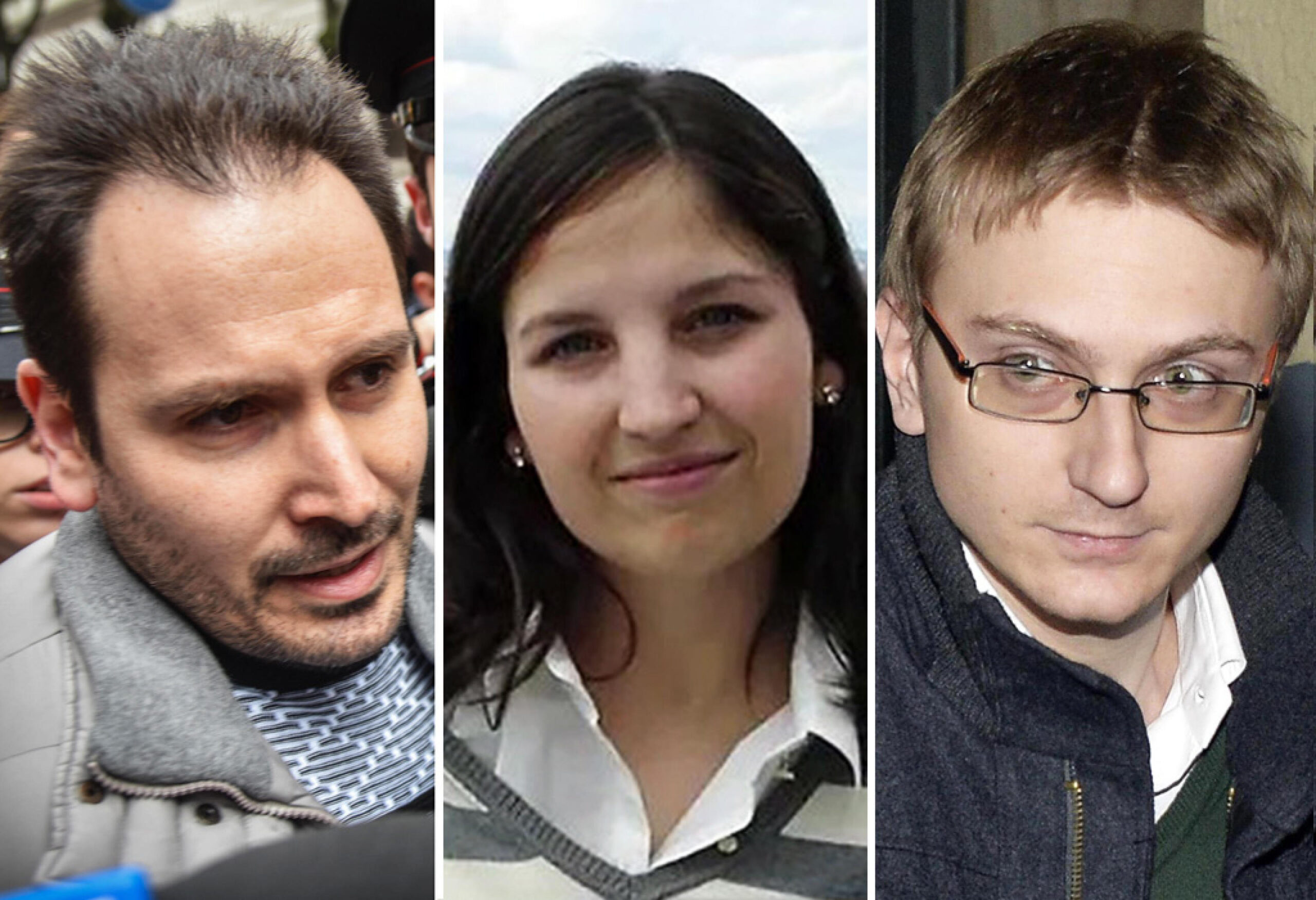
A man definitively convicted for the murder of Chiara Poggi and another who, according to the Pavia Prosecutor’s Office, would be the real person responsible for the same crime. Almost twenty years after that morning of 13 August 2007, the Garlasco case finds itself faced with a judicial scenario as complex as it is unusual, in which the attempt to arrive at a new procedural truth risks clashing with a sentence which, at least for the moment, remains definitive.
The week ending November 6th marked a fundamental transition. The Pavia Prosecutor’s Office has requested the indictment of Andrea Sempio for the aggravated murder of Chiara Poggiconfirming a radically different reconstruction from the one that in 2015 led to Alberto Stasi’s sentence to 16 years in prison. Yet, just as the investigation seems to be moving closer to a possible trial, a procedural obstacle looms that could slow its start.
Sempio’s defense, in fact, intends to request the suspension of the proceedings pending the evaluation of the request for review of Stasi’s conviction. A strategy which, if not accepted, could also translate into a question of constitutional legitimacy. The result is that the Garlasco crime, after years of expert reports, testimonies and conflicting reconstructions, could enter a new phase dominated not only by the search for evidence, but also by a legal question: how can a final conviction and a new trial that attributes responsibility for the same murder to another person coexist?
Garlasco, the Prosecutor’s Office requests the trial of Andrea Sempio
The turning point came on Tuesday 3 November, when the Pavia prosecutor Fabio Napoleone announced the filing of the request for indictment against Andrea Sempio, 38 years old, a friend of Marco Poggi, the victim’s brother.
The charge is of voluntary homicide aggravated by cruelty and abject motives. According to the reconstruction of the magistrates, Sempio would have attacked Chiara after the young woman had rejected his sexual approach. A reconstruction that the defense disputes and which will have to be subjected to the evaluation of the judges.
In the indictment, the prosecutors refer to the violence of the attack, highlighting the numerous injuries suffered by the victim and hypothesizing that the crime occurred following the rejection of the advances. The accusatory hypothesis is that of a single person responsible, identified in Sempio, in contrast with what was established by the final sentence against Stasi.
A conclusion that the investigators reached after a new season of investigations, scientific consultations and analysis of the elements collected during the original investigations, including the genetic findings and fingerprints already the subject of numerous controversies.
Sempio, through his lawyers, reiterated that he is ready to face this judicial phase too and that he is convinced that his innocence will be proven. The request from the Prosecutor’s Office, moreover, is not equivalent to a conviction or even to an already ordered indictment: the judge of the preliminary hearing will decide whether the conditions exist for holding the trial.
Judge Luigi Riganti and the risk of suspension
On November 4, the file was assigned to Luigi Riganti, judge of the preliminary hearing of the Court of Pavia. He will have to examine the request from the Prosecutor’s Office and evaluate the issues that will be raised by the parties.
But the first battle may not directly concern DNA, fingerprints or the reconstruction of the attack.
The lawyers Liborio Cataliotti and Angela Taccia, who are assisting Sempio, have announced their intention to request the suspension of the proceedings precisely because there is already a definitive conviction for the same murder. According to their approach, before proceeding against a new accused it would be necessary to wait for the developments of the review of the sentence pronounced against Stasi.
In the event that the judge does not accept the request, the defense could raise a question of constitutional legitimacy, calling the Consulta into question.
This is, however, an interpretation supported by the defenders and not an automatism envisaged for the Garlasco case. The existence of a final conviction does not in itself lead to the suspension of a new investigation or proceeding against another person. The issue will have to be addressed in the competent judicial bodies, also considering the peculiarity of the two accusatory reconstructions.
The risk, therefore, is that the preliminary hearing turns into the first battleground in a matter that could take much longer than initially assumed.
Alberto Stasi prepares the review of the sentence
On the opposite front, meanwhile, another decisive deadline is approaching. Alberto Stasi’s lawyers, Giada Bocellari and Antonio De Rensis, are preparing a new request for review of the final sentence which in December 2015 found Chiara Poggi’s ex-boyfriend guilty of the murder.
The filing is expected between 10 and 20 November before the Court of Appeal of Brescia, competent to examine the request.
The defense believes it can present new elements capable of calling into question the evidentiary framework on which the conviction was based. A significant part of these elements is connected to the investigations carried out by the Pavia Prosecutor’s Office as part of the new investigation into Sempio, but their actual value will have to be assessed by the judges.
The review represents an extraordinary tool of the judicial system and does not constitute a new level of judgment automatically accessible after a final conviction. To obtain the reopening of the process it is necessary to pass an initial admissibility screening, demonstrating the existence of the conditions established by law.
The Court of Appeal of Brescia could reject the application on the basis of the documents or set a hearing to examine it. Only in the event of admission would a substantive phase open in which to discuss the elements which, according to the defence, could justify overcoming the previous decision.
The times are not yet defined. A first evaluation could arrive in the first months of 2027, but this is a forecast and not an official deadline.
Two proceedings for the same murder: the problem of sentences
It is precisely the intertwining of these two paths that makes the current phase particularly delicate.
On the one hand, the Pavia Prosecutor’s Office claims to have gathered sufficient elements to request Sempio’s trial. On the other hand, there is a definitive sentence that identifies Stasi as the perpetrator of the murder. The two reconstructions, as they were formulated, attribute responsibility for the crime to different people.
But on a judicial level the situation is more complex than it might appear.
The request for indictment against Sempio does not cancel Stasi’s conviction, just as a possible trial of the new accused would not automatically lead to the release or acquittal of Chiara’s ex-boyfriend. Likewise, the opening of a review proceeding would not in itself represent proof of the innocence of the convicted person.
The problem is understanding how to coordinate two distinct procedures that could find themselves evaluating at least in part the same evidentiary material, potentially arriving at different conclusions.
Sempio’s defense believes that this situation justifies a suspension. Other legal interpretations instead consider the continuation of the proceedings possible, at least until there are two definitive rulings that are actually incompatible.
It is not a technical detail, because the timetable of the entire judicial matter could depend on the judge’s decision.
The position of the Poggi family
In this scenario, the position of Chiara’s family also continues to be central, who over the years have maintained their faith in Alberto Stasi’s conviction.
The family has made it known that it does not intend to become a civil party in the possible new trial against Sempio. A decision that reflects the position already expressed by the Poggi and which also presents aspects of a technical-legal nature linked to the previous procedural event.
For the family of the young woman, killed at the age of 26 in her own home, the return of the case to the center of public attention also means having to deal again with reconstructions, hypotheses and details of a crime that profoundly marked their lives.
What happens now in the Garlasco case
The next few weeks will be crucial to understand which direction the case will take.
The first step concerns the setting of the preliminary hearing before judge Luigi Riganti, who will have to evaluate the request for trial for Andrea Sempio and any exceptions presented by his defenders.
The second concerns the request for review of Alberto Stasi’s sentence, expected in the second half of November and destined for the Court of Appeal of Brescia. On this front, it will also be important to understand what position the Milan Prosecutor’s Office will take, which has not yet announced its own initiative.
Profoundly different scenarios could arise from these decisions: a trial against Sempio, a suspension of the proceedings, a review of the judgment on Stasi or two judicial paths destined to develop simultaneously.
Almost twenty years after the death of Chiara Poggi, therefore, the Garlasco case has not reached a new conclusion. Rather, it has entered a phase in which the search for truth is confronted with one of the fundamental principles of justice: the stability of definitive sentences and the possibility, when new elements emerge, of calling them into question.
The question is not only to establish whether Andrea Sempio should be tried, but to understand what weight the new investigations could have on the sentence already pronounced against Alberto Stasi. Two different paths which, in the coming weeks, could end up influencing each other.