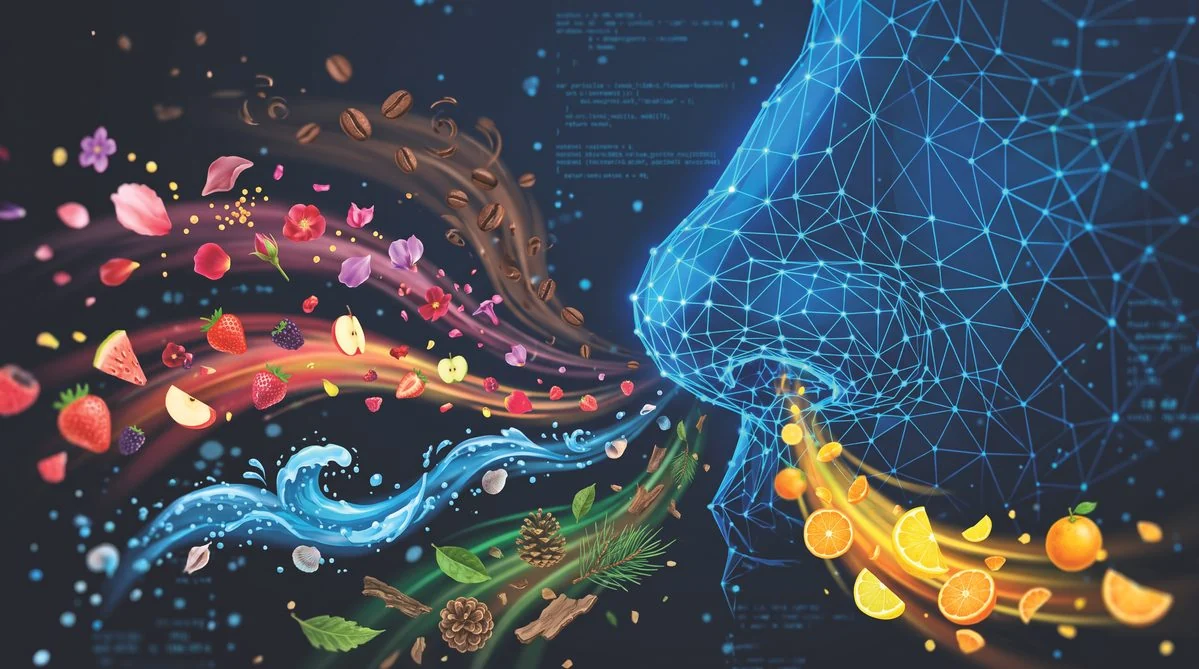
A forest after the rain, the sea, a slice of coconut. The smell of anything will be reproducible by technology, which identifies its chemistry, turns it into data and creates the bouquet. The next step? “Resurrect” the fragrances of the past
The next photograph might have a scent. That of the sea on a summer day, of a forest after the rain or of the house where we spent our childhood. It sounds like science fiction, but artificial intelligence is learning to do something that until now seemed impossible: transform smells into digital information, store it and use it to recreate the same scents elsewhere. And even invent new ones that never existed.
A first experiment succeeded in 2024 in the laboratories of Osmo, an American company founded by neuroscientist Alex Wiltschko, a former Google researcher. The protagonist, a simple slice of coconut. Its smell was analyzed by an instrument capable of identifying the chemical substances present in the air, transforming the information collected into data, and then recreated through a mixture of molecules. Osmo also worked on the scent of a plum, creating a reconstruction using the same process. The underlying principle of this technology is the following: unlike images and sounds, which can be converted directly into digital signals, odors are made up of molecules; when we smell a rose, for example, some of the volatile substances released by the flower reach our nose and activate the olfactory receptors; to digitize that scent you must first identify its chemical components with an instrument called a gas chromatograph-mass spectrometer, which separates and analyzes the molecules present in the air sample. Artificial intelligence interprets the data and develops a sort of recipe, which is then sent to a robotic system capable of mixing the substances necessary to recreate the original smell.
The scientific breakthrough came in 2023, with a study published in Science by researchers from Google, Osmo and the Monell Chemical senses center in Philadelphia. After being trained on the odor characteristics of around 5,000 molecules, a neural network had learned to predict how they might be perceived by the human nose. Tested with hundreds of substances, she was able to describe their odors with results comparable to those of specially trained people. The system had thus built a sort of digital atlas of odors, in which molecules are classified based on the similarity of their scents. Then, a study published in March 2026 in Digital Chemical Engineering by researchers at the University of Tampere, Finland, described a device that autonomously learns to imitate an odor. It first records their characteristics with a sensor, then mixes up to five chemicals, analyzes the result and adjusts the mixture until it comes close to the original. The tests were mainly conducted on relatively simple mixtures, but the principle is interesting: a machine that searches for the recipe for a perfume on its own. Finally, another novelty has just arrived from Japan, where a group from the Institute of Science Tokyo has created a small device that attaches to the virtual reality headset and contains eight liquid fragrances. As a person explores an environment reconstructed on the computer, the device receives digital instructions, mixes the fragrances and diffuses the smell directly towards the nose.
Thus, by visiting a virtual forest, you can smell its scent, or perceive the smell of the sea while exploring a beach. In the first experiments, the addition of odors increased participants’ sensation of actually being in the depicted environments. “We have already managed to expand the range of odors that we can reproduce, but we are still far from being able to recreate them all,” Takamichi Nakamoto, of the Institute of Science in Tokyo, explains to Panorama. In previous experiments his group had used a fixed device capable of combining twenty odorous substances. Now the goal is to achieve similar results with the small wearable device. «We are increasing the number of substances it can mix. With a sufficient number of components we will be able to reproduce a much wider range of odors,” adds Nakamoto.
At this point your imagination can run wild. The most surprising possibilities concern the past. A project called Resurrecting the Sublime attempted to reconstruct the scent of three now-extinct flower species. Starting from DNA recovered from dried specimens preserved in the herbariums of Harvard University, scientists from the Ginkgo Bioworks company reconstructed some genes that contained the instructions for producing odorous substances. They then inserted them into yeast cells, turning them into small molecule factories that likely contributed to the original scent.
Norwegian researcher and artist Sissel Tolaas ultimately used this information to recreate a possible version of the lost fragrances. Among the flowers was Hibiscadelphus wilderianus, a Hawaiian plant whose last known specimen was observed in 1912. We don’t know if the reconstructions correspond exactly to the original odors, but for the first time it was possible to try to smell something that nature no longer produces.
Even history could acquire an olfactory dimension. The European Odeuropa project used artificial intelligence to search for references to odors in approximately 167 thousand historical texts and 43 thousand images, reconstructing part of the European olfactory landscape of recent centuries. What scents filled the seventeenth-century shops? What did the markets, streets or houses of a nineteenth-century city smell like? By cross-referencing historical documents and chemical knowledge, reconstructions have been developed which are also intended for museums and exhibitions.
And if we could precisely record the scent of a place or a person, we could preserve and reproduce it even after many years. Artificial intelligence is also inventing new combinations. In 2025 Osmo launched Generation, a service to develop new fragrances starting from descriptions, images and suggestions provided by customers.
These are all mind-blowing possibilities. But the most interesting aspect of this news is not what artificial intelligence is managing to do. It is the deeply human question that it raises: do we really want to live in a world where we contemplate the sea on a screen and breathe in its scent diffused by a device, rather than going to a beach and really smelling it?