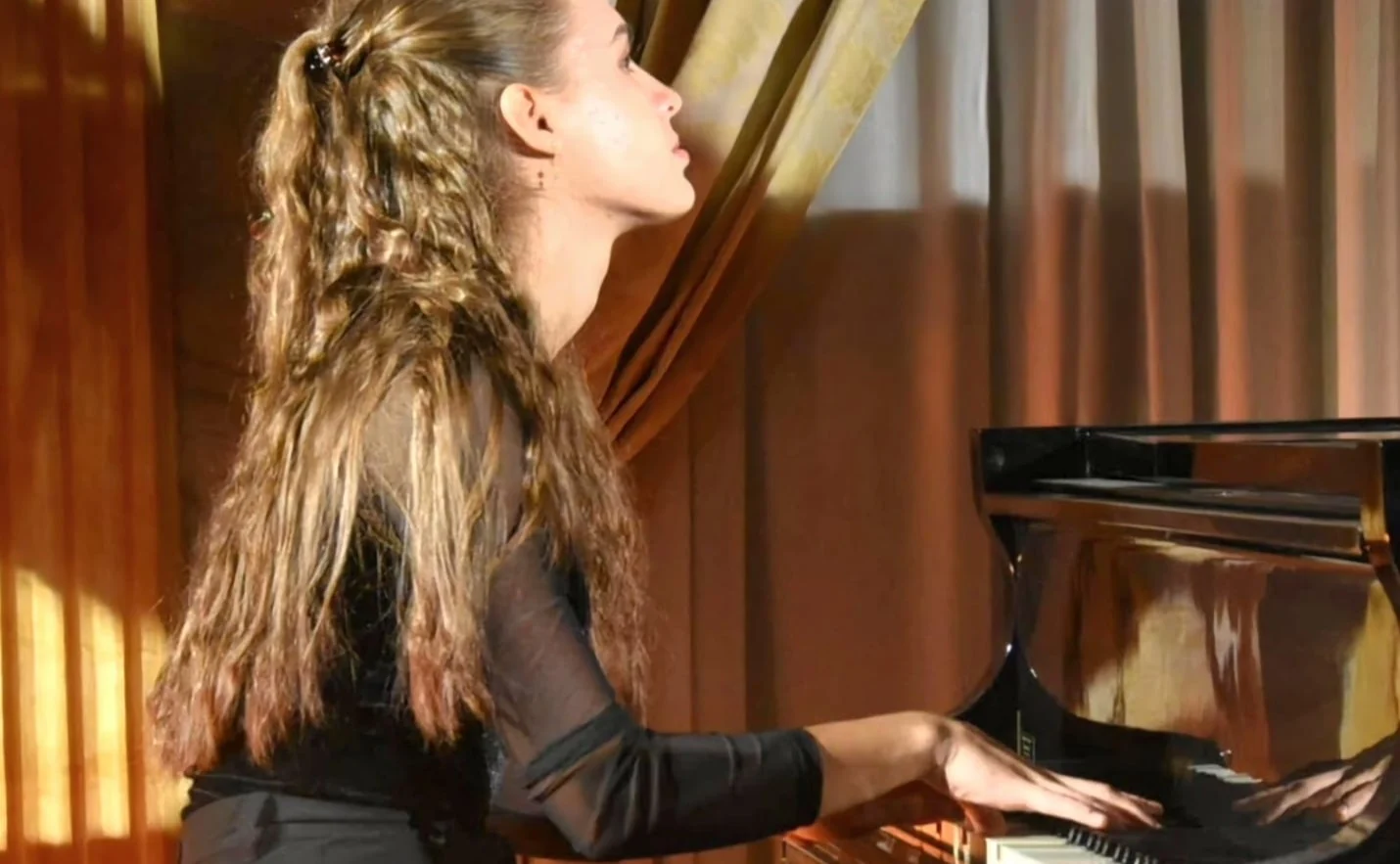
With Onda Melodica the young pianist brings to light for the first time the unpublished compositions of the Marquis Gian Raimondo Serponti
“A certain race of people between twenty and thirty-five years old, no more, almost always full of talent, more advanced than their century. Independent like the eagle of the Alps, ready for good as well as evil: restless, troubled, turbulent…”
This is how Cletto Arrighi described the non-conformist and restless artists of the Dishevelment: that movement which in the Milan of the second half of the 19th century made rebellion against bourgeois conventions and osmosis between different art forms its peculiar trait.
It was precisely in this cultural ferment that Tal moved Gian Raimondo Serponti di Mirasole, Lombard marquis, pianist and composer whose melodies remained silent for over a century among the family scores. Until today, when his descendant Giovanni Favero decided to give him a life beyond paper, resurrecting his music thanks to the piano and the interpretative sensitivity of the very young musician Irma Cantoni.
“Onda Melodica” was released last November 6thsix pieces for solo piano that bring to light the music of the aristocrat from Lecco. Despite not having undertaken a professional career, Serponti was able to combine the aristocratic tradition with the spirit of research of his time, conquering nineteenth-century critics, until arriving at the Teatro La Fenice in Venice in 1886 with the opera Leonora.”
We asked Irma Cantoni to tell us about this journey of rediscovery, whose emotional voice still reveals an already well-defined maturity and musical mastery.
Irma, how did you come into contact with the music of Gian Raimondo Serponti di Mirasole?
“The encounter with his music occurred thanks to one of his descendants, Giovanni Favero, who had the desire to protect his memory. Time had diluted the memory, leaving only a vague knowledge of his being a composer. Giovanni therefore decided to bring his works back to life, of which there were no recordings, but only scores.
It was a choral work that combined my contribution as an interpreter – I also took care of the selection of the songs – with the commitment of the family and the intense historiographical research of Francesco D’Alessio, fundamental for reconstructing the historical and cultural context. The work on the scenario really helped me a lot, allowing me to build a wonderful frame of art, history and feelings of that late 19th century context around the music.”
How did you find playing these pages? Is there something you feel particularly close to despite the distance of almost two centuries?
“At first glance, Serponti’s writing struck me for the richness of details, contrasts and nuances, while maintaining a great naturalness and ease of listening even for those who are not experts in the field. I really liked its narrative dimension: they are simple and immediate pieces to follow, both for those who perform them and for those who listen to them. Almost all the pieces I selected – except one – belong to the so-called program music, that is, they have titles and extra-musical references such as Dolci chimere or Giunchiglia, which help to immediately enter in a precise imaginary. They are compositions created for late nineteenth-century private salons, as demonstrated by the dedications to Countess Guglielmina Durini and her cousin Margherita Rusca.”
Why did you choose to title the album “Melodic Wave”?
“The title takes up one of the six songs on the album, which seemed particularly representative to us. It stands out from the others for a more modern and engaging style: it alternates dramatic moments with more cheerful ones, closing with a completely unexpected ending compared to the tension that precedes it. In general, however, all six selected songs offer a great variety of characters and contrasts – from joyful to sad, to sweet – creating a real narrative arc.
Serponti was a marquis and not a professional musician. What has this condition taken away from him or what has it added to him?
“The fact of belonging to an aristocratic family and having economic solidity allowed him to have no worries. He was an “amateur” in the highest and noblest sense of the term. As the press of the time underlined, for figures like him, music was a special elective occupation. Having no financial constraints or forced commissions, he had the enormous freedom to write and compose exactly what he wanted, without constraints. His most significant work is Leonora, performed for the first time at the Teatro La Fenice in Venice on 17 February 1886: it was favorably received by critics, who recognized in Serponti a musical talent capable of going beyond the limits of aristocratic amateurism.”
Recording a repertoire for the very first time means having no previous references. Did you feel more difficulty or freedom?
“I would say both. But above all this experience has made me aware of the great responsibility that we musicians have – a responsibility that should actually concern everyone – in cultivating the curiosity to explore our musical heritage, rediscovering even the most hidden and least frequented pages.” For those who want to listen to these rediscovered melodies live and breathe in that slightly retro air of late nineteenth-century living rooms, the appointment is for Sunday 22 November at 6.15 pm in the setting of Villa Ghirlanda in Cinisello Balsamo.