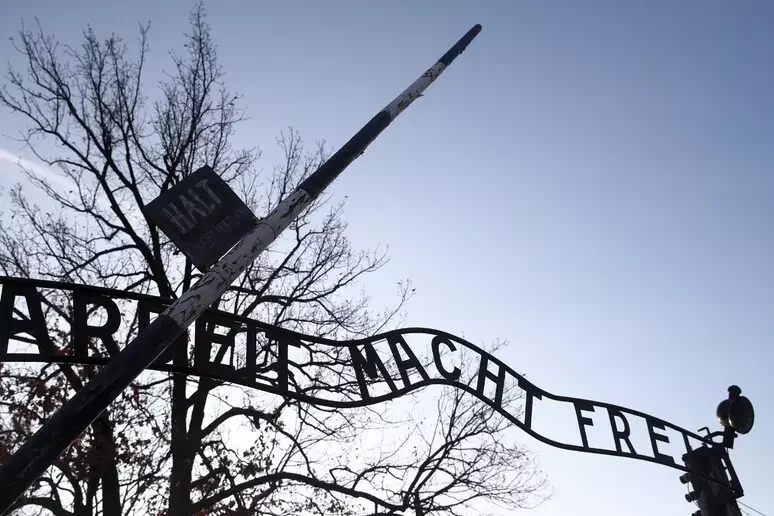
January 27, 2025 is the anniversary of the liberation of the Auschwitz concentration camp, a symbolic place of the extermination of millions of people who were deported and killed there and in the other centers of the ruthless Nazi-fascist death machine. Since 2000 in Italy and since 2005 with a resolution of the United Nations Assembly, January 27th has been Remembrance Day throughout the world.
Our thoughts turn to the survivors of the extermination camps who are still alive. How do they who have experienced exclusion from every area of everyday life since their early years of life, then persecution, those who are witnesses of extermination, how do they experience what is happening today? Are they experiencing in their last years (naturally we hope as many as possible up to 120 as we say in our communities) something that recalls those exclusions? That hate? Only they can answer in an authoritative way, we can reason about what we perceive today compared with what we have studied and heard from them over the years. Years of sharing but also years of silence.
How does this fear materialize? In calls for massacre, in boycotting culture, science, sport, commerce labeled as of Israeli origin, but also if the word “Jewish” appears. In the physical threat to those who dress or wear recognizable signs of the Jewish religion and in the verbal violence that spreads with all kinds of threats and hopes of returning to the crematoria. Why is it more serious? Because the justification for all this would be Israel’s behavior and the rights of the Palestinian people. The people who suffered are now the executioners. The Nazi is Israel, as a state and as a nation. Genocide is committed today by those who suffered it. Gaza has (always) been an open-air concentration camp. This is what we hear especially from those who have never listened to testimony and never visited the Auschwitz extermination camp and dozens of other camps and subcamps.
Quotations from the most famous poems and pages written by those who survived are used as titles to accuse the Jewish people of exactly the same crimes to which the warning was referred. This is cruelty.
So our survivors are massacred once again. Not from oblivion and ignorance but from a pure campaign of hate. It does not matter what the complexity of the Palestinian situation and geopolitical relations in the Middle Eastern region really is. The important thing is to chant through a slogan and repeat falsehood that they become truth. And the scheme of mass communication that leverages the most basic feelings always works and acts as a convenient sounding board. A heavy responsibility of the media to reiterate data and repeatedly use shots that focus on just one pixel of an entire picture.
Likewise, and no less serious is the nostalgia for the symbols of fascism and Nazism, hoping that the world order dictated by totalitarianism whose destructive scope has been forgotten will resume. Not only towards the Jews but for all of Europe and the world war. Among external threats toEurope of those who try to penetrate it using precisely those very strong protections of freedom established and regained after the war, and internal threats that regenerate totalitarian nostalgia and anti-Jewish prejudices, we are lost.
And so we ask ourselves, 80 years after the liberations or the end of the war, what have we really consolidated and understood and what are the paths that generate hope. Not everything is going in the direction of evil. There are also points of light and careful and coherent commitment to which we can pay our respects. Not because we are given attention and caress but because they are people and institutions who welcome and send out to others the invitation to reflect on Italian responsibilities. The warning and the commitment to remember the name of each of the six million exterminated in the camps is part of a culture that puts the person and their life at the center of every action and every choice. This culture of life is the one that every day, drawing on Jewish values, we try to live and reiterate as a response to the culture that justifies death through religion.
The 27th will pass after 24 hours which will certainly be intense. This is the moment of the choice of coherence that is made towards the entire year and the coming decades. If we give space to trivializing the danger or we monitor through coherence and attention to those who, with immense sacrifice, pain and effort, have tried in recent years to share their testimony.
Noemi Di Segni, President of the Union of Italian Jewish Communities UCEI