They say it’s a horror novel, but the truth is that it seems more like a sociological essay or a particularly successful journalistic investigation. Of horror, Negative Space, just published by Nero edizioni, has, if we like, hallucinating tones, certain disturbing suggestions that make one think of the best of Clive Barker. But within this choral magma conceived by BR Yaeger there is nothing invented, nothing “fantastic”, nothing that does not pertain to Western everyday life. Unfortunately.
“I want to write fiction that acts as a document for that historical period,” said this Massachusetts-born and rather mysterious author (few interviews, little publicity, a lot of attention to video games, card games and Web subcultures). “Fiction can be as much a testimony to how things were in a certain era as non-fiction or essays.” And indeed Negative Space and the previous novel Amygdalatropolis (also translated by Nero), Yaeger has perfectly peeled the black heart of this era. In fact, to be honest it was prescient. These two books now date back to a few years ago and, if for the early 2020s they were extreme, today they seem almost photographic.
As in any horror, there are monsters. Except those monsters are teenagers. This is an element that has also been captured with a certain irony by a TV series like the one on Wednesday Addams, which with a light touch brings out the monstrosity hidden in our time. Yaeger, of course, uses different tones. In Amygdalatropolis it deals with a sort of Incel, a boy who lives isolated from the world and from his parents, locked in his own room where he spends his time browsing online forums in which hatred for the human race, and for women in particular, is the least vile element. Nothing that the news hasn’t shown us recently, to be honest. The profile is exactly that of minors who stab teachers after poisoning themselves with digital violence. Those kids frequent online forums where extreme brutality is talked about, they talk about, plan and show rapes and abuses of various kinds, and they do it with a light heart, because ultimately the monstrosity leaves one indifferent. Evil reigns, but it does not cause shocks, it is simply omnipervasive, it invades the screens and cannot be stopped.
“I felt it was worth documenting,” Yaeger said of that book. “Now that those sites are being shut down, I occasionally come across threads on 4chan where people are talking about Amygdalatropolis and saying things like, ‘This guy doesn’t know what he’s talking about. You can’t even write that on the forum.’ And I think: “That’s because I frequented forums that were very different from yours.” I see it as complete documentation. I try to capture the sensation of certain events, some of which are very personal, and I try to let myself be guided by intuition.”
Forums, chats and darkness are also present in Negative Space. The novel is itself a sort of enormous forum, a set of characters’ voices that tell the story of the existence of a small American town in which an epidemic of young people’s suicides explodes. The deaths are announced and commented on online. Those who don’t take their own lives take drugs and are oppressed by an evil that has the shape of society itself.
Lu, one of the characters, says: «For as long as I can remember, I have always felt the low hum of suicide resonating in my body. I closed my eyes and saw flashes of strange industrial machinery boring holes into my skin. My silhouette crashing onto the rocks at the foot of a jagged cliff. A thousand blades that tore me to shreds. Reassembling my body in ways not accessible while I was alive. Pushing myself beyond the threshold to be reborn into something new. It was one of the reasons I followed the forum, to see all the examples of those courageous individuals radically altering their state of life. Aware that there was no possibility of going back.”
Once again: does this really sound that strange to you? Isn’t it this horror that sneaks up on the streets, in the apartments, in the schools every day? Isn’t this black hole the one from which the various and fearful forms of contemporary violence, especially adolescent violence, arise?
«It’s difficult to define precisely. I’m not entirely convinced that online culture brings out the worst in humanity: it simply makes it visible and allows communities to form, sometimes around virulent behavior,” says Yaeger. «I think this is precisely the aspect that fascinated me the most while I was writing Amygdalatropolis: not so much the antisocial behavior itself, but the existence of communities centered on such behavior. Even when people only wanted to destroy others, this need for connection, for approval from another human being, persisted. I think this is a fascinating, and in many ways tragic, tension. There is therefore the superficial horror of the violence described (or in some cases actually committed) by these people, but the deeper horror occurs on a personal and interior level.”
Online communities where monsters gather or normal kids discover themselves as monsters. «Thinking in terms of monsters and transformation, how does this transformation happen? Many of the people who frequent these environments say they have been abused, and this is their explanation for monstrous behavior. Others are there simply because they find it fun: they have an active desire to become monstrous, to destroy within themselves the ability to empathize with others. I have no real answer to why this happens, but I thought it was worth documenting.”
And upon closer inspection it is an exceptional document, much clearer and more effective than a thousand studies. Yes, of course, we read Paolo Crepet’s essays on adolescents, and in some ways we even find them acceptable. We also read those of the great expert Gustavo Pietropolli Charmet, such as Intelligent Adolescents, in which he tries to offer an optimistic vision of today’s youth. The tragedy, however, is that only Yaeger gets to the crux of the matter. He is not a moralist, he does not judge and does not exaggerate. But it offers a despairing picture. Even if he still tries to grasp a trace of humanity in the darkness.
In Negative Space, he says, “I wanted to represent an online community not focused on mischief, but rather on processing an ongoing tragedy. It’s a form of adaptation. It may seem strange, given that it’s a forum where people try to predict who will commit suicide next, where photos of dead bodies are posted, but ultimately I think it’s a way to try to make sense of this nebulous pattern of violence, which no one understands. It’s dark humor. I often see this dark humor on social media, and Covid has only accelerated it (…). He’s cynical, but he’s not cruel or insensitive, in fact, I think the opposite is true. The present and future seem like a nightmare, in many ways, beyond our control on an individual level, and people are simply trying to figure out how to deal with it. It’s a form of solidarity, and I think it’s ultimately positive. Even when the ship is sinking, it’s nice to have someone by your side.”
The point, however, is that the ship is sinking. Yaeger does not diagnose. It simply describes an existential malaise that cannot find peace.
Gus Van Sant managed to do something similar with Elephant, a brutal film about school shooters. Many years have passed, and the overall picture has not improved. Even Larry Clark, in a disturbing film like Ken Park, had captured the symptoms of a Western alienation that started from adults and moved to children. Even in that case, time has only confirmed the intuitions.
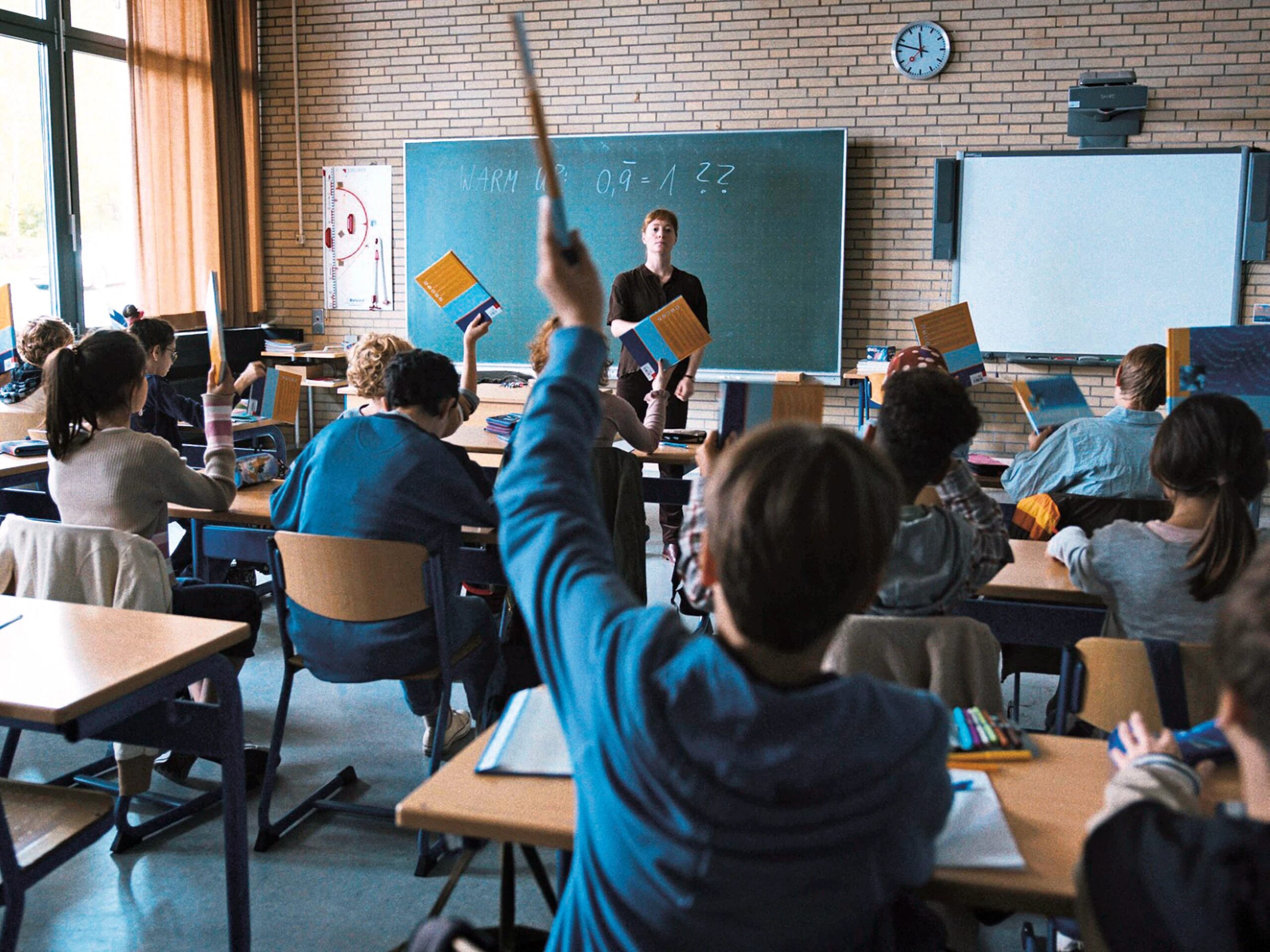
More recent (2023) is The teachers’ room by Ilker Çatak, a German of Turkish origins. It deserves to be seen on Raiplay because it perfectly describes the collapse of a school in which authority has simply evaporated and in which adults are unable to control the students in any way. They don’t understand them, they don’t educate them, they are even victims of them. You watch the film and think that this is the product of decades of political correctness, the terminal phase of a do-gooder society curled up on itself. But then you read Yaeger and you understand that perhaps the worst is yet to come.
Perhaps, one might say, the true and most pervasive horror that emerges from all these works and that no analyst really grasps is only one: the lack of meaning. In a world where authority, truth and purpose do not exist, everything becomes not so much permissible as useless and destructible. Violence inflicted on oneself, or on others, is automatic and inevitable, torpor and the abyss are outside the door.
Here’s the point, here’s the question that scares you the most: who can give meaning back to existence today? And how?