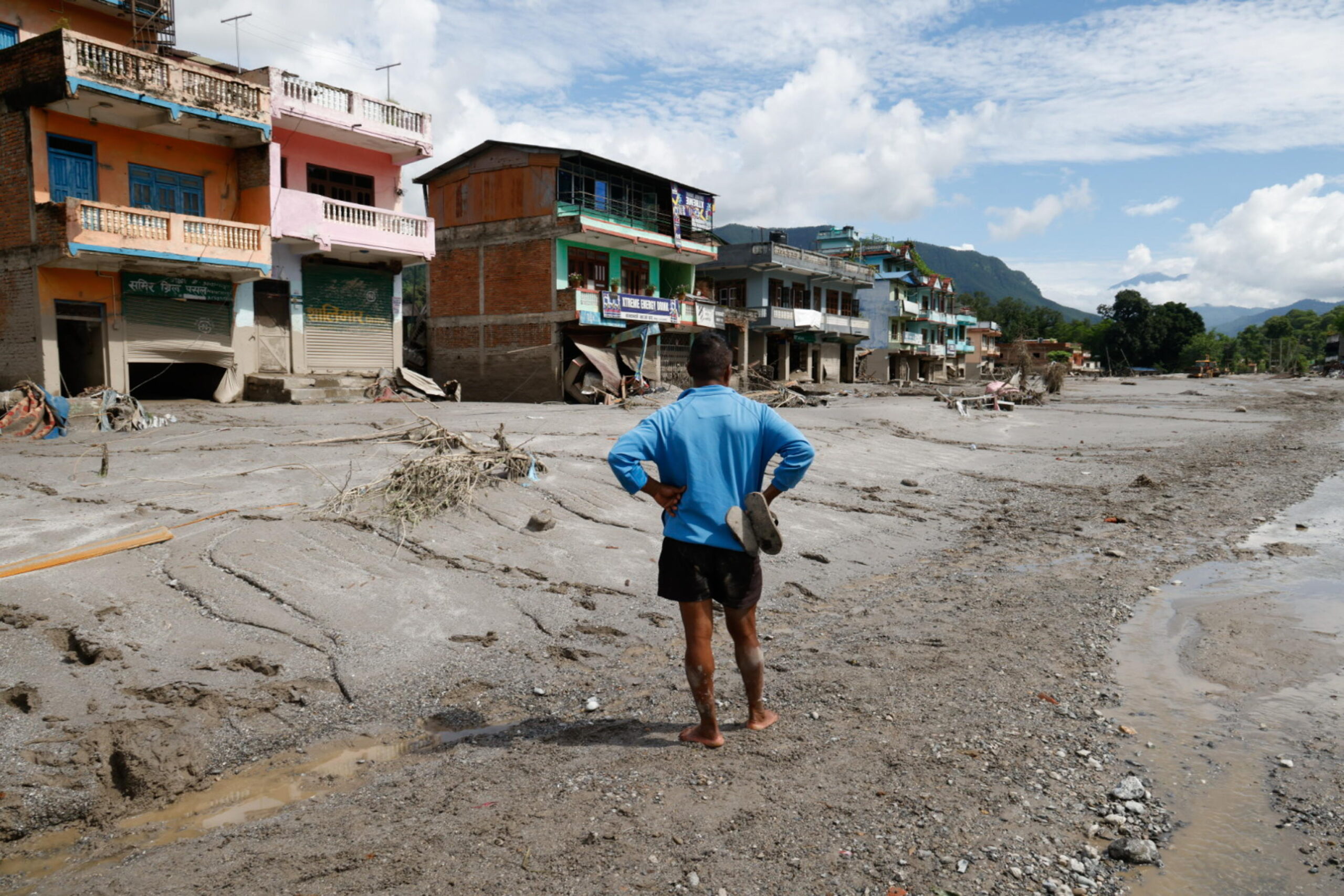
The river of water, ice, rocks and mud came down from the mountains with such violence that it obliterated roads, dragged away bridges, swallowed up houses and pushed the bodies of victims for dozens of kilometers downstream. Just over twenty-four hours after the catastrophe that hit the border between Nepal and Tibet, the toll continues to change hour by hour and shows the dimensions of one of the worst natural disasters in recent years in the Himalayan region: over 350 people have died and more than 1,300 are missing or still unreachable, while rescue teams search for survivors in an area where communication routes have been broken and entire communities have remained isolated.
For Italy, added to the images of devastation is the wait for three compatriots with whom contact has been lost. Among them is Marco Ratto, 50 years old, a goldsmith from Rapallo, passionate about mountains and trekking, who left a few days after August for a trip he had been preparing for some time. His family can no longer reach him and has asked the Farnesina to intervene. The Crisis Unit’s checks continue through the General Consulate of Italy in Calcutta, responsible for Nepal, the Honorary Consulate of Kathmandu and the local authorities.
The hope, for Ratto as for many of the foreigners of whom there is no news, is that the absence of communications is a consequence of the collapse of the telephone network and connections and does not necessarily mean that they were overwhelmed by the flood. But as the hours pass, the apprehension increases.
Who is Marco Ratto, the missing goldsmith from Rapallo
Marco Ratto belongs to a well-known family of merchants from Rapallo and is co-owner of the Silver’s goldsmith’s shop in Piazza Cavour. He had left alone to join an organized group and undertake a series of excursions. He loved the mountains and, according to what emerged in the last few hours, he had trained daily to prepare for this trip, which had already been previously planned and then postponed.
The last element that makes his situation particularly delicate is precisely the position in which he should have found himself: the area affected by the immense flood that devastated the district of Rasuwa on Wednesday morning and the corridor that leads to the Tibetan border.
The Farnesina had already communicated in the first hours of the emergency that, based on the registrations made through the “Where we are in the world” portal, around 90 Italians were between Nepal and Tibet. The Ministry of Foreign Affairs had immediately activated the Crisis Unit, while other compatriots had managed to contact the Italian authorities.
Two Italians, Valentina Piccinini and Stefano Lotumolo, are among the foreign tourists rescued in the areas of Timure and Bhote Koshi. In total, 27 foreign travelers were recovered in the first operations, while during the day the airlift organized by the Nepalese army allowed hundreds of people to be evacuated from the areas that remained isolated.
«The river rose, rose»: the eight hours of fear of two Italians
Giovanni Fassini, 42, an accountant from Brescia, and Marco Lombardi, 26, who were stranded on their way to Kathmandu after a trekking holiday, also told what happened in the hours of the catastrophe.
Their bus was traveling from Pokhara to the capital when the journey suddenly became impossible. The roadway had been invaded by mud, the banks had disappeared and the Trishuli continued to swell. The two Italians were stuck for about eight hours, unable to either continue or go back, while the excavators tried to make at least part of the road passable again. They eventually managed to return safely to Pokhara.
Their experience also tells one of the aspects that make it extremely difficult to establish the actual number of missing people. Hundreds of people could be alive but isolated, without electricity, cellular networks and road connections, in a region crossed in recent weeks by hikers and especially pilgrims heading towards Mount Kailash, one of the holiest places in Asia.
Among the untraceable are citizens of dozens of countries. Nepalese authorities have reported hundreds of foreign tourists still without contact, including Indians, Americans, Ukrainians, Malaysians, Australians, Britons and Canadians.
What happened in the Himalayan mountains
The images look like those of an earthquake, but the point is precisely this: the earthquake may not have been the origin of the disaster.
In the first hours after the catastrophe, the hypothesis circulated that a seismic shock had caused a gigantic landslide. Subsequent analyzes have instead shifted attention towards a phenomenon that started much higher up, among the ice of the Himalayas.
According to preliminary reconstructions by Nepalese scientists, a huge mass of ice and rock broke off at high altitude, falling towards the Lhende river basin. The debris would have blocked the watercourse, forming a natural dam in a very short time. An enormous quantity of water would have accumulated behind that barrier, until the dam suddenly collapsed.
At that point no more water would simply flow down. The flood would have dragged with it ice, earth, boulders, trees and debris, transforming into a very dense and very fast mass capable of overwhelming everything in its path.
The first satellite analyzes cited by experts indicate the detachment of a portion of the glacier of enormous dimensions, falling over a kilometer in altitude. The mass would have reached the river system upstream of the border and triggered a succession of events that lasted a few hours but with catastrophic consequences.
At 9.05 in the morning on Wednesday 26 August, according to the technical reconstruction of the Nepalese Flood Forecasting Division, the authorities already received reports of a large flood coming from the Tibetan side. The wall of water entered the Bhotekoshi and continued along the Trishuli until it reached the Narayani system, dragging victims and debris further and further from where the disaster began.
What is a GLOF and why is it not yet certain that it happened
Among the most used words in the last few hours is GLOF, an acronym for Glacial Lake Outburst Flood: a flood caused by the sudden emptying of a glacial lake.
These lakes can form in front of, under, or on top of a glacier and are often held back by ice or accumulations of unstable material. If the barrier gives way, millions of cubic meters of water can be released in a few minutes, flowing down very steep valleys and gaining devastating power.
It is a phenomenon known in Nepal and this region had already experienced one in July 2025. But automatically attributing the August 26 catastrophe to a GLOF would, at present, be premature. One of the reconstructions considered most plausible involves first the collapse of a mass of ice and rocks, then the formation of a temporary lake behind the debris and finally the collapse of this natural dam. Scientific investigations are trying to establish the exact sequence.
The new alarm: «Another flood could arrive»
And it is precisely what is happening upstream that worries the authorities now.
Reconnaissance has identified a new accumulation of water caused by a debris barrier, with the risk that the natural dam could suddenly give way and release a second wave along the Bhotekoshi. For this reason, surveillance remains very high and communities in potentially affected areas have been put on alert.
It is the risk of a disaster within a disaster: while thousands of rescuers search for the missing, recover bodies and try to reach isolated villages, the terrain continues to be unstable and numerous roads and bridges no longer exist.
Nepal has mobilized thousands of military personnel and dozens of civilian and army helicopters. Hundreds of people were evacuated by air from Timure, Dhunche and Mailung on Thursday alone. The operations also continue along the rivers downstream, where the bodies are found dragged by the current at a very great distance from the initial area of the flood.
The Himalayas are increasingly fragile
The disaster also inevitably reopens the question of the fragility of the Himalayan mountains in the face of rising temperatures.
The Hindu Kush-Himalaya region is undergoing a rapid transformation: glaciers retreating, glacial lakes increasing in volume, permafrost losing stability and rock faces becoming more vulnerable. It does not mean that every single collapse can be directly attributed to climate change, but warming changes the conditions in which these phenomena occur and can increase their probability and danger.
The paradox is that the water produced by the melting of glaciers can become a threat to populations living hundreds or thousands of meters below.
Reinhold Messner, whose life is inextricably linked to the Himalayas, took to social media to express his pain over the images arriving from Nepal, describing it as “heartbreaking” to see what is happening in a country that has welcomed generations of travelers and mountaineers with warmth and the traditional “Namaste”. His thoughts are with the families who have lost someone and those who are still waiting for news.
And it is precisely the wait, now, that is the thread that unites Rapallo to the mountains of Nepal: that of Marco Ratto’s family and of the hundreds of families scattered around the world who, faced with a telephone that doesn’t ring, still hope that behind that silence there is only a destroyed bridge, a broken road or an out of order telephone network.