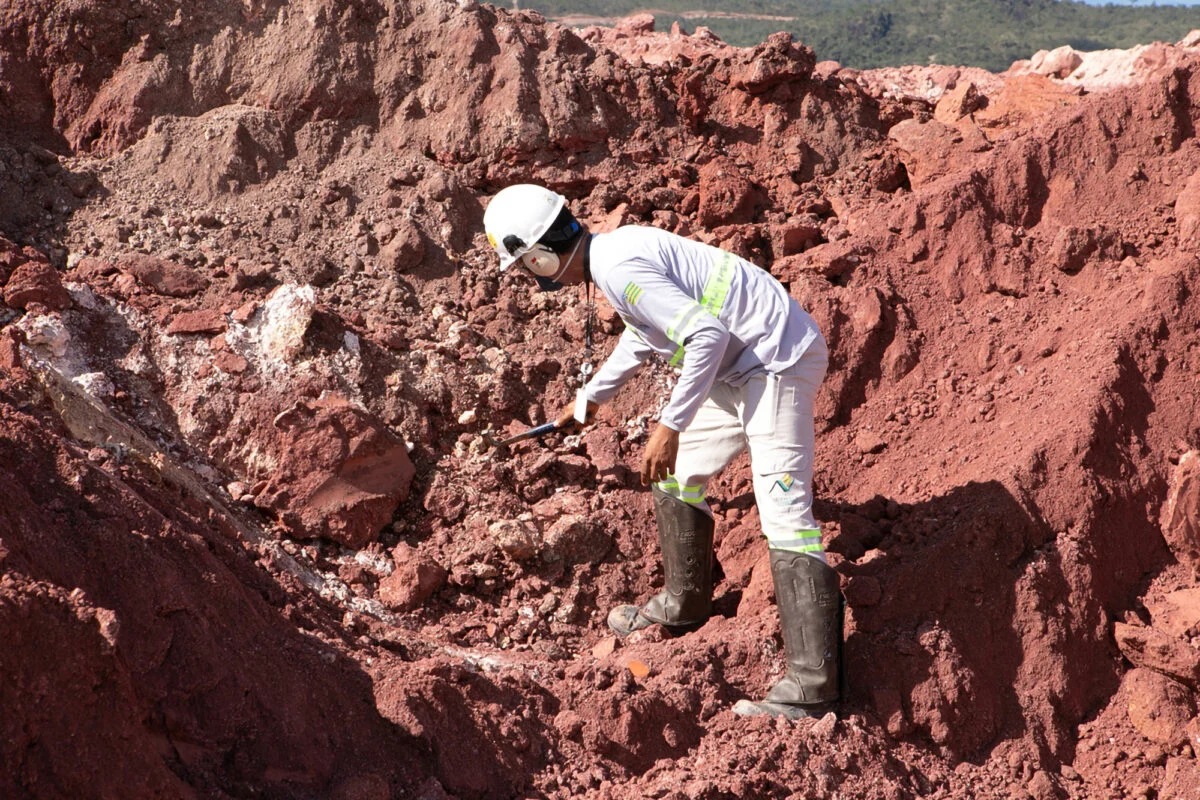
Brazil has among the world’s largest reserves of rare earths and critical minerals. The United States, Europe and Japan are looking to the South American giant to reduce dependence on China and build a new strategic supply chain.
For decades, Brazil has been identified with its immense agricultural crops, iron mines and large offshore oil fields. Today, however, the South American giant is taking on a central role in one of the most important challenges of the global economy: that of the control of rare earths and critical minerals indispensable for the technologies of the future, and therefore in the competition between the United States and China (the real dominus to be fought).
There are 17 fundamental raw materials which, although not particularly scarce in nature, are difficult and expensive to extract, separate and refine, a factor which enormously increases their strategic value. Batteries, semiconductors, electric vehicles, advanced defense systems, digital infrastructure and artificial intelligence applications all need it. And only the gigantic South American country may be able – it is now understood – to offer a credible alternative to the dominance built by Beijing in recent decades.
According to the most widespread estimates, Brazil has approximately 21 million tons of rare earth reserves, the second largest endowment in the world after China (44 million). And there is a boom in requests: to date the federal government is examining 2,758 extraction projects (by comparison, between 1975 and 2020 there were just 250 applications).
Resources in the Brazilian subsoil include neodymium and praseodymium, used to produce permanent magnets used in electric car engines and wind turbines. Dysprosium and terbium are also present, essential to guarantee high performance even in extreme operating conditions.
Reserves also include cerium, lanthanum, samarium and yttrium, materials used in advanced electronics, radar systems, telecommunications and the aerospace industry.
The main deposits are located in the states of Goiás, Minas Gerais, Bahia and São Paulo, regions which in recent years have attracted the growing interest of mining groups and international investment funds. The objective is to build an alternative supply chain to the Chinese one, which today continues to dominate not only the extraction but above all the refining of these materials, i.e. the process that transforms the raw mineral into material usable by industry.
It is precisely this processing capacity that has allowed Beijing to consolidate a near-monopolistic position and to use similar resources as a strategic lever in international relations.
That’s why the United States, the European Union, Japan and India are investing billions of dollars in finding alternative suppliers and developing new supply chains.
However, rare earths represent only a part of the Brazilian mineral heritage. In fact, the country also has important reserves of lithium, nickel, copper, graphite and cobalt, all essential materials for batteries and energy storage systems. Added to these is niobium, a metal little known to the general public but fundamental for the production of special steels intended for the aerospace, energy and military sectors. According to numerous estimates, over 90% of the world’s niobium reserves are found in the South American country.
The availability of raw materials, however, is not sufficient to guarantee a leading role. The real challenge is to create a complete industrial supply chain that includes refining, processing and production of high value-added components. It is precisely in this sector that China continues to maintain a significant advantage over its competitors: Beijing controls approximately over 60% of global rare earth extraction and approximately 90% of global refining capacity.
A dominance such as to push the West to invest in technologies capable of reducing dependence on these elements. In the United States, for example, the company Niron Magnetics is developing magnets that do not require the use of elements such as neodymium and dysprosium. The technology is based on iron nitride and was made possible thanks to the research of the Chinese-American physicist Jian-Ping Wang from the University of Minnesota. Projects are also underway in Europe and Japan to create electric motors and magnets capable of limiting or eliminating the use of the most critical rare earths. Despite these advances, global demand for strategic minerals will continue to increase with the expansion of artificial intelligence, renewable energy, robotics and electric mobility.
But at the moment rare earths remain fundamental, and their extraction in Brazil is vital. The United States is accelerating its presence. One of the most significant transactions concerns the acquisition by the American mining company Ultra Rare Earth Inc. of Appia Brasil Rare Earths Mineração, owner of the PCH project in the State of Goiás. At the same time, Terra Brasil Minerals, a company that controls important reserves of phosphates, titanium, potassium and rare earths, has started negotiations with the US International Development Finance Corporation for the American agency’s entry into the company’s capital. Furthermore, in April, USA Rare Earth (another US mining and manufacturing company specialized in the extraction, processing and production of rare earths) announced a 2.8 billion dollar agreement to acquire Serra Verde, owner of the Pela Ema mine and processing plant. The operation guarantees the Americans an exclusive supply for 15 years and represents one of the most important Western investments in the sector.
Even the Australian giants are moving. “Brazil is the future of large global projects involving the extraction of rare earths,” Andrew Tunks, CEO of the Australian mining company Meteoric Resources, told DW magazine. “I believe that over time it will be able to compete with China.” And in fact his company invests heavily in the Caldeira project, located in the state of Minas Gerais, considered the largest deposit of ionic clay in the world (a soil that is easy to extract and work). For its part, another big name, Viridis, which already owns the Colossus deposit, has guaranteed that in this epochal dispute with China, it will only allow Western countries to process the extracted material.
According to Mário Sérgio Lima, analyst at Medley Global Advisors, the strengthening of cooperation between Brazil and the United States represents an advantage for both parties. Brasilia can attract new investments and develop its industry, while Washington obtains an alternative source of supply by reducing dependence on China. The issue of rare earths has even contributed to fostering a political rapprochement between Brazilian President Luiz Inácio Lula da Silva and Donald Trump after months of diplomatic tensions. And the green-gold industrial world also wants to accelerate.
For Rinaldo Mancin, director of the Instituto Brasileiro de Mineração, transferring even just a significant part of the rare earths supply chain to the country could generate billions of dollars in added value and thousands of highly qualified jobs. An opportunity that Brazil cannot afford to miss.