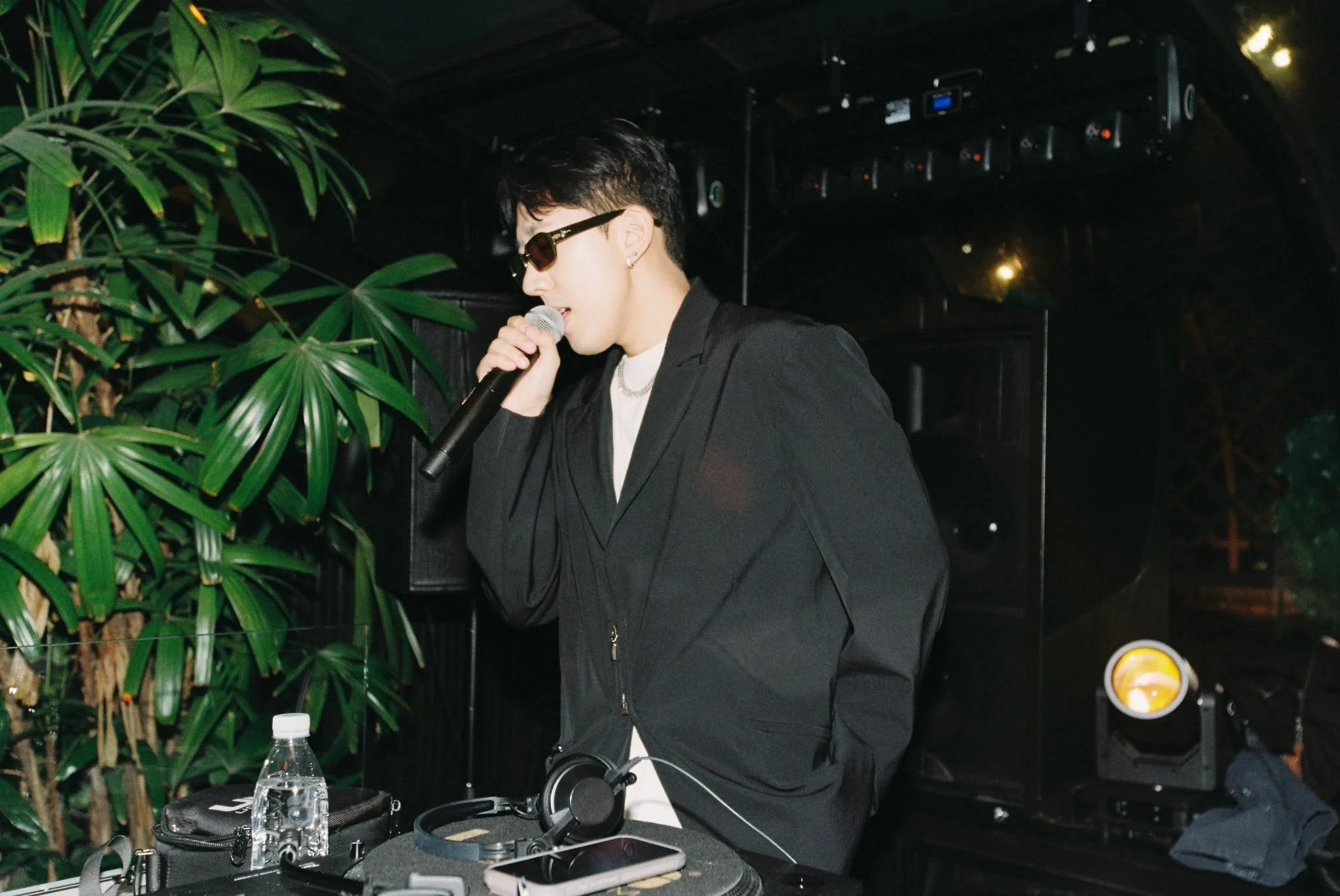
The sun has already set, yet the sky still retains the colors of the day. In English this phenomenon has a name, afterglowand it is the word that VINCI chose to tell what remains of a love story when it is now over. «That ember that remains lit while the flame goes out», as he himself defines it.
In the history of the Italian-Korean artist, musical references coexist that one would hardly imagine in the same path: Laura Pausini and Tiziano Ferro during their childhood in Milan, the rehearsal rooms of the K-pop industry a few years later. Even before learning to sing and dance to become an idol, VINCI dreamed of performing live like those two Italian singers whose songs he had known since he was a child.
«At home I grew up with Korean culture, away from home with Italian culture. I feel right halfway between the two, and over time I have understood that this is my greatest wealth: I don’t have to choose, I can take the best from both”, he tells Panorama.
Today VINCI has chosen to tell his story through music that moves between pop and R&B, far from the logic of idol groups and with deeply autobiographical writing. His first EP, Afterglowpublished on September 16, was born from personal experiences and from a question as simple as it is uncomfortable: when we miss someone, are we really still in love with that person or do we miss the habits we built together?
Through six songs, of which he signed all the lyrics, VINCI retraces the different phases of a relationship, even intervening on the rhythm of the songs to accompany the listener from the lightheartedness of falling in love to the melancholy of separation. Made with producers HEMIAN and LiVi and with the participation of TWLV in the title track «Bet», the project ideally follows the transition from summer to autumn, from the brightest days to those in which you realize that something has changed, without being able to establish exactly when it happened.
However, the history of VINCI also offers the opportunity to get to know another musical Korea, the one that exists beyond the large entertainment agencies, lightsticks and international charts. An R&B and independent scene still relatively little explored by the Italian public, to which the artist belongs, bringing with him a cultural and musical background that also has roots in our country.
With Panorama he spoke about his past as a trainee, his nostalgia for Milan, the differences between Italy and Korea, but also how difficult it is to write a song when, to do so, you have to go back to dealing with your own life.
The interview with VINCI
Let’s start from Afterglowyour first EP, released on September 16th. The title recalls that light that remains in the sky even when the sun has already set, an image that seems to also tell very well the emotions that survive the end of a relationship. When you started working on this project, what story did you want to tell and how much of what we hear comes from experiences you’ve personally had?
I wanted to tell a love story at sunset: that ember that remains lit while the flame goes out, the awareness that everything has a beginning and an end, and the feeling you get when you realize that something that “belonged” to you is no longer there. These are all stories that I have experienced firsthand, but I believe that each of us, sooner or later, has felt these emotions. That’s why I wanted to share them.
You have Italian and Korean roots, but above all you have the opportunity to get to know two cultures from the inside that live and express emotions in different ways. How much of Italy is there in your way of being, of loving and making music, and which aspects of your identity do you feel most deeply linked to Korea?
At home I grew up with Korean culture, away from home with Italian culture. I feel right halfway between the two, and over time I have understood that this is my greatest wealth: I don’t have to choose, I can take the best from both.
From Italy I got my way of being and being with people: I am open, spontaneous and sincere, and even in love I am very direct.
From Korea I took respect and concern for others, that attention to never being a burden to those around me. And musically I owe her a lot: for a period I was a trainee to become an idol, and there I studied a lot, I learned to dance and sing. Then, listening to Korean pop, I also understood a lot about how to construct a song.
Afterglow it opens with «You n me» and closes with «Star (outro)», as if to accompany the listener through the different phases of a story. How did you construct the six-song sequence and how important was it to you that this EP be heard as a narrative, from start to finish, rather than just a collection of songs?
As I was saying, everything at the beginning is warm, bright and full of beautiful moments, while towards the end it becomes darker and slower. In this EP I wanted to tell precisely this journey: a love lived intensely, until it is lost and only then does one truly understand its value. A bit like when a hot summer ends and autumn arrives, and this is also why I chose to release it in September.
Listening carefully, you notice that the first song starts with a very energetic rhythm and that, track after track, the tempo slows down more and more. In the last song I paid a lot of attention to the atmosphere, because I wanted that very ember to remain lit at the end. This is why it was important to me that the EP was listened to from start to finish, as a single story.
In «Bet» you collaborate with TWLV, an artist who has his own recognizable identity in the Korean R&B scene. How did this collaboration come about, what made you realize that your voices would work together and why did you choose this song to represent the project?
A few months ago I went to one of his concerts: live he gave me a lot of positivity and energy, and there I immediately understood that «Bet» would be perfect for his vibe.
I chose it as the title track because the chorus has a simple melody that instantly sticks in your head, and a bright energy that can reach anyone, at any age. As we worked on it, it naturally became the most pop track on the EP.
«너였어», which we can translate as «Eri tu», is one of the most evocative titles of the album, because it seems to enclose in two words the moment in which we realize how much a person means to us. What is the story behind this song and, if you had to tell the memory or emotion from which it was born, where would you start?
«너였어» is the turning point of the EP. It is the song that is halfway between summer and autumn: it tells of the moment in which you begin to understand that that person is no longer there and you find yourself searching for something about them in your memories.
When I wrote it I was right in that transition phase: I was looking for those memories in things that no longer existed. I couldn’t choose just one memory to start from, because every place, every object and every habit was linked to her.
In «Out of Habit» you address, starting from the title, an aspect of relationships that perhaps is still talked about too little: the difficulty of distinguishing the lack of a person from the lack of the habits we have built together with them. What does this song mean to you and how difficult is it, in real life, to understand when a feeling is still love and when it has become just the need not to lose something we know?
It’s probably the most sincere song on the EP. It depends a lot on how long a relationship lasted and how deep it was, but I believe that in every story many habits are born, small and large, built together by adapting to each other. This is why it is so difficult to understand whether what remains is love or just habit: because, over time, those habits can become the person himself.
You wrote the lyrics for all six tracks of Afterglow and you participated in the composition of several songs, also working with HEMIAN and LiVi. When you enter the studio, where does one of your songs usually come from: from a melody, from a phrase that you can’t get out of your head or from something you feel the need to tell? And how much has your way of writing changed since the beginning?
Today, with the HEMIAN and LiVi manufacturers, we usually start from a theme and build the base; above I write the melody and, lastly, the lyrics.
Compared to the beginning, my way of writing has changed a lot: before I tried to follow trends and only wanted to make happy songs, while now I write starting from my life, from how I am and from the atmosphere I am experiencing at that moment.
Let’s return for a moment to your relationship with Italy. What is the Italian memory you are most attached to, the one that still manages to make you feel at home even when you are far away? And if you had to choose an Italian song that represents you or that has had an important role in your life, what would it be and why?
The memories of school, the trips and the days with friends, the atmosphere among the people and that typical Italian tranquility are still very much alive within me. Every time I miss Italy, I go back home to Milan.
There are many Italian songs that I love, but if I had to choose two I would say «La solitude» by Laura Pausini and «Sere nere» by Tiziano Ferro. I’ve been listening to them since I was a child, and listening to them I always thought that one day I wanted to sing live like them.
In your musical journey you have also had the opportunity to collaborate with ZELO, while today you are building an increasingly personal project, in which your voice and your writing play a central role. What have collaborations with other artists taught you and what has been the most important knowledge you have gained about yourself since you started making music?
I really enjoy working with other artists, especially in finding the right balance between their color and mine. Everyone has different ideas and points of view, so often things arise that I would never have thought of on my own, and being able to combine them gives me enormous satisfaction.
About myself, however, I realized that I wasn’t as stubborn as I thought: I always tend to meet others. And maybe that’s what makes collaborations so natural for me.
In Italy, interest in Korean music has grown enormously in recent years, but we often still tend to identify the country’s entire music industry with K-pop, forgetting how rich and varied the R&B, indie and alternative scene is. How do you experience this international attention towards Korean music and what would you like the Italian public to discover about a music scene that goes far beyond idols?
I’m very happy. When I was little, so many people didn’t even know where Korea was! This is why it still resonates with me to see how well known she has become around the world thanks to Korean entertainment.
In other countries, K-pop has been popular for several years, and many fans have started to dig deeper, discovering many different genres. I believe the same will happen in Italy too. Beyond TV and idols, I can proudly say that there is a huge world waiting for you: that of the R&B and indie scene.
Afterglow it ends with «Star (outro)», a title that evokes something that continues to shine even when everything else seems to have gone out. If you look at your journey, what was the person, experience or dream that continued to guide you in times when making music seemed particularly difficult? And now that you’ve released your first EP, what would you like the next chapter in your story to be?
My family, friends and past relationships are like stars in my sky: they have helped me move forward even in the most difficult times. For the next chapter, I really hope that the new star is a label or agency that helps me shine even brighter.
If you had to define yourself, not only as an artist but also as a person, with just one word, which one would you choose and why?
Transparent. In every relationship I try to be as transparent as possible, without calculations or filters. And the same goes for my music.